*IF THIS MESSAGE IS NOT DISPLAYING PROPERLY, PLEASE CLICK "View this email in your browser" AT THE BOTTOM OF THIS EMAIL.
SCHOOL'S OUT: Summer is for building family connection!
Ahhhh summertime. Long, lazy hot days for out-of-school children spent climbing trees, riding bikes, tongues blue or green from eating popsicles. Perhaps a day lounging by a pool or building sand castles at the beach. Staying up late around a campfire telling ghost stories, catching fireflies or watching fireworks. Idyllic, relaxing, carefree. Wait… what? If you are a parent or caregiver of a child or children with attachment or trauma-related challenges, attention deficits (ADHD) or other special needs, the summer experiences described above seem like something out of a silly 1950’s sitcom, not a reflection of real life. In real life, the transition from the structure of school days to the less structured days of summer can be jarring and often overwhelming of our children. For adults, piecing together a patchwork of extended school year opportunities, therapists, and recreation while managing homelife and continuing to work can be a daunting juggling act wearing us down to the bone. It's not only the popsicles that are melting by this stage of the summer.
ATTACh invites you to do something we talk about in nearly all of our trainings: “Practice the Pause.” Take a deep breath, pause, reflect and regroup. Instead of thinking about summer as a marathon obstacle course, consider it as a time to focus on building and strengthening connections with your child(ren) while also attending to your own self and community care needs. Without the pressing demands of the school year, summer provides an opportunity to engage in attachment-focused activities with your child(ren) and to build memories and bonds that will serve you well when harder times come.
ATTACh offers many resources families seeking to strengthen attachment with children through play, day-to-day activities such as meal-times, and sensory experiences with nature, art or music. The resources include live and on-demand courses, monthly support groups and workshops at our annual conference. The newly released book, Healing Connections: A Community Approach to Childhood Trauma and Attachment, includes Chapter 3: Parenting for Connection: The Dance of Attachment and Bonding, written by Mary-Jo Land, RP and Norm Thibault, Ph.D. As a way to offer supportive tips for not only surviving but making the most of the remaining days of summer, we are pleased to provide a brief excerpt of this chapter in this month’s newsletter. We hope this excerpt will be useful to you and we encourage you to read the entire book for much more helpful information as you navigate your caregiving or professional journey.
Click HERE to learn how you can obtain a copy of the Healing Connections book. In addition, we have gathered a few key resources to support attachment activities for families- which you can learn about HERE.
 Our attendees always have the opportunity to play & learn at our conference. These play skills can then be taken home and applied with family members.

SUBMIT A PROPOSAL HERE!

Treating Developmental Trauma and Attachment in Children (TDTAC) is a live, online, 38.25-hour, post-graduate level course for mental health professionals in the fields of child welfare, children’s mental health and adoption / permanency. The course consists of self-directed learning of resources that will be provided, a 1-hour pre class meeting, 31.25 hours of on-line or in-person class, and 6 hours of knowledge implementation classes. TDTAC combines the recent research on Interpersonal Neurobiology with the physiological and relational practices. After completion, participants will be eligible to register as an ATTACh mental health clinician and receive one year membership to ATTACh.
The course will focus on the current thinking about childhood developmental trauma through the lenses of attachment and trauma. Current terminologies and schools of thought including Developmental Trauma and ACEs will be explored. Attachment theory, theories of trauma and interpersonal neurobiology will be explored in parallel with current psychotherapeutic modalities and techniques including on sensory, somatic, and brain-based traumagenic differences.
WHO SHOULD ATTEND: Therapists, Clinicians, Mental Health Professionals, School Counselors
EDUCATIONAL LEVEL: Advanced Level / Post-Graduate or equivalent experience (5 years minimum)
FORMAT:
- Part 1: 1 hour Pre Class-Meeting
- Part 2: 5 Day Online Interactive or In Person Classroom (31.25 hours)
- Part 3: 3 2-hour knowledge implementation learning assessment meetings (6 hours)
This is an instructor-led, online course. Reading will be assigned to be completed outside of class time. Participants must complete all three parts to be eligible for CE credit hours.
Upon completion, graduates are eligible 38.25 CE Credit Hours and a one-year free membership to ATTACh and entry into Community of Practice group of other graduates for on-going learning, support, and implementation of knowledge into practice.
CEs: 38.25 Credit Hours through NBCC
 ATTACh (Association for Training on Attachment and Trauma in Children) has been approved by NBCC as an Approved Continuing Education Provider, ACEP No. 7481. Programs that do not qualify for NBCC credit are clearly identified. ATTACh (Association for Training on Attachment and Trauma in Children) is solely responsible for all aspects of the programs. NBCC ACEP No. 7481.
COST: ATTACh MEMBER $505 | NON-MEMBER $555
AGENDA & OBJECTIVES REGISTRATION
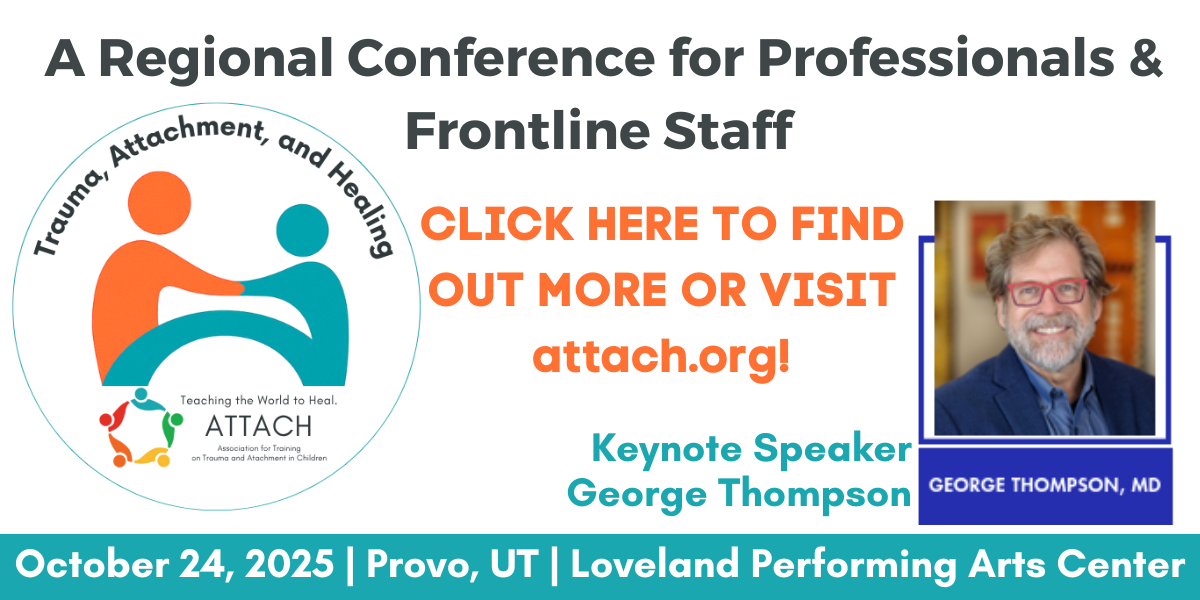
Calling All Professionals and Frontline Staff!
Join us in Provo, Utah for ATTACh’s 2025 Regional Conference — a one-day event designed for those working directly with children and families impacted by trauma and attachment challenges. Co-hosted with Heritage Community, this event features practical, workshop-style sessions led by experts in the field and offers valuable opportunities to connect with others who share your commitment to healing.
MORE DETAILS HERE REGISTER HERE
Excerpt from Healing Connections: A Community Approach to Childhood Trauma and Attachment, Chapter 3: Parenting for Connection: The Dance of Attachment and Bonding bu Mary-Jo Lan, RP and Norm Thibault, Ph.D. excerpt is from pages 41, 44-48:
It is within the context of the parent-child relationship that the infant human brain develops. Adequate physical care may allow the child to live; however it is the relationship, the face-to-face interactions with a parent, that nurtures the growth of the brain and its interconnections. The human brain is incredibly resilient, and it is necessarily adaptive, developing in the ways that will optimally prepare the child to function in its physical and social environment. That environment may be loving, safe, joyful, responsive, and consistently meeting the child’s needs or, at the other end of a continuum, it may be neglectful, toxic, frightening, painful or chaotic.
A typically developing child sneaks a couple of cookies when no one is looking, as children will. The parent discovers this and says, “Hey, honey, I see you helped yourself to some cookies, so I guess you have had your dessert already. Sorry you won’t be able to have dessert tonight. Next time, I hope you will ask before taking.” The child accepts this consequence, knowing its reasonable because she knows she broke the rule about asking first for treats.
A child who has experienced early trauma and neglect, sees an opportunity to get food and takes some cookies. The child feels a need to make sure he has access to food later, implicitly experiencing the need to protect himself from hunger. Taking food, hiding it, or eating it quickly, is a behavior linked to self-preservation even though food shortage is no longer a reality. If the parent made the same statement as above, this child might only hear that food is being taken away and react with excessively big feelings and big behavior! The child might also feel a relational rupture; “you are taking food away me and therefore you don’t care about me.” Therapeutic parenting begins with connection: “Hey, honey can you come and sit with me for a minute? Have a snack of cherries and hot chocolate.” (Connection) While sharing this snack, “I noticed that you were hungry earlier. Is that right?” The child looks down, not answering, feeling shame? Fear? “Yes, I have noticed that quite often you get hungry or worry that you will get hungry. I think maybe before you hadn’t enough food and maybe you didn’t have enough yummy sweets like my homemade cookies.” Parent is smiling. “I want you to know that you will always have enough food now. You can help yourself anytime to fruit and veggies or crackers and cheese. (Correction) We have a rule, as you know, about taking sweets because I care about your health. I hope that you can trust me to say yes to cookies as often as is healthy for you. Can you please try to ask? I will say no sometimes, and that is because I care about you. (Connection again) Sometimes, “no” means I care. Can you remember that?” The parent’s voice remains kind and calm throughout, face smiling. These are signs of safety that the child’s mid-brain reads, allowing the words to reach the thinking upper brain.
Wow, that’s a lot of work! Imagine working out how to talk to both levels of the brain at once for every limit setting or disciplinary event. If parents can develop a therapeutic parenting lens early on, this will support attachment and resolution of trauma. …..
Biological Regulation
Children with complex developmental trauma, as discussed in the previous chapter, have bodies that are continuously prepared for defense, rather than only when a threat is present. Bodies and brains on high alert will struggle to let go of survival vigilance enough to go to sleep. Defense for protection is incompatible with a relaxed state needed for on-going body maintenance: eating, eliminating, digestion, and resting. Parents may find that their child has difficulty falling asleep, staying asleep and sleeping long enough. Children may be very picky eaters, may sneak food or need access to food day and night. Children may have difficulties around wetting, soiling or constipation. Once medical causes are ruled out, therapeutic parenting supports the child in regulating their autonomic nervous system so that a calm state is more pervasive than too high or too low arousal. Parents may need to support the child around sleeping and eating as if the child was much younger. Creating rituals and routines that are consistent and predictable will help a child with trauma develop somatic rhythms that will assist in this regulation of the body. Teenagers may be unable to express that they are frightened to go to sleep so may find ways to self-regulate that are not acceptable to parents such as digital over-use, gaming, or substance misuse. Under- or over-eating are difficulties which usually respond poorly to correction through discipline or behavior management. The biological re-regulation needed occurs over time as the child’s body recovers from complex trauma within the relationship with the caring adult.
Biological regulation strategies:
- Routines for sleeping, eating, snacks, and exercise
- Walking (especially in nature)
- Rocking in arms or in a hammock
- Touch, both fun and soothing.
- Singing, breathing
- Yoga, dance, and movement activities
- Relationship with an animal
Additionally, children may have sensory processing difficulties that drive emotional and behavioral dysregulation. Imagine that your seven senses (sight, hearing, taste, smell, touch, proprioception--position of body--and vestibular--body orientation in space awareness) each have a volume dial. Each sense may be turned up too much (overwhelming) or turned down too low (so hard to attend to). Some may be exactly right. Being over-whelmed by the world around you or struggling to get the input you need is exhausting. This difficulty is under-diagnosed. Refer to Chapter 4 by Maude LeRoux for further information on parenting for sensory processing difficulties. Parents may need to seek assessment from an Occupational Therapist specializing in Sensory Processing.
Difficulties in biological regulation drive emotional and behavioral dysregulation. Parents learn to distinguish what a child can and cannot control with their cognitive brain. Therapeutic parenting considers the brain- and body-based differences in children with complex developmental trauma.
Affect or Emotion Regulation
Optimally, babies, both before they are born and after, when experiencing distress, are soothed quickly and effectively by caring and competent parents. Affect regulation is experienced in the first months and years by the actions of the parent. The baby cries from some discomfort, the parent provides the solution and the comfort; the rocking, singing, smiles and touch. In this way, a typical healthy early childhood involves distress but not too much and not too long. It involves distress that the baby learns will be resolved by the parent; the relief and comfort become expected and predictable. Emotional distress is not overwhelming or pervasive. An attuned and sensitive parent recognizes when their baby needs play or rest, more or less engagement, and more or less arousal. This regulation by parents of emotional experiences forms the basis of self-regulation by the child.
When children experience toxic stress prenatally and or in their early years, and that stress is not regulated and soothed by parents, the range and intensity of emotions they experience is overwhelming. With little experience of being co-regulated, their capacity to regulate their emotions later in childhood becomes compromised. Therapeutic parenting provides the co-regulation of emotions that was missed in earlier years. Knowing, accepting, and expecting that emotional storms will be more frequent and more severe, helps parents to adjust their expectations. Co-regulation of emotions involves:
- Being present, calm, and making few demands in times of dysregulation
- Giving the time needed, which is longer than typical, to re-regulate
- Having a resource kit containing sensory or comfort items
- Offering or providing touch, kind eyes and gentle voice as much as can be accepted.
A goal of therapeutic parenting is that the child can accept comfort and regulation from the parent.
ABOUT THIS COURSE:
Healing Connections provides a comprehensive, research-based approach to understanding and supporting children and families impacted by trauma and attachment challenges. This dynamic curriculum is designed for parents, caregivers, and professionals working with children and families. The core modules cover essential topics like Attachment, Trauma, Grief, Loss, Permanency, the Parent-Child Relationship, and Trauma-Responsive Schools. In addition, advanced modules dive deeper into critical areas such as Assessments, Medications, Safety, Aggression, Harm within Families, and Self and Community Care.
WHY CHOOSE THIS COURSE:
- Foundation: Explore why a shift in paradigm is needed with the latest research.
- Diversity: Benefit from a variety of views and approaches, embracing diversity in thoughts and experience.
- Gain Tools & Strategies to apply immediately.
- Practice & Reflection: Access to ongoing support through virtual meetings with experts in the field to discuss practical applications.
HIGH LEVEL LEARNING OBJECTIVES
- Understand the impact of attachment, trauma, grief, and other factors on healthy child development.
- Learn practical tools and techniques to foster secure attachment and promote resilience in children.
- Recognize the importance of healing relationships and community support in the well-being of children and families.
OPEN TO PARENTS, CAREGIVERS, & PROFESSIONALS
PILOT PROGRAM
- 4 Live, Virtual 3-Hour Sessions, covering the CORE MODULES
- Wednesdays August 27 – September 17
- 5:30pm-8:30pm US CT | 6:30pm-9:30pm US ET
- Special Pricing**: $50 ATTACh Members | $75 Non-Members- Take advantage of the reduced pricing during our pilot program!
- 12 CEs offered through NBCC
MORE INFO & REGISTRATION HERE
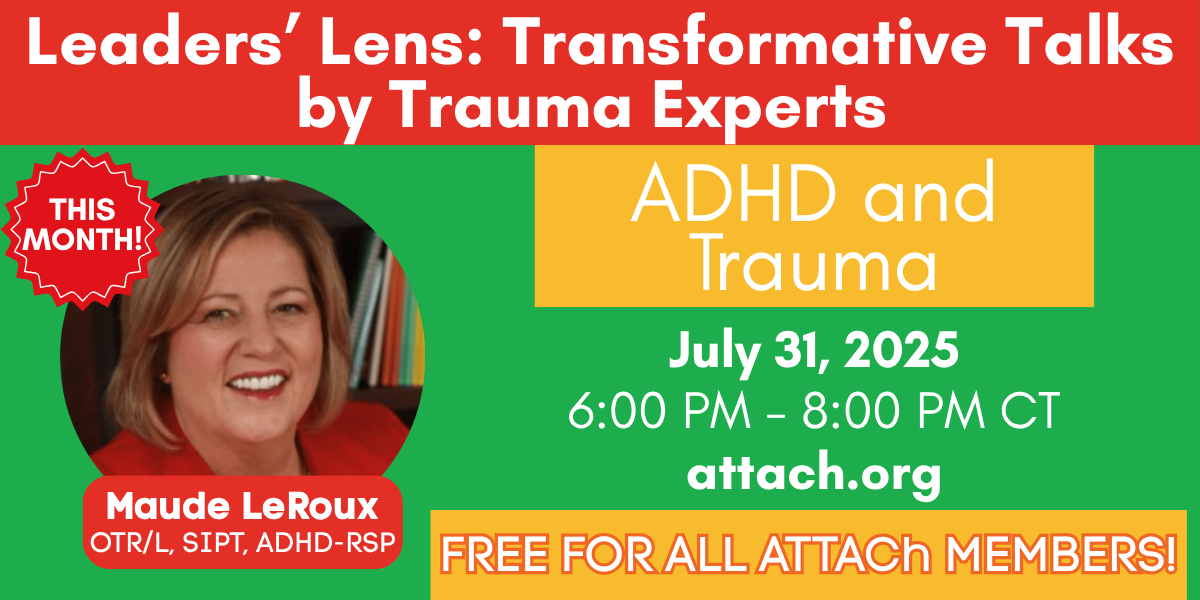
Leaders' Lens is a dynamic webinar series designed to deepen your understanding of childhood trauma and attachment and equip you with the insights and tools to foster healing and growth. Over the course of these sessions, you’ll have the opportunity to engage with leading professionals who bring a wealth of specialized knowledge, experience, and practical expertise in the field of trauma. This training opportunity is FREE for members of ATTACh!
Our next session is entitled Our Home has Become Frightening: When Children Harm in the Home, led by Maude LeRoux, OTR/L, SIPT, ADHD-RSP, on July 31, 2025 from 6:00 PM to 8:00 PM CT.
ABOUT THIS SESSION
ADHD is a neurodevelopmental disorder. Trauma symptoms frequently arise from specific adverse events. In this webinar, we will discuss the similarities and points of connectivity, while highlighting that intervention may certainly be different depending on the causality of symptoms of each individual profile. Participants will gain deeper understanding of how to support children and their families when both ADHD and Trauma are present.
LEARNING OBJECTIVES-
Attendees will be able to:
1. Define the intersection between ADHD and Trauma.
2. List 3 aspects of attention deficit that can mask a history of trauma.
3. Consider the connecting point of safety in both ADHD and Trauma.
4. Compare aspects of manifestation of both working and long-term memory in both Trauma and ADHD.
*Optional 1.5 CEs are available through NBCC*
Click below for information and registration!
REGISTER HERE SESSION INFO HERE
FACEBOOK INSTAGRAM LINKEDIN
Help Us Make a Difference!
Your Generosity fuels our mission! With your tax-deductible contribution, we can sustain and amplify our impact in the year ahead. Every dollar directly fuels initiatives that drive positive change in our community.
Here's how you can be a part of our transformative journey:
💲One-Time Donation: Click below to securely donate online and make an immediate impact.
💖 Monthly Supporter: Join our family of sustaining donors with a monthly contribution. Even small, consistent donations have a huge ripple effect over time.
📣 Spread the Word: Share our mission with your network! Your advocacy helps us reach new supporters who may not yet be familiar with our work.
Your commitment to ATTACh is invaluable. Together we're shaping a brighter future for those we serve.
Thank you for considering our request. Your support is a beacon of hope, and with your help, we can continue making a tangible difference.
DONATE HERE