.svg)
.svg)
.svg)
.svg)
.svg)
.svg)
.svg)
.svg)
.svg)


.svg)
.svg)
.svg)
.svg)
.svg)
.svg)
.svg)
.svg)

.svg)
.svg)
.svg)

.svg)

.svg)
.svg)
.svg)
.svg)
.svg)


.svg)
.svg)
.svg)
.svg)
.svg)
.svg)
.svg)




.svg)


%20(1).png)

Most nonprofits have board members who show up excited, attend the first few meetings, then slowly disappear. Rarely is it bad intent. Usually, there are unclear expectations. They didn't know they were supposed to give financially, or that they'd need to give so much of their time.
A board member agreement is the simplest fix for this, and most nonprofit organizations can put one in place within weeks.
In this guide, we'll explain what your board member agreement should include, how to get buy-in from existing members, and provide a free template to get you started.
Key takeaways
- Set expectations upfront every time 📋 A board member agreement ensures no one joins your board without knowing exactly what's expected of them.
- It's not a contract, but it works like one 🤝 These documents aren't typically legally binding, but they create meaningful accountability that changes behavior.
- The give/get section matters most 💰 Fundraising expectations are where most boards either create clarity or avoidance. Be transparent about the expected financial commitment.
- Every board member should sign one ✍️ Have existing board members sign your agreement and make it part of your onboarding process.
- Download the free template and customize it today 📄 No starting from scratch required.
Download your free board member agreement template
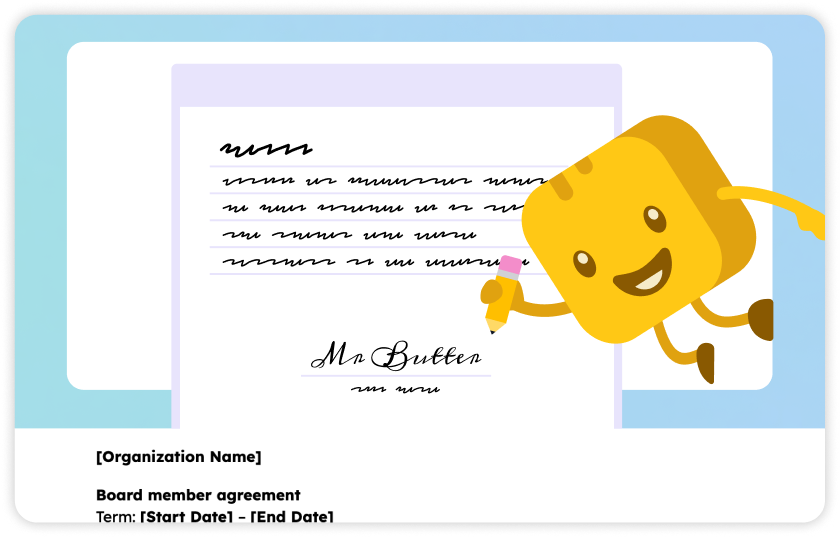
Board members and nonprofit leadership teams (including the executive director and director of development) both benefit from a clear board member agreement. Download our free board member agreement template to get started with a ready-to-use document that covers:
- Expectations
- Support
- Conduct and conflict of interest statements
- Agreement statement
What is a board member agreement & why do I need one?
A board member agreement (also known as a board member commitment form or a board contract) outlines what the organization expects from each board member during their term, and what the board member receives in return.
Unlike bylaws, which govern the organization's legal structure, a board member agreement is a personal commitment signed by each board member.
A board member agreement:
- Sets clear expectations ✅ Removes ambiguity that can lead to checked-out board members.
- Creates accountability 🙌 People honor commitments they've put their name on.
- Improves retention 📈 When members know what they're signing up for, they're more likely to stay engaged long term.
- Protects the organization 🔒 Especially for confidentiality and conflict of interest provisions.
- Signals organizational maturity ✨ Funders and major donors notice when a nonprofit is well-governed.
- Prevents board member burnout 💪 Nonprofit burnout is real. A clear document that outlines roles and support can create a healthier working environment.
What to include in a nonprofit board member agreement
Your board member agreement should include roles, commitments, and a signed acknowledgment from each board member. You can tailor the sections to fit your organization's specific mission and work, but these are the core components of a nonprofit board member agreement.
1. Board member responsibilities 💼
Start by outlining the key responsibilities of a board member, such as:
- Support and uphold the mission, vision, and values of [Organization Name]
- Act in the best interest of the organization at all times
- Participate in strategic planning and long-term sustainability efforts
- Review financial statements and key organizational reports
- Fulfill fiduciary duties of care, loyalty, and obedience
💡 Pro tip: Include definitions of the duties of care, loyalty, and obedience so members clearly understand their obligations.
2. Term length & meeting expectations 📅
Set a standard board term length for all members (typically 1–3 years). Detail how many meetings are planned, the expected attendance, and what a member should do if they're unable to attend.
Here's a sample board member agreement section for term length and meeting expectations you can adapt for your organization:
- Board term length: [1–3 years]
- Number of board meetings per year: [X meetings]
- Expected attendance: At least [75%] of scheduled board meetings
- Participation in annual retreat: Yes / No
- Remote attendance policy: [Specify if applicable]
💡 Pro tip: Be specific. "Board members are expected to attend at least 75% of full board meetings per year" is more actionable than "regular attendance is expected."
3. Financial commitment 💰
This is the section many nonprofits avoid, but it's essential for fundraising organizations.
In a recent Givebutter poll, only 43% of respondents said fundraising expectations for board members were formally documented during recruitment. Clear written expectations help prevent confusion and make board members more confident in their role from the start.
A helpful approach is "give or get." Board members can either make a personal gift or raise the equivalent amount. Be direct about your give/get policy: Set a minimum gift amount or a specific fundraising target for each board member.
Here's an example of this in action:
- Make an annual personal financial contribution of $[Amount]. OR
- Raise or secure at least $[Amount] per year through personal outreach, introductions, or fundraising efforts.
Whatever your policy is, name it here so there's full transparency.
4. Ambassador role 📣
Board members have fiduciary duties, but they also serve as ambassadors for the organization. Set your expectations on how board members should do this.
Consider these ideas:
- Actively promote the organization in their networks
- Share fundraising campaigns and events when appropriate
- Introduce potential donors, sponsors, or partners
- Thank and steward donors when requested
5. Committee & volunteer participation 🤝
Most boards expect participation beyond monthly meetings, including local engagement, donor outreach, or volunteer activities. Board members can also extend their involvement into the community through committee work.
Examples of board committees include:
- Governance
- Finance
- Fundraising
- Programs
- Events
6. Confidentiality 🔒
Board members handle sensitive information, so it's essential to include a confidentiality statement. The agreement should acknowledge that board members will keep internal matters confidential during and after their term.
Here's some sample wording from our free template:
As a board member, I may have access to sensitive information, including financial data, donor records, personnel matters, and strategic plans.
I agree to:
- Keep confidential information private during and after my term
- Refrain from disclosing internal discussions or documents without authorization
💡 Pro tip: Consider hosting a training session around the importance of confidentiality and data security.
7. Conflict of interest 🚫
Board members must disclose actual or potential conflicts of interest and recuse themselves from related votes. The agreement should require this and may reference or attach the organization's formal conflict of interest policy (required for IRS purposes).
You can borrow the wording from our free template:
I agree to:
- Disclose any actual or potential conflicts of interest
- Recuse myself from discussions and votes where a conflict exists
- Comply with the organization's conflict of interest policy (attached or linked)
In some cases, it's clear where a conflict of interest might arise. Often, it's helpful to create a brief FAQ document outlining potential conflicts of interest.
8. Code of conduct ✅
Set expectations for professional behavior, ethical decision-making, and how board members represent the organization publicly.
Here's an example of a nonprofit board member code of conduct:
I commit to:
- Acting respectfully and professionally
- Supporting board decisions once they are made
- Engaging in constructive discussion
- Avoiding actions that could harm the organization's reputation
Putting your code of conduct in writing provides clarity and promotes a positive working environment.
9. Acknowledgment of key documents 📄
Board members should confirm in writing that they've received and reviewed key organizational documents, including:
- Nonprofit bylaws
- Recent financial statements
- Strategic plan
- Conflict of interest policy
- IRS Form 990
💡 Pro tip: You can add other documents or reports for board members to review as well, such as internal policies or background materials.
10. Board member support from the organization 📚
Most of the agreement covers your expectations of board members, but this section should explain what you offer in return.
Here's what to include:
In return, the organization agrees to:
- Provide timely information needed for informed decision-making
- Offer orientation and training as needed
- Maintain appropriate directors & officers (D&O) insurance coverage
- Provide fundraising tools and staff support
It's essential that your board members feel equipped by your executives and broader team. Clear written agreements also make it easier to address gaps when commitments aren't met.

11. Acknowledgment & signatures ✍️
Finally, include a section for an acknowledgment statement and signatures for the board member and the board chair. Both parties should sign and date the agreement, and return it to make it valid.
How to introduce a board member agreement
A board member agreement only works if your board actually uses it. Here's how to introduce it in a way that builds buy-in and accountability.
Step 1: Draft with board input 📝
Avoid presenting a finalized agreement as a done deal. Bring a draft to your board for discussion to make it feel collaborative.
Frame the proposed board agreement as a tool to help everyone succeed, not a compliance requirement. The process of reviewing it together often surfaces important topics that haven't been discussed before.
Step 2: Ask all current members to sign ✍️
Even long-tenured board members should sign a current agreement. Once you've finalized the agreement, present it to all members for signing.
It's best to add this to the agenda for a future board meeting, so that there's room for discussions and to address concerns. If there's likely to be pushback, introduce the review and sign-off as part of a collaborative moment, such as a board retreat or an annual planning meeting.
Step 3: Make it part of onboarding 🎉
Going forward, have every new board member sign before or at their first meeting. Include the board member agreement in your welcome packet, along with the bylaws, the conflict of interest policy, and orientation materials.

Step 4: Review & refresh annually 🔄
Board member agreements should be reviewed annually or any time expectations change.
Some organizations re-sign annually, while others ask members to sign once per term. Either approach works. What matters is that the document stays current.
Give your board the tools to fundraise & make decisions with Givebutter
A board member agreement ensures every individual knows what's expected of them, including their role in fundraising. But expectations only go so far if your organization's fundraising tools make participation difficult.
Givebutter helps board members share campaign pages, track fundraising progress, and monitor donations and donor engagement, all from one platform. When your board has the right tools and clear guidance, they can show up in meaningful ways.
.png)
Launch sharable fundraising pages with Givebutter
Sign up for Givebutter to empower your board with the fundraising and analytics tools they need.
FAQs about board member agreements
Is a board member agreement legally binding?
In most cases, a board member agreement is not legally binding. It's a governance document, not an enforceable contract. Its value comes from setting shared expectations and creating accountability. That said, legal counsel should review any agreement involving financial commitments or confidentiality.
What's the difference between a board member agreement & a board member contract?
There's no meaningful difference between a board member agreement and a board member contract. They are functionally the same document, just with different names. Some organizations prefer the more approachable "agreement" over the formal-sounding "contract."
What is a board member confidentiality agreement?
A board member confidentiality agreement, also known as a non-disclosure agreement (NDA), is a legally binding document. It requires individuals to agree not to share confidential information, including trade secrets, donor records, or financial data.
What is a board member commitment form?
A board member commitment form serves a similar purpose as a nonprofit board member agreement, but is often shorter and less detailed. It typically focuses on key commitments, fiduciary duties, and conduct expectations.
What's the difference between a nonprofit board member agreement & bylaws?
Bylaws are your organization's governing legal document. They establish the board structure, voting requirements, officer roles, and meeting procedures. A board member agreement is a signed commitment that outlines expectations for individual board members. Both documents are essential, but they serve different purposes.
Share this article







.svg)
.svg)