.svg)
.svg)
.svg)
.svg)
.svg)
.svg)
.svg)
.svg)
.svg)


.svg)
.svg)
.svg)
.svg)
.svg)
.svg)
.svg)
.svg)

.svg)
.svg)
.svg)

.svg)

.svg)
.svg)
.svg)
.svg)
.svg)


.svg)
.svg)
.svg)
.svg)
.svg)
.svg)
.svg)




.svg)



%20(1).png)

Running a board meeting seems straightforward until you're the one setting the agenda.
Board meetings create the space for strategic decision-making and essential governance, but without a clear structure, they can quickly become the most dreaded two hours on everyone's calendar. Whether you're a first-time executive director or a seasoned board chair, a strong nonprofit board meeting agenda is the key to running meetings that move your mission forward.
In this guide, you'll find a free downloadable board meeting agenda template, a step-by-step agenda format, best practices, and answers to the most common board meeting questions.
Key takeaways
- Structure drives productivity 📋 A clear agenda keeps meetings focused, on time, and actionable.
- Send it early 📨 Share your agenda 5–7 days in advance. Prepared board members make better decisions.
- Save time with a consent agenda ⏰ Bundle routine items and save 15–30 minutes per meeting.
- Keep meetings under two hours ⏱️ Meetings longer than two hours see diminishing returns. Respect everyone's time and drive decision-making rather than discussion.
- Mission moments matter 💛 A brief impact story in every meeting keeps your board connected to the "why."
Download your free nonprofit board meeting agenda template
Create effective meeting agendas every time with our free nonprofit board meeting agenda template. This ready-to-use template covers all the essential sections, including minutes approvals, executive director report, finance update, and action item reviews.
Nonprofit board meeting agenda format: What to include & how to structure it
The secret to effective board meeting agendas is to use the right format and keep it consistent.
Many nonprofit boards loosely follow Robert's Rules of Order, a widely used framework for running meetings and making decisions. You don't need to follow every rule to the letter, but the structure can help keep meetings organized and on task.
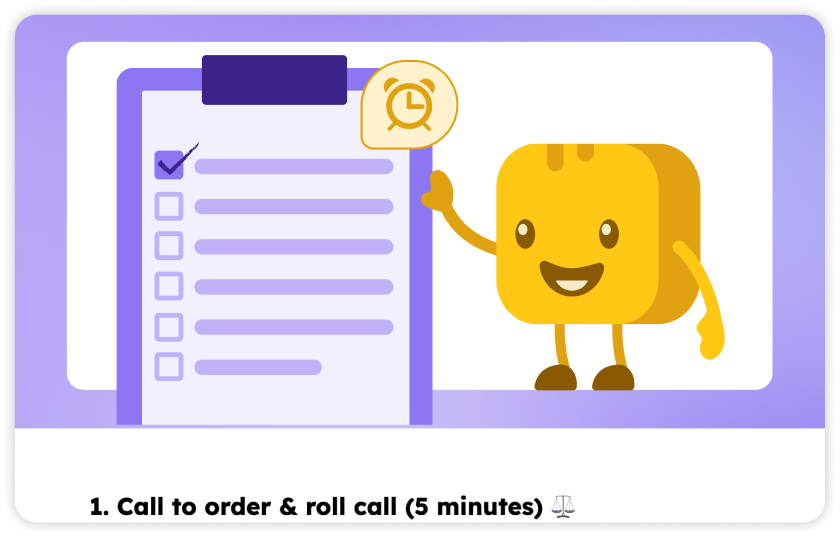
1. Call to order, roll call, & confirm quorum ⚖️
Start by calling the meeting to order. Begin with a roll call where you confirm who is present and who is absent, which is essential for accurate meeting minutes and compliance.
At this stage, determine whether a quorum is present. A quorum is the minimum number of people required for the meeting to be legally valid, typically 50% + 1. If you can't meet quorum, you can't pass motions or make decisions.
2. Mission moment 💛
Before diving into reports and decisions, take a few minutes to reconnect the board to your mission. Share a brief story, program highlight, or impact update that reminds everyone in the room why the work matters.
This simple practice helps keep board members engaged across meetings. Boards that stay connected to the mission make better decisions.
3. Approve the previous board meeting minutes 📝
Next, approve the minutes from the previous board meeting. This step creates an official, legally binding record of the last meeting and also supports governance best practices and accountability.

4. Review the consent agenda ✅
A consent agenda is an optional meeting inclusion that allows you to group routine and non-controversial updates into a single section of the meeting, rather than listing them individually.
Consent agendas typically include routine items like:
- Standard committee reports
- Staff updates
- Routine financial summaries
- Other non-controversial items
The advantage of using a consent agenda is that you can quickly approve various reports or items that don't require in-depth discussion, allowing you more time to focus on the main agenda items in your board meeting.
5. Review reports 📊
Review updates and reports from the executive director or CEO, the board treasurer, and committees. These updates provide all board members with insights into the current landscape and any issues they should be aware of.
Common reports to review include:
- Executive director update: A broad overview of the organization's progress since the last meeting.
- Financial report: An update on the nonprofit's current financial position, along with any relevant updates such as financial statements or audit outcomes.
- Committee updates: Insights from committees that are non-standard, controversial, or require extra discussion.
Stick to the same order of business every time, starting with your executive director's update. This creates helpful context for the rest of the reports.
6. Discuss fundraising performance & strategic priorities 🎯
Treat fundraising as its own focused agenda item. This section is for strategic conversation and decision-making, rather than simply reviewing reports.
Matters to discuss include:
- Campaign performance
- Donor trends
- Upcoming fundraising initiatives
- Grant updates
Use Givebutter's reporting dashboards to create board-ready updates that highlight key metrics. This gives board members strategic insights into what's happening so they can make informed decisions.

7. Address old business (unfinished action items) 🔄
Review any unfinished action items from previous meetings to ensure follow-through. Ask for (and provide) updates, and check off anything that is now complete. This section is essential for continuity and accountability.
8. Introduce new business & vote on decisions 🗽️
Next, it's time for new business. This agenda item covers any new proposals, policy changes, approvals, and strategic decisions the board needs to vote on. Whenever possible, share materials in advance to keep discussions focused on decision-making.
9. Confirm next steps, assign action items, & adjourn 👋
Before you end the meeting, review any decisions you've made and confirm the next steps. Turn tasks into specific action items with deadlines.
Make sure every task has an assigned owner. After the meeting, update your task management system with clear next steps and deadlines.
Before adjourning, confirm the date of the next meeting. It's best to arrange this in advance, but if necessary, you can discuss and agree on a date during the meeting itself.
Board meeting agenda best practices
Even the best nonprofit board meeting agenda can fall flat without the right execution. These best practices will help you run productive, compliant meetings while avoiding the most common board meeting mistakes.
- Send the agenda and board packet 5–7 days in advance 📨 Prepared board members make better decisions. Avoid sending materials 24–48 hours before the meeting or not sending them at all.
- Keep meetings to two hours or less ⏱️ Engagement drops sharply after two hours. Overloading the agenda is one of the fastest ways to derail productivity and lead to burnout.
- Use a consent agenda for routine items 📋 Bundle non-controversial reports into one approval vote to save 15–30 minutes. Don't include major policy changes or budget approvals.
- Prioritize strategic discussion over passive reporting 🎯 Don't let one topic or voice dominate the meeting. Protect time for strategic planning that moves the mission forward.
- Don't skip financial or compliance updates 💰 Financial transparency protects your organization. Skipping required reports can create governance risks.
- Assign a timekeeper and start and end on time 🕐️ Respecting the schedule builds trust and signals professionalism.
- Include a mission moment in every meeting 💛 A short impact story reconnects board members to your purpose.
- Clearly assign action items before adjournment ✅ Confirm ownership and deadlines for each task to ensure follow-through.
Prepare board-ready reports with Givebutter
Your board meetings are only as effective as the agenda guiding them. With the right structure, preparation, and a shared framework, you can turn every meeting into two hours of meaningful progress.
Download your free board meeting agenda template to get started, then let Givebutter handle the heavy lifting. Your nonprofit CRM keeps donor records organized and up to date, so when it's time to present fundraising performance, you're walking in with clear numbers and real insights—not a last-minute spreadsheet scramble.
If you want to go even further, sign up for Givebutter Plus for custom reporting, automated workflows, and task management that keeps action items moving between meetings.

Do more with your donor data
Sign up for Givebutter to give your board members the reports and insights they need to make informed decisions.
FAQs about nonprofit board meeting agendas
Are nonprofit board meeting minutes public?
No, nonprofit board meeting minutes aren't typically public. Board meetings are held behind closed doors with only invited members in attendance. Minutes are kept for compliance and internal accountability, but they're not generally shared beyond the board and executive leadership.
How to run a nonprofit board meeting?
Start by setting a clear agenda and sharing it in advance. During the meeting, follow the agenda, keep discussions focused, and record decisions. Assign a timekeeper and note-taker, and distribute meeting minutes promptly.
How often should a nonprofit board meet?
Most nonprofit boards meet quarterly, though some meet more frequently depending on their size and needs. On average, boards meet around seven times per year, totaling about 20 hours annually.
How long should a nonprofit board meeting last?
A typical board meeting agenda includes 7–8 items over 90–120 minutes. This gives board members enough time to discuss key updates and make decisions without losing engagement.
First board of directors meeting agenda: What's different?
The first board of directors meeting agenda is more focused on legal, governance, and compliance matters rather than ongoing operations. Common agenda items include approving incorporation documents, adopting nonprofit bylaws, appointing officers, and setting a future meeting cadence.
What should an annual board meeting agenda template include?
An annual board meeting agenda template should include all standard sections, such as call to order, approval of minutes, and reports. Many organizations also include a review of the business plan, annual fundraising plan, fundraising strategy, and budget for the year ahead.
What is a quorum at a nonprofit board meeting?
A quorum is the minimum number of board members required to be present for the meeting to be legally valid and for decisions to be binding. Most nonprofits set a quorum at a simple majority, meaning more than half of the board must be present.
Share this article






.svg)
.svg)