.svg)
.svg)
.svg)
.svg)
.svg)
.svg)
.svg)
.svg)
.svg)


.svg)
.svg)
.svg)
.svg)
.svg)
.svg)
.svg)
.svg)

.svg)
.svg)
.svg)

.svg)

.svg)
.svg)
.svg)
.svg)
.svg)


.svg)
.svg)
.svg)
.svg)
.svg)
.svg)
.svg)





.svg)



%20(1).png)

Every nonprofit needs someone to manage the books, but not every organization has the budget for a dedicated bookkeeper or accounting firm. For most nonprofits, bookkeeping is handled in-house and often falls to someone wearing multiple hats.
Nonprofit bookkeeping also includes requirements that general guides don't always cover. Restricted funds, Form 990 reporting, and fund accounting are all part of the territory. But once you understand the basics, the rest clicks into place faster than you'd expect.
This guide covers core bookkeeping tasks, best practices that protect your organization and build donor trust, and a free nonprofit bookkeeping template to help you put it all into action.
Key takeaways
- Save time and improve accuracy with the right foundations 📝 Separate funds and categorize income and expenses from the start to support better reporting and decision-making.
- Develop monthly reconciliation and reporting habits ✔️ Stay informed about what's happening regularly to avoid potential issues later in the year.
- Simplify workflows and reduce errors with accounting software 🤖 Replace manual data entry with simple workflows and processes for greater accuracy.
- Enable donation data to flow seamlessly with Givebutter Plus 🧈 Use Givebutter Plus's QuickBooks integration to sync detail-rich donation data from Givebutter to QuickBooks automatically.
Core nonprofit bookkeeping tasks
Nonprofit bookkeepers handle a variety of tasks that keep the organization's finances running smoothly, including day-to-day data recording and preparing for audits.
Here's what falls under this role:
- Recording income: Donations, grants, membership dues, program fees, and in-kind gifts
- Recording expenses: Vendor payments, program costs, and overhead
- Processing payroll: Running weekly or monthly payroll
- Making payments: Writing checks or sending bank transfers
- Bank reconciliation: Matching records to bank statements monthly
- Accounts payable and receivable: Managing invoices and receipts
- Maintaining the chart of accounts: Making sure the nonprofit chart of accounts is up-to-date and accurate
- Preparing for audits: Updating financial documents and preparing statements for the audit process
- Form 990 filing: Preparing, checking, and submitting the Form 990 by the deadline
💡 Pro tip: Many of these tasks can be automated or simplified with bookkeeping or accounting software, freeing up your team to focus on more strategic work.
Download your free nonprofit bookkeeping template
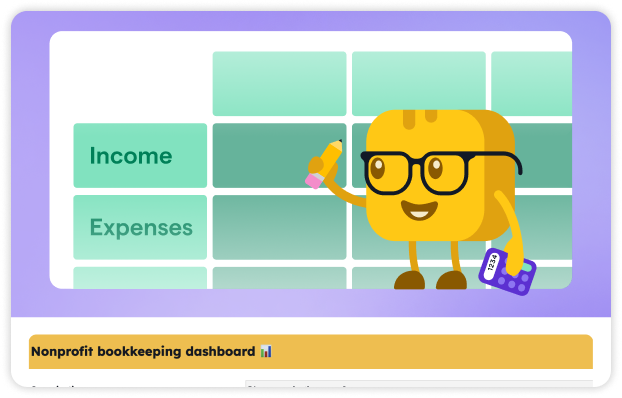
Start strong with our free nonprofit bookkeeping template. This spreadsheet has everything you need for simple nonprofit bookkeeping, including a transaction log, a chart of accounts, and a budget vs. actual tracker.
It also features a fund tracker, bank reconciliation, and an at-a-glance financial dashboard, all connected with built-in formulas.
Nonprofit bookkeeping best practices
Strong bookkeeping habits aren't just about staying organized. They also protect your nonprofit, build donor trust, and simplify grant reporting. Adopt these best practices to create a culture of financial health and transparency.
1. Separate your funds from day one 🗂️
Restricted funds are donations or grants given for a specific purpose, like a grant designated for a youth literacy program. Unrestricted funds can be used however the organization sees fit.
Keep your restricted and unrestricted funds separate from the start to ensure accurate reporting, better decision-making, and full alignment with donor or grant requirements.
Separating funds also enables you to monitor for compliance with donor restrictions and grant requirements on spending, leading to greater transparency and trust.
💡 Pro tip: If your funds are mixed, start by categorizing transactions with codes or tags. Over time, you'll be able to separate restricted and unrestricted funds cleanly.
2. Structure your books around Form 990 📋
Organize your finances according to Form 990 categories early so reporting is easier when it's time to file.
Classify your expenses into three main categories: programs, management/general, and fundraising. This structure makes it easier to create an accurate chart of accounts and helps decision-makers quickly see how funds are allocated and whether spending is balanced across each area.
3. Reconcile monthly, not annually 📅
Prevent a minor mistake from becoming a major concern during audit season by implementing monthly reconciliation habits.
Schedule time each month to review bank transactions, credit card statements, and changes to savings account balances. Check that they match your internal records, and investigate further if they don't.
4. Keep documentation for every transaction 📁
Maintain records for everything financial-related to ensure peace of mind and a clear audit trail for grant-givers, the IRS, and external auditors.
Store all your receipts, invoices, grant award letters, donor acknowledgment letters, and records of commitments, requirements, or payments. Keep everything securely stored in the cloud with appropriate access level permissions and backups.
💡 Pro tip: Introduce a system for file naming and storage, so that everyone involved knows where to save and find the information they need.
5. Separate financial duties where possible 🤝
Reduce fraud risk and improve transparency by having more than one person involved in financial transactions and reviews.
Wherever possible, have a second person review spending, such as a finance team member or operations manager. At a minimum, have a board member review financials monthly.
6. Prepare monthly reports 📝
Provide monthly finance reports to help leadership and board members make informed decisions.
Prepare and share a statement of activities, a balance sheet, and a cash flow report (or request them if your accountant handles them). Include a summary that highlights any areas of interest or concern, so members can quickly understand any pressing issues.
7. Automate where you can ⚙️
Save time, streamline workflows, and reduce errors by switching from manual data entry to automated processes. The right accounting software can sync with your fundraising data and donation transactions, so you have a clear view of incoming funds, what the source is, and whether they're restricted or not.
With the Givebutter Plus QuickBooks integration, donation data syncs directly into QuickBooks, removing the need for manual data entry.

Simplify nonprofit bookkeeping with Givebutter
With the right processes and tools in place, your team can spend less time manually entering data, fixing reconciliation issues, or scrambling during audit season. Givebutter helps simplify day-to-day financial workflows with built-in donation tracking, reporting tools, donor management, and QuickBooks syncing.

Get audit-ready with Givebutter & QuickBooks Online
Sign up for Givebutter to build better systems, stay organized, and make nonprofit bookkeeping easier to manage.
FAQs about bookkeeping for nonprofit organizations
What's the difference between accounting and bookkeeping for nonprofits?
Accounting and bookkeeping both support strong financial management, but they serve different roles. Accounting focuses on strategy, data analysis, reporting, audit preparation, and tax filings. Bookkeeping handles day-to-day financial tasks like making payments, reconciling accounts, and managing invoices.
How do I set up bookkeeping for a new nonprofit?
To get started, open a nonprofit bank account and create a chart of accounts. Set up systems to track income and expenses separately, so it's easier to keep funds separate and report on them. Adopt best practices and introduce workflows that support sound financial stewardship, such as monthly reporting.
How do I handle restricted funds in nonprofit bookkeeping?
Restricted funds should be kept separate from general funds and used only for their intended purpose. Organize restricted funds into separate accounts and report on them transparently, allowing board members to make informed decisions about spending and broader nonprofit investing strategies.
How do I structure my nonprofit bookkeeping for Form 990?
Structure your books around Form 990 categories by classifying assets, liabilities, net assets, revenue, and expenses. Expenses should be further categorized into programs, management/general, and fundraising.
How can I automate bookkeeping for my nonprofit?
Use nonprofit accounting software to automate repetitive tasks. Accounting software can sync data between platforms, automatically create a chart of accounts, and allow you to apply, sort, and filter by categories to organize data effectively.
Do nonprofits need a dedicated bookkeeper?
Smaller nonprofits may manage bookkeeping internally, but as operations grow, a dedicated bookkeeper can improve accuracy and compliance. Some nonprofits may choose an internal bookkeeper or finance manager, while larger or more complex organizations often benefit from an external bookkeeping or accounting firm.
Share this article









.svg)
.svg)