.svg)
.svg)
.svg)
.svg)
.svg)
.svg)
.svg)
.svg)
.svg)


.svg)
.svg)
.svg)
.svg)
.svg)
.svg)
.svg)
.svg)

.svg)
.svg)
.svg)

.svg)

.svg)
.svg)
.svg)
.svg)
.svg)


.svg)
.svg)
.svg)
.svg)
.svg)
.svg)
.svg)





.svg)


%20(1).png)

Strong board members don't appear by magic: you have to find and vet them. If you're relying solely on personal networks and informal conversations to recruit, you may not be attracting the most engaged or mission-aligned candidates.
A simple board member application form helps you evaluate fit, communicate expectations, and build a stronger board from day one. This guide will show you what to include in a board member application and provide a free template you can customize for your organization.
Key takeaways
- Board member applications do double duty 💼 Screen for fit and communicate expectations at the same time.
- Keep it short but purposeful 📝 5–8 questions is the sweet spot for an application form.
- Be clear about fundraising expectations 💰 Explain what’s required upfront so there are no surprises after joining.
- Review applications as a committee ✔️ Use a nominating committee for accountability.
- Always follow up with an interview 🗨️ The form gathers info, but an interview assesses fit.
What to include in your board member application
A board member application doesn’t need to be long, but it should be intentional. Every question should help you assess the candidate’s fit and set expectations before anyone commits. Here’s what to include in each section.
Contact info & professional background 👤
Collect all the basic information you need up front to find and compare applications easily. This section should cover the applicant’s contact details, professional background, and a short skills checklist.
Examples of what to include:
- Full name
- Preferred pronouns
- Email address and phone number
- LinkedIn profile
- Role and employer
- Career summary
- Areas of expertise
- Experience with the organization’s mission
The checklist format makes it easy to spot gaps in your current board composition at a glance and build a stronger, more balanced board.

Connection to the mission 💛
Next, ask the applicant a couple of open-ended questions about why they’re interested in your specific organization. Find out why the mission area has shaped their life or work, and what motivated them to get involved.
Questions to ask:
- Why are you interested in serving on the board of [organization name]?
- How has [organization name]’s mission shaped your life or work?
This isn't about finding the "right" answer. It's about seeing whether candidates have engaged with your mission beyond a quick Google search. As real nonprofits point out, the strongest board candidates are motivated by the mission, making these questions crucial to include in the application.
Board commitment & availability 📋
Set clear expectations around meeting attendance, committee service, personal giving, and network engagement from the beginning.
Confirm they can meet these commitments:
- Attend [number] board meetings per year
- Serve on at least one committee
- Make a personal financial contribution at a meaningful level
- Help open doors to donors, partners, and community connectors
Fundraising participation 💰
Board members are often expected to make personal donations and support fundraising efforts, so this should be clearly outlined in your application process.
Ask your applicants:
- Are you comfortable asking your personal network for support?
- Do you have relationships with individuals, foundations, or companies that might support [organization name]?
In a Givebutter poll of 42 nonprofit professionals, only 43% formally document board fundraising expectations—33% keep fundraising requirements informal, and 7% never discuss them during recruitment at all.
Setting fundraising expectations early helps prospective board members decide whether they're comfortable with the role and prevents misunderstandings later.
Conflict of interest disclosure ⚖️
Discuss any potential conflicts of interest up front to establish a culture of trust and transparency from the start.
Ask would-be board members:
- Do you have any potential conflicts of interest to disclose?
- Are you currently serving on other nonprofit or corporate boards?
You don’t need to write off a candidate because of a potential conflict of interest. The disclosure serves as documentation, rather than an automatic disqualification. Review each application thoroughly and consider the individual circumstances before making a final decision.

References 🤝
Request the name, relationship, and contact information for two professional or community references. Some organizations skip the reference step, but it’s one of the best ways to identify potential red flags before the candidate gets voted in.
Download your free nonprofit board member application template
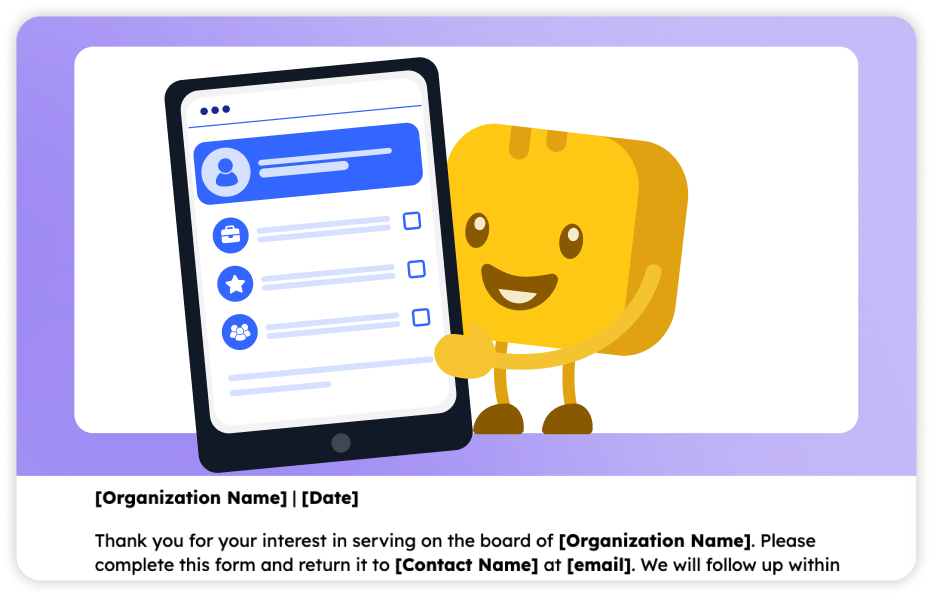
The steps above outline what to include in your board member application, and this free template puts it all together in one place. Download, customize, and share it with prospective board members. It's designed to serve as a standalone document, so you can send it digitally or print it for in-person conversations with would-be board members.
If you'd rather collect applications online, you can also recreate this template with an online signup form to streamline submissions.
Build your board with Givebutter
A clear, intentional board member application process helps you find best-fit candidates and gives them a clear understanding of what's expected before they join. Use our free board member application template to create a more consistent, transparent recruitment process.
Once your new board members are in place, Givebutter helps you turn those strong candidates into engaged advocates. Collect applications online with signup forms, simplify onboarding with automated workflows, and manage donor relationships and fundraising efforts from one place.
Whether a board member introduces a major donor, helps secure a corporate sponsor, or launches a peer-to-peer fundraiser, Givebutter's nonprofit CRM makes it easy to track every relationship and measure your board's fundraising impact over time.

Turn board connections into lasting donor relationships
Sign up for your free Givebutter account and streamline board recruitment from application to onboarding.
FAQs about board member applications
What should a board member application include?
A board member application form should collect essential contact information, work history, alignment with the mission and personal interests, meeting requirements, fundraising capacity, and conflict-of-interest disclosures. Keep the application form to 5–8 questions and use our free template to create your own board member application.
How do you join a nonprofit board?
Most nonprofits use an informal referral process for adding members to their board, but organizations with a more formal process generally include a written application, an interview with the nominating committee, reference checks, and an official board invitation.
What is the difference between a board member application and a nomination form?
A nomination form is used by someone recommending a candidate to serve as a board member, often for existing members up for re-election. The candidate themselves submits an application.
Is it okay to require an application for a volunteer board?
Yes, it’s a good idea to require candidates to apply to serve on a volunteer board. A short yet organized application process signals that your nonprofit is well-run and allows both sides to assess whether the fit is right. Even a one-page form with a 30-minute follow-up conversation is valuable.
Should every nonprofit require a board member application?
While very small nonprofits sometimes recruit board members informally, a written application helps create a more consistent, transparent selection process. It also gives prospective board members a clear understanding of expectations before they commit, making it a valuable tool for organizations of any size.
Share this article







.svg)
.svg)