












You’re sitting down to write a grant application or plan a major giving appeal. Your campaign goals are in a spreadsheet, and your website includes a mission overview. But pulling all that information together takes hours, and that’s before you’ve even asked your nonprofit’s leadership for input.
This is exactly the problem a case for support can solve. It’s a central document that outlines your mission, campaign goals, budget breakdown, specific asks, and more.
We’ll share how to build a case for support you can adapt for major gift appeals, grant applications, online giving, and more. We’ve also included real case for support examples any nonprofit can learn from.
Key takeaways
- Lead with a problem & solution 💡 Start with the problem your mission aims to solve, and the plan your nonprofit has to fix it.
- Share proof of impact 👐 Show what your nonprofit is capable of by highlighting your past impact.
- Interview your community 🎤 Draw insight from how board members, donors, and program staff talk about your mission.
- Include a specific ask 🙏 Clearly explain what your nonprofit is asking for and how reaching this goal will positively impact your community.
- Adapt your core document 📜 Use your case for support as the foundation for email campaigns, grant applications, and social media marketing.
- Include highlights on your campaign page 🧈 Share your case for support using Givebutter’s customizable fundraising pages.
What is a case for support?
A case for support (sometimes called a case statement) is a persuasive document that explains the problem your organization is working to solve, how you plan to solve it, and why this goal is so important.
Nonprofits often use a case for support as the foundation for their marketing materials and fundraising initiatives, such as capital campaigns, major gift drives, annual appeals, and grant applications.
What to include in a case for support
While every nonprofit's mission and impact are different, a strong case for support should answer the same donor questions, including what your mission is and why your nonprofit is well positioned to do this work.
Here’s what every case for support should include:
The problem & your solution 🧩
Start with a high-level view of the problem your nonprofit aims to solve, followed by the steps to solve it. Think of this section as your vision, need, and solution.
- Vision 👀 The better future you hope to build.
- Challenge 🚧 Obstacles standing in the way of this future.
- Your solution 💡 Your plan to overcome these obstacles, and why your nonprofit is uniquely positioned to do so.
Imagine you’re introducing your work to someone who’s never heard of you, and your job is to explain what sets your organization apart from others with similar missions.
🎬 See it in action: A nonprofit has a vision for every child in their city to read and write. The challenge they face is a lack of public school funding and resources. They plan to partner with public schools to offer additional literacy support to young children, and they already have strong connections with 10+ schools.
💡 Pro tip: Nonprofits say the best case for support statements are concise and focus on the community impact the organization has, not on the organization itself.
Proof of impact 💛
Share stories that show how your organization has made a difference. Pair testimonies with specific outcomes or data to build trust and credibility with donors.
💡 Pro tip: Use nonprofit reporting with Givebutter Plus to access donor trends, campaign performance, and fundraising insights that help back up your proof of impact.
The plan & budget 📋
Once you’ve laid the foundation, it’s time to spell out your campaign goals, so your readers can see what they’ll be helping to fund.
Start with the big picture, then break down your overall goal into smaller budget items. This level of detail and transparency helps persuade readers that you have a realistic plan and the capability to reach your goals.
🎬 See it in action: A food bank sets a big-picture goal of $35K to raise money for their new community kitchen. They break this down into $8K for labor costs, $22K for building materials, and $5K to stock the kitchen with food for one month.
The ask & what each gift does 🎯
Make your ask, whether it’s more monthly donors, grant funding, or a one-time gift. Get down to the specific dollar amount, like a $1K sponsorship, $50 one-time donation, or $35 recurring gift.
Share how each gift amount translates to impact for your organization. For example, one $35 gift means one family can eat three nourishing meals for a week. If you’re appealing directly to donors, create giving tiers so your campaign is accessible to a wider range of budgets.
💡 Pro tip: You can build donation tiers using Givebutter’s customizable fundraising pages. Set your own donation amounts or use Givebutter’s suggested amounts, and include a description of each donation’s impact.
How to write a case for support
You don’t need to hire a consultant to craft a strong case for support that reflects your goals and mission. We’ll break it all down in more detail below.
Gather input from leadership, staff & donors 🗣️
Your case for support should be a collaborative effort. Set up brief interviews with your executive director, program staff, board members, donors, and beneficiaries to gather impact stories and fresh perspectives.
Draw inspiration from the language your community uses to talk about your organization and work. We’ve included some interview questions in our free, downloadable case for support template to help you get started.
Draft one core case, then adapt it 📝
Keep your main case for support as a master document, then adapt it depending on use, whether it’s a grant application, major donor appeal, or online fundraising campaign, to align your messaging and asks across all channels.
Here’s how to tailor your case for support for different audiences.

Choose your format 📱
Choose a format that fits your audience. For a digital case for support, add videos and links to create a more interactive experience. If you’re making a significant ask or planning a major giving appeal, pair your case for support with a personal, one-on-one conversation.
The table below breaks down when to use your case for support, how to format it, and what to include.
💡 Pro tip: Use Givebutter Magic’s campaign creator to design your campaign page in minutes. It pulls photographs, branding, and stories directly from your website, so you can quickly review, adjust, and publish.
Nonprofit case for support examples to learn from
While some nonprofits keep their case for support as an internal document, others use it to speak to supporters directly to encourage higher giving.
Below, we’ll break down two nonprofits that publicly shared their cases for support, why they worked, and what nonprofits can learn from each.
Habitat for Humanity 🏠
Habitat for Humanity's digital case for support includes photographs, videos, and links to external resources and research. It’s cleanly designed and scannable, and it drives home the importance of the nonprofit’s work and its impact.
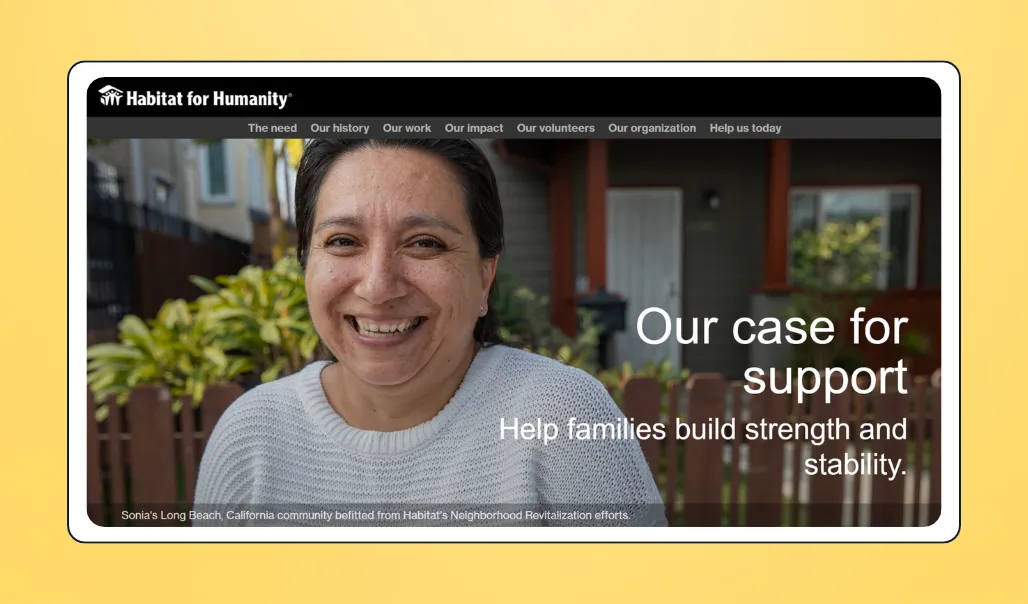
✨ What made it work: Habitat for Humanity’s case for support opens with the problem: housing shortages and unsafe living conditions. Then, it explains how it’s uniquely positioned to solve this problem by constructing new housing, improving existing homes, and partnering directly with families in need.
📋 What orgs can learn: Pair your impact data and mission overview with one specific beneficiary story, compelling photos, and direct quotes from the people you’ve helped.
Longview World of Wonders 🧸
Longview World of Wonders features a capital campaign case for support on its fundraising page, sharing a concise overview of its mission and how donor contributions are used.
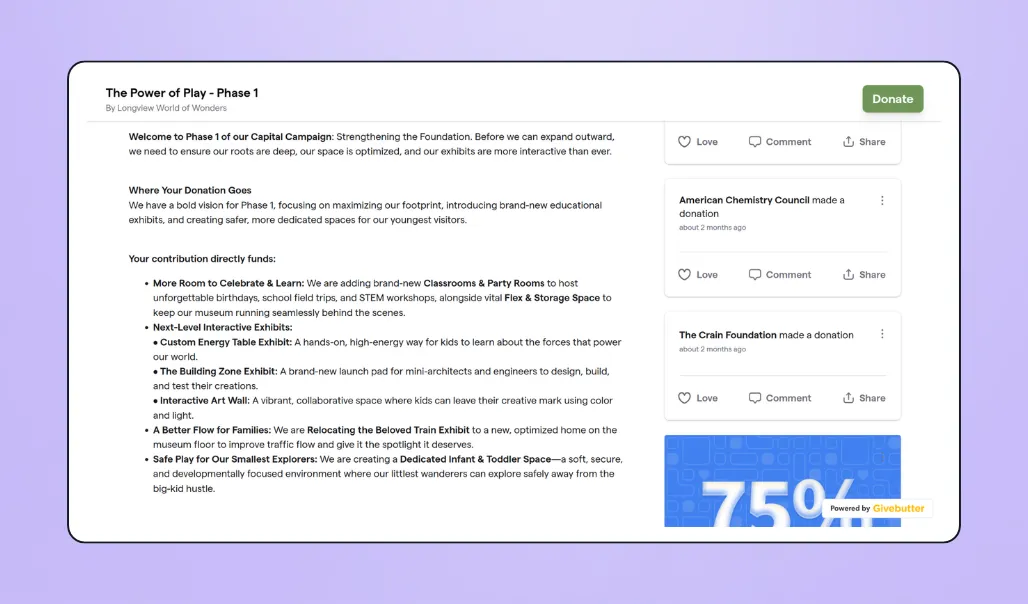
✨ What made it work: The case for support begins by sharing how Longview World of Wonders works to empower East Texas kids. It outlines the purpose of the capital campaign: strengthening the center’s existing infrastructure and programming before expanding to serve more families. It also explains how donors' contributions fund projects, including new classrooms and party rooms, and how those projects support the mission of giving kids more room to celebrate and learn.
📋 What orgs can learn: Add your case for support directly to your Givebutter campaign page so donors can quickly navigate to your donate button and choose to give monthly, annually, or once.
Download your free case for support template
Download a free case for support template that you can customize for your nonprofit.
The template walks you through proof of impact, your plan, and ask amounts, along with case for support sample phrasing and a final review checklist to help you build a persuasive case statement for your nonprofit.
Make the case once, then let it work all year
Instead of starting from scratch every time you need to craft a fundraising appeal or grant application, a case for support ensures that every communication to donors is mission-aligned and cohesive.
Start small: book three 15-minute interviews this month with a board member, a donor, and a program staffer, then use the template to draft your core case.
With Givebutter, you can easily turn your case for support into a free campaign page that shares your nonprofit’s story and impact with photographs, videos, a fundraising goal bar, campaign updates, and more.

Turn your case for support into a campaign page
Sign up for your free Givebutter account today and use your case for support to help you raise more.
FAQs about case for support examples
How long should a case for support be?
An internal case for support could run eight pages or more because it includes detailed information about your mission, impact, budget, and goals.
For a public-facing version, such as a printed document, PDF, or campaign page, aim to keep it concise, with one or two pages.
Who should write a case for support?
A strong case for support draws on input from your board members, community leaders, program staff, and beneficiaries. One lead writer, such as your development director or a team member with strong writing skills, can bring those perspectives together into one cohesive master document.
What's the difference between a case statement & a case for support?
Many nonprofits use the terms "case statement" and "case for support" interchangeably. Some nonprofits use one term to refer to their internal master document and the other for the shorter public version.
Can you use a case for support outside a capital campaign?
Nonprofits use a case for support for annual and major gift appeals, grant applications, email and direct mail appeals, social media campaigns, and more to ensure their messaging is aligned across all communication channels.
Share this article