.svg)
.svg)
.svg)
.svg)
.svg)
.svg)
.svg)
.svg)
.svg)


.svg)
.svg)
.svg)
.svg)
.svg)
.svg)
.svg)
.svg)

.svg)
.svg)
.svg)

.svg)

.svg)
.svg)
.svg)
.svg)
.svg)


.svg)
.svg)
.svg)
.svg)
.svg)
.svg)
.svg)





.svg)




%20(1).png)

Your congregation may have outgrown its current space. It may be time to renovate aging facilities, pay off debt, or fund a major ministry initiative. Whatever the goal, launching a church capital campaign can feel like a daunting task, especially when you're asking supporters to give above and beyond their regular tithes and offerings.
That's exactly what a church capital campaign is designed to do. With the right plan, you can rally your congregation around a shared vision, secure early commitments, and raise the funds your church needs without losing momentum along the way. In this guide, we'll walk through the three essential phases of a successful church capital campaign, plus real examples to inspire your own.
Key takeaways
- Make sure you’re ready 🚦 Build a solid foundation of regular giving before launching your campaign and align church leadership with your plan.
- Set a clear goal 🥅 Tie your goal to a specific need, such as $500K for a building renovation.
- Start with the quiet phase 🤫 Aim to raise at least 50% of your total from major donors before you go public.
- Don’t mix funds 💰 Keep capital campaign funds separate from regular giving and Sunday tithing.
- Focus on follow-up 📣 Build campaign momentum by following up through email, text, direct mail, and from the pulpit.
- Express gratitude 🫶 Send personalized donor recognition based on giving amount and frequency.
- Use tools that simplify giving ⚙️ Choose a platform like Givebutter that offers multiple payment methods, recurring giving, pledges, and separate campaign pages.
What is a church capital campaign?
A church capital campaign is a multi-year fundraising effort, typically for large-scale projects like a building renovation. Unlike annual giving or traditional fundraising campaigns, a church capital campaign typically secures 50%–70% of its goal through major donors before publicly launching the campaign.
Before launching a church capital campaign, it's important to make sure your church has the right foundation in place. The three phases below will help you assess your readiness, build momentum, and keep your campaign on track.
How to run a church capital campaign: 3 essential phases
Successful church campaigns follow three distinct phases: preparation, the quiet phase, and campaign launch and follow-up. This framework helps you sustain momentum and improve your chances of reaching your goal.
%20-%20Flipcause%20impact%20blog%20graphic%20(1).jpg)
Phase 1: Plan & assess readiness 📋
Capital campaigns come with larger fundraising goals and longer timelines. Jumping in too early can result in a stalled effort. To prevent that, start by clearly defining the project your campaign will support and assessing whether your church is ready.
- Define your goal 🎯 Base your capital campaign goal on a real, mission-critical need. Explain why your goal is important and how the funds raised will help you achieve it.
- Run a feasibility study 🤔 Interview board members, key volunteers, and potential major donors to establish a realistic goal range and to understand donor interest and giving capacity.
- Map out your timeline 🗺️ Decide when you’ll launch the quiet phase, set a campaign deadline, and plan how you’ll keep your congregation informed.
- Assign roles 👷♂️ Decide who will lead donor outreach, communications, and overall campaign management.

Phase 2: Run the quiet phase 🤫
The quiet phase lays the foundation for your entire church capital campaign. Before announcing your campaign publicly, use this time to secure early commitments from major donors, gather feedback, and refine your fundraising strategy.
Here’s how to approach the quiet phase of your capital campaign:
- Identify potential major donors 🔍 Use your CRM and donor segmentation tools to pinpoint them in your community.
- Develop campaign materials 📖 Create compelling proposals and presentations explaining why people should contribute to your campaign.
- Plan 1:1 conversations 👐 Major gift appeals should be made in person, and tailored to that church member’s personal interests and values.
- Refine your goal 🖌️ Adjust your goal if you’ve exceeded your 50% benchmark, or lower it if you’ve fallen short.
💡 Pro tip: Fundraisers on Reddit recommend securing 50%–70% of your goal during the quiet phase before launching publicly. Announcing a campaign that's already gaining traction can help build momentum and encourage broader participation.
Phase 3: Launch the public campaign & follow through 🎉
Once the quiet phase is complete, it’s time to go public. Share your campaign with your regular Sunday givers, committed volunteers, and the wider congregation.
Here’s how to launch and sustain a capital campaign that keeps your congregation invested:
- Protect donor intent 💰 Keep capital campaign gifts separate from regular tithes and offerings. With Givebutter, you can manage multiple funds from one centralized giving hub.
- Show appreciation 💛 Send a personalized thank you after every donation to recognize supporters and strengthen relationships.
- Track your progress 📈 Monitor your milestones and share regular updates with your congregation. Givebutter’s fundraising thermometer displays real-time progress right on your donation page.
- Follow up through multiple channels 📣 Don’t skip the follow-up. Maintain momentum with text, email, social media, direct mail, and in-person Sunday service updates.
- Use the right software 🧈 Choose a platform that offers multiple payment methods, pledges, text-to-donate, and recurring donations to make supporting your campaign as easy as possible.
Church capital campaign examples to learn from
These real Givebutter campaigns show how faith-based organizations have turned big visions into successful fundraising efforts. Notice how each campaign clearly communicates its purpose, makes giving easy, and keeps supporters focused on the impact of every donation.
Let’s Build a Church 🕍
The Holy Virgin Russian Orthodox Church split its capital campaign into two phases to help fund a permanent church home for its growing congregation.
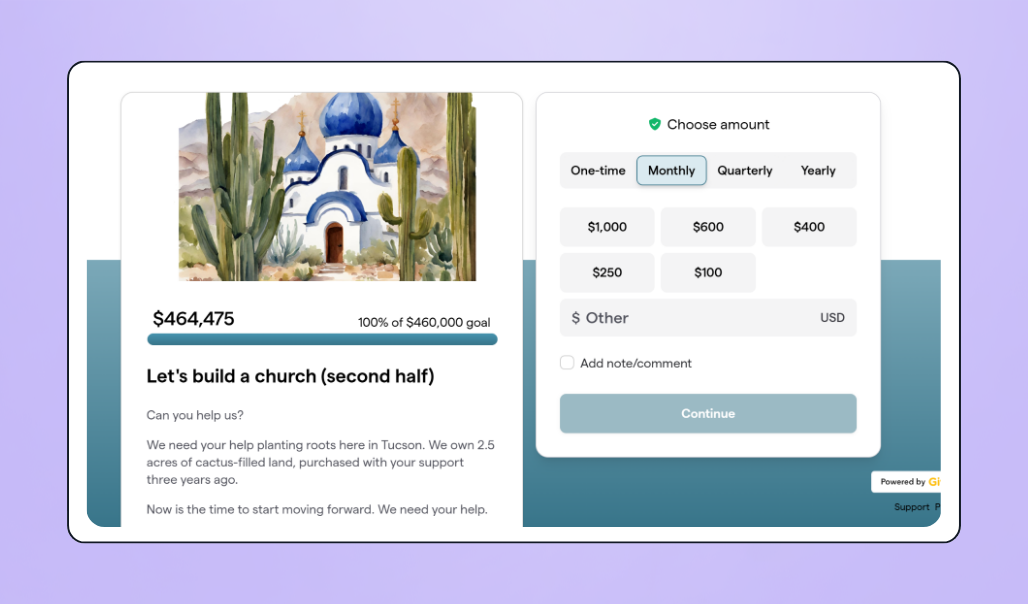
💰 Amount raised: $464K (100% of their goal!)
👥 Supporters: 743
⛪ Campaign purpose: Build the first phase of a permanent church campus, including a worship space, classrooms, and community facilities.
📋 What churches can learn: Breaking a large capital project into manageable phases makes ambitious fundraising goals feel more achievable. By clearly showing what phase one will accomplish, the church gives donors confidence that every gift moves the project closer to reality.
Fullness of Life, Future of Hope 🏛️
The Fullness of Life, Future of Hope capital campaign, launched by the Ursuline Sisters Mission as part of its 150th anniversary celebration, aims to raise $10M to care for retired sisters.
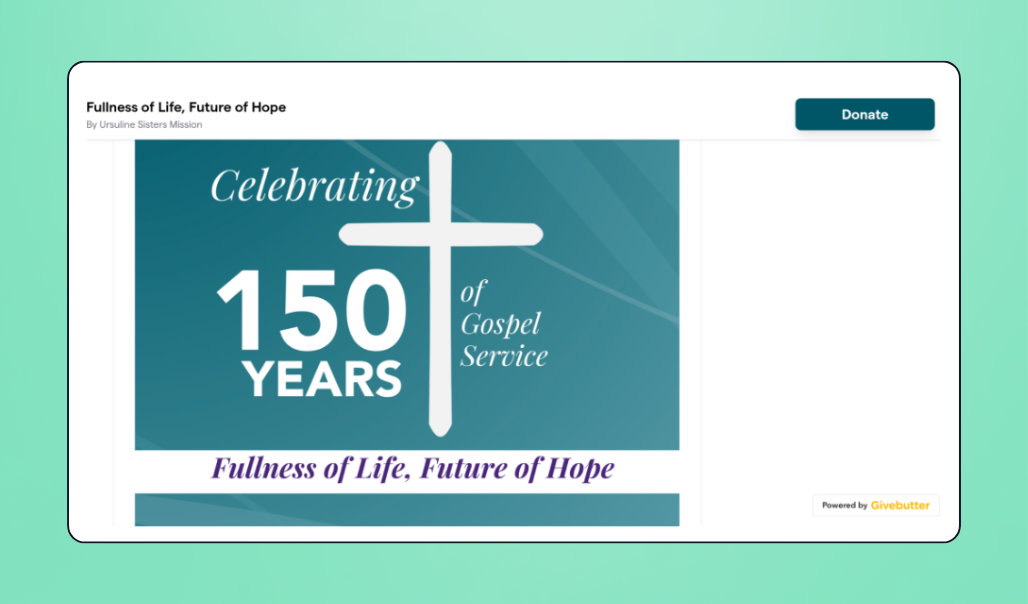
💰 Amount raised: $5.1M
👥 Supporters: 1,300+
⛪ Campaign purpose: Support retirement care for the Ursuline Sisters while preserving their ministry for future generations.
📋 What churches can learn: The campaign ties every donation to a clear mission and explains exactly how contributions will be used. Launching alongside the organization's 150th anniversary also gave supporters a meaningful milestone to celebrate and support.

Launch your church capital campaign with Givebutter
Turning a bold vision into a fully funded church capital campaign is no small task. But with the right tools, you can organize your campaign, engage your congregation, and keep every donor and pledge on track from start to finish.
Givebutter helps you put your capital campaign plan into action. Create a dedicated fundraising page, collect one-time gifts and multi-year pledges, keep capital campaign donations separate from regular giving, track every donor relationship in your nonprofit CRM, and keep your congregation engaged with email, text, and real-time fundraising updates—all without juggling multiple tools.

Keep every campaign pledge on track
Sign up for your free Givebutter account and give your church everything it needs to plan, launch, and grow a successful capital campaign.
FAQs about church capital campaigns
How much can a church raise in a capital campaign?
Your fundraising total depends on your goal, strategy, timeline, and member support. Smaller congregations may raise a few hundred thousand dollars, while larger churches often raise several million. Many campaigns rely on multi-year pledges, allowing supporters to spread their gifts over two or three years.
Do I need a consultant for a church capital campaign?
No, but they can offer expert advice on whether your church is ready to launch a capital campaign and on the best way to approach fundraising.
Whether you work with a consultant on your capital campaign strategy or organize the campaign yourself, Givebutter can help you execute your capital campaign with customizable donation forms, a centralized giving hub, recurring donations, and a CRM to track your major donors.
How long does a church capital campaign take?
Capital campaigns typically take multiple years. There are three phases of each campaign (the planning phase, the quiet phase, and the public launch and follow-up). Typically, the final stage is the longest, often taking 2–3 years.
Taking time to plan and secure early support is key to building momentum for long-term success.
Share this article






.svg)
.svg)