.svg)
.svg)
.svg)
.svg)
.svg)
.svg)
.svg)
.svg)
.svg)


.svg)
.svg)
.svg)
.svg)
.svg)
.svg)
.svg)
.svg)

.svg)
.svg)
.svg)

.svg)

.svg)
.svg)
.svg)
.svg)
.svg)


.svg)
.svg)
.svg)
.svg)
.svg)
.svg)
.svg)





.svg)


%20Guide_4x.webp)
%20(1).png)

You've probably heard it called a dozen different things: fund-a-need auction, special appeal, cash call, fund the need, mission moment, raise the paddle, or fund-a-cause. They all refer to the same short yet critical moment during your event where giving becomes collective, visible, and deeply personal.
In this article, we've got the full spread on fund-a-need appeals—what they are, why they're so effective, and how to plan one that makes the biggest impact for your nonprofit.
Key takeaways
- Fund-a-need is a direct donation moment at events where guests pledge to support a specific program or need.
- The average fund-a-need raises tens of thousands of dollars in a single program segment, often making up more than half of total event revenue.
- Success depends on storytelling, timing, giving tier strategy, and pre-committed momentum donors.
- Givebutter makes it easy for attendees to pledge and give in real time during your fund-a-need moment.
What is a fund-a-need?
A fund-a-need, also known as a fund-a-need paddle raise, is a live fundraising appeal built into your nonprofit event program. An emcee invites attendees to pledge to contribute at various giving levels—no bidding, no prizes—just a heartfelt ask tied to a specific mission need.

Why fund-a-need is worth building your event around
Fund-a-need appeals are often the most lucrative segment of an entire gala evening, generating an average of 40–60% of total event revenue and raising $44K in a single 10–15-minute window.
Compared to live or silent auctions, fund-a-need appeals require very little overhead and save your team hours of legwork on sourcing donated items. (Of course, you can always do both!)
Beyond the revenue-generating and cost-saving benefits, a fund-a-need often serves as the most mission-pure fundraising moment of the night, which makes it the most emotionally resonant for donors. With the right tools, timing, and emcee, you can make your fund-a-need moment a smashing success.
How to run a high-performing fund-a-need in 6 steps
Follow these six steps to create a smooth experience from start to finish for your donors and your team.
1. Set your fund-a-need giving levels 💸
Giving tiers can be a make-or-break moment for fund-a-need organizers. Set them too high, and you'll lose the room; set them too low, and you'll leave money on the table.
The following tips will help you match giving levels to your audience:
- Know the room's giving capacity—review donor history before the event
- Lead with your highest level (e.g., $10K or $5K) and go down from there
- Tie every level to a tangible outcome: “$500 provides one student's scholarship for an entire semester.”
- Make sure your lowest tier feels accessible—many organizations end at $100 or $50
- Don't set any limits on how many donors can give at each level
Sample tier structure 💸
2. Secure momentum donors 🎯
57% of successful fund-a-need organizations secure pre-committed donations before the event, with an average pre-commitment of $20K.
These are your momentum donors (sometimes called “plants”): your most reliable major donors whom you ask in advance to raise their paddle at the highest giving tier. Nothing kills a fund-a-need faster than silence at the top of the ask. Momentum donors solve that problem before the event even starts.
How to recruit momentum donors:
- Identify your top 3–5 most generous donors before the event
- Ask them personally (call or email, not a form) to commit at a specific tier
- Confirm they'll be seated where they're visible
- Brief the emcee or auctioneer on who they are, so they can be recognized in the room
3. Craft the emotional story 🎥
A fund-a-need without storytelling is just asking for money. A fund-a-need with storytelling is a movement.
Follow this structure for the best results:
- Video (3–4 minutes): Share a beneficiary's story—not stats, but a real person. Let them tell it.
- Live speaker (1–2 minutes): Invite the person from the video (or someone connected to your mission) to say a few words in the room. Keep it short. The emotion does the work.
- The ask (10 minutes): Transition directly—don't let energy dissipate between the story and the paddle moment.
4. Time it for maximum revenue ⏱️
Nearly 45% of organizations run their fund-a-need at the end of the event, which may leave them missing out on gifts. Running yours too late means you could miss donors who've left early, lose energy that peaked earlier in the evening, and kill the momentum you've built all night.
Instead, run your fund-a-need after dinner, but while the room is still energized—typically before dessert or immediately after a core program moment. Moving it earlier can yield a 10–20% increase in revenue!
5. Execute the live ask confidently 🎤
As your emcee transitions from the story moment directly into the ask, we recommend following this highly effective format:
- Call out the highest giving level first, explain the impact, and ask for pledges.
- Wait in silence for at least 10 seconds. Silence is your friend here!
- Work down through each tier, recognizing donors by name or paddle number as they give.
- Rely on your live donation display to show real-time totals toward your stated goal.
- Close the segment with a heartfelt thank-you and a celebration of the grand total.
Here's what “the ask” might sound like as you get started at your highest giving level:
“Tonight, we begin at a level that changes the entire landscape of our year. For $10K, you aren't just making a gift; you are effectively keeping the lights on and the shelves stocked for our shelter through 2027. You are ensuring that every animal that comes through our doors for the next 12 months has what they need to thrive. Who will lead the way tonight by fully funding our shelter overhead for an entire year?”
🌟Pro tip: If no one jumps at $10K after a long pause, your auctioneer can pivot slightly: “Is there anyone who would like to join forces? Perhaps two of you at $5K to reach that $10K goal together?”
6. Adapt for virtual & hybrid events 🌐
Fund-a-need moments can absolutely work in virtual and hybrid formats, but you'll just have to adjust the pacing.
Virtual fund-a-needs via livestreaming move faster because attendees typically won't stay engaged as long. Start with your beneficiary video, pause for live comments, then quickly brief attendees on how giving will work.
Share your goal thermometer or live goal bar on screen, and have your emcee call out donors as gifts come in. Instead of raising paddles, participants can contribute immediately via a QR code, text-to-donate, or the donate button on your event landing page.
Take your fund-a-need ideas to the next level with Givebutter
A fund-a-need is one of the most powerful and highest-return fundraising segments a nonprofit can run—but it requires strategy, storytelling, and preparation to execute well.
Givebutter offers an easy, all-in-one platform that gives nonprofits everything they need for a successful fund-a-need campaign, from event ticketing and email marketing to built-in paddle-raise software and seamless pledge management.
Instead of wrestling with clunky software or taking hours to log pledges by hand, now you can spend more time on what matters most—inspiring your audience and building connections.
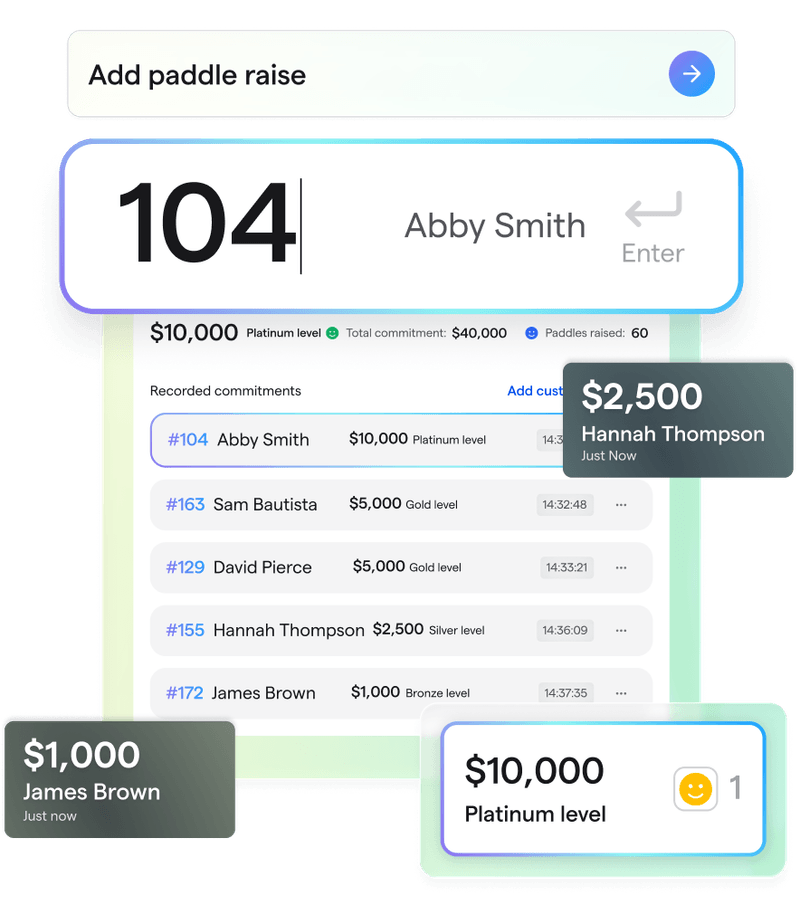
Free paddle raise software for your next fund-a-need
Sign up for your free account today and start planning your next fund-a-need event with Givebutter.
FAQs about fund-a-need campaigns
What is a fund-a-need in fundraising?
A fund-a-need (also called a paddle raise or special appeal) is a direct donation moment during a fundraising event where attendees give at preset giving levels to fund a specific program or need, with no bidding or prizes involved.
How much can a fund-a-need raise?
The average organization raises $44K in a single fund-a-need segment. High-performing organizations can raise significantly more. It often represents 40–60% of total event revenue.
What are the fund-a-need giving levels?
These are the donation tiers you will present to your audience during the fund-a-need. Research your audience's giving history, then create 5–7 tiered levels from highest to lowest dollar amount. Tie each level to a tangible impact statement. Make sure the lowest level is accessible to all guests.
Do you need an auctioneer for a fund-a-need?
Not required, but highly recommended: 53% of successful organizations use a professional auctioneer or emcee. A skilled facilitator brings energy, pacing, and confidence that drive higher giving.
When should you do the fund-a-need during your event?
Earlier is generally better—but not too early. After dinner but before dessert is ideal. Avoid running it at the very last moment, or you'll lose energy and miss early departures.
Can you do a fund-a-need at a virtual event?
Yes! Virtual fund-a-needs work well with QR codes, donation buttons, text-to-donate, and a live fundraising thermometer on screen. Keep the ask shorter than an in-person fund-a-need and have a moderator shouting out donors in real time.
Share this article








.svg)
.svg)