.svg)
.svg)
.svg)
.svg)
.svg)
.svg)
.svg)
.svg)
.svg)


.svg)
.svg)
.svg)
.svg)
.svg)
.svg)
.svg)
.svg)

.svg)
.svg)
.svg)

.svg)

.svg)
.svg)
.svg)
.svg)
.svg)


.svg)
.svg)
.svg)
.svg)
.svg)
.svg)
.svg)





.svg)


%20(1).png)

Many nonprofit resumes look like corporate resumes with the word “mission” pasted on the top. It might get you past the applicant tracking system (ATS), but a generic resume can’t represent how passionate you are about the organization or the value you offer.
Hiring managers want three things: mission alignment, quantified impact, and programmatic fluency. This guide will help you transform your resume from average to exceptional, with advice on these three areas, plus a full annotated example and a free template.
Key takeaways
- Mission alignment lives in specifics 🎯 List specific programs, outcomes, and issue areas rather than leaning on adjectives like “passionate” or “dedicated.”
- Lead with quantified results 📊 Quantified bullets show hiring managers exactly what you can do. “Stewarded 42 donors, renewing 89% YoY” outperforms “managed donor relationships.”
- Volunteer work is real experience 🧩 Format volunteer experience identically to paid roles with quantified bullets, action verbs, and outcomes. If the impact was real, the format should reflect that.
- Translate, don’t just transplant 🔄 Swap corporate language for nonprofit equivalents. “Client retention” becomes “donor retention,” “revenue” becomes “contributed revenue,” and so on.
- One page is the default, not a rule 📏 Senior roles can go two pages as long as every line is earning its place. When in doubt, cut it down.
The structure of a nonprofit resume
Nonprofit resumes follow a similar format to corporate resumes, but they should also include a section on your volunteer and community experience and impact. Here’s how to structure your nonprofit resume:
Contact information 📞
Include your key contact information (like your phone number and email address) at the top of the resume, so it’s easy for recruiters to find.
Professional summary 📌
Skip the objective statement (e.g., “Seeking an opportunity to apply my skills”). It takes up valuable space, and nonprofit hiring managers are blunt: objective statements are generally considered outdated. Replace it with a short professional summary instead.
A professional summary explains your work history and how your skills and knowledge align with the role. Lead with your years of experience and top skills, and keep this section to no more than four or five lines.
Follow this pattern: [X+] years in [role], two quantified accomplishments, and one humanizing detail that reflects genuine mission alignment.
Skills section 🔑
Cover all your relevant skills, organized so recruiters and applicant tracking systems (ATS) can clearly understand. Include hard skills (like experience with grant writing, Salesforce, or Excel) and programmatic skills (like community outreach or stakeholder engagement).
Experience section 💼
Present your work experience in 3–5 bullets per role, and include a measurable outcome (a number or clear impact) in every bullet. This is your opportunity to demonstrate that you can not only do the work, but also drive tangible results.
Volunteer & community experience 🤝
Format your volunteer and community experience section the same as your paid experience, using quantified bullet points, action verbs, and measurable outcomes.
Education & certifications 🎓
Add a short section at the end of your resume for education, certifications, and nonprofit professional development achievements. List your degree(s), along with professional credentials like the Certified Fund Raising Executive (CFRE) or Project Management Professional (PMP) certification.
How to write each section, step by step
Follow this step-by-step guide to craft each section of your nonprofit resume that showcases your qualifications effectively.
1. Write a summary that signals mission alignment 🎯
Use your professional summary section to explain why your work history and experience relate to the role as well as the organization’s broader mission and vision.
The way you word your summary depends on the career move you’re making. Here’s how to approach it from a few different angles:
Career changer (private sector → nonprofit):
[Job function] professional with [X] years of experience [your most relevant experience translated into nonprofit language]. Proven track record of [quantified corporate accomplishment reframed as mission-aligned impact]. Passionate about [specific issue area] and seeking to apply [top 2–3 transferable skills] to advance [specific mission].
💡 Ideal for: Applicants switching from a corporate environment to the nonprofit world
⭐ What this approach achieves: Helps the hiring manager understand why you’re changing careers and how your existing skills and experience translate into the nonprofit sector.
New grad/early career:
[Field] graduate with [X] hours of volunteer experience in [issue area]. Skilled in [2–3 relevant hard skills] and [2–3 relevant soft skills], with a track record of [specific quantified accomplishment from internship, volunteer work, or coursework]. Ready to contribute to [specific mission area].
💡 Ideal for: Fresh grads looking for their first job in a nonprofit organization
⭐ What this approach achieves: Highlights your volunteering experience and genuine interest in the organization’s work.
Experienced nonprofit professional:
[Role] with [X]+ years driving [specific impact area] across [type of organizations]. Led [quantified accomplishment] and managed [budget/team size/program scope]. Specialized in [2–3 top programmatic or functional skills]. Seeking to [specific growth goal] at a mission-driven organization.
💡 Ideal for: Changemakers looking for a new, rewarding experience
⭐ What this approach achieves: Introduces you as an experienced professional, with the achievements and skills to back it up.
📊 Nonprofit pros weigh in: In our survey, 57% of nonprofit professionals said authentic voice was what they looked for most in an application, more than impact metrics or an answer to “why us.” Hiring managers can spot a template, and your summary is the first place to prove yours isn’t one.

2. Build an ATS-friendly skills section 🤖
Your skills section should be easy to read, with keywords that signal to ATS and recruitment software that you’re qualified for the role.
Use this skills bank as inspiration, and tailor the keywords you include to your experience and the job description.
As you build this section, only list skills you can confidently discuss in an interview. Keep soft skills in your experience bullets, support them with examples, and organize everything under clear headings for easy scanning.
💡 Pro tip: Include 10–15 keywords that match the specific job description. Tailor your resume for every application, so it’s always relevant to the role.
3. Write quantified impact bullets 📊
In the work experience section, use quantified bullets to explain how you contributed to specific projects or programs. Avoid vague, weak, overly corporate statements. This is your opportunity to highlight the real-world impact you made.
Use this formula to write your statements: action verb + what you did + quantified outcome.
Here are some examples of this in action:
The “before” statements explain what was in your job description, but the “after” statements are clear, specific, and backed by evidence.
4. Treat volunteer work like paid experience 🧩
You don’t need previous work experience to secure a role with a nonprofit organization. In this world, volunteering counts for a lot, so it should appear on your resume with the same confidence and conviction as paid experience.
Use the same format as the previous section to explain the results from your volunteering work. Most people under-quantify volunteer experience because they were not paid for it. Reframe it exactly as you would a paid role. Here are some examples:
💡 Pro tip: No nonprofit experience yet? Lead with volunteer work, then transferable skills, then academic projects with measurable outcomes. Hiring managers care more about quantified impact than job title. A strongly quantified volunteer role beats an unquantified paid role every time.
5. Translate transferable skills (for career changers) 🔄
While the work may be similar at times, corporations and nonprofit organizations use different language to refer to activities, stakeholders, and metrics.
Here’s how to translate common corporate terms into nonprofit language:
📊 Nonprofit pros weigh in: Translating experience is one of the biggest hurdles for career changers. In a Givebutter survey of 40 nonprofit professionals, 20% said knowing which transferable skills to highlight was the hardest part of the switch, and another 15% said translating their experience into nonprofit language was their biggest challenge. The table above helps you cover both.
6. Format for skimmability 📏
The first step of the screening process often involves an ATS, and your resume needs the right formatting to get past this stage.
Follow this checklist for ATS-friendly resume formatting:
- Tailor your resume to each job description by emphasizing the most relevant hard skills you genuinely have.
- Use a single-column layout, never tables or text boxes
- Don’t put text in headers, footers, or images
- Stick to a clean sans-serif font (Arial or similar)
- Save as PDF (or .docx if the posting requires Word)
- If you use an ATS scanner like Jobscan, aim for a 75–80% match, but prioritize natural language over a specific score.
- No page numbers
- No color-coded text
- One page as standard (two pages only for senior ED roles)
📊 Nonprofit pros weigh in: In our survey, 40% of nonprofit professionals said they use AI to draft applications but always edit heavily before sending, and 35% skip it altogether. AI assistance is fine as a starting point, but the specificity and mission fit have to come from you.
💡 Pro tip: AI tools can help tighten your language and tailor bullets, but treat them as a starting point. Revise for specificity, authenticity, and mission fit before you send.
Keep your resume clear, simple, and focused on what matters: the content that explains why you’re a good fit for the role.
Make sure your LinkedIn profile mirrors your resume. Hiring managers cross-check, and inconsistencies between the two get flagged.
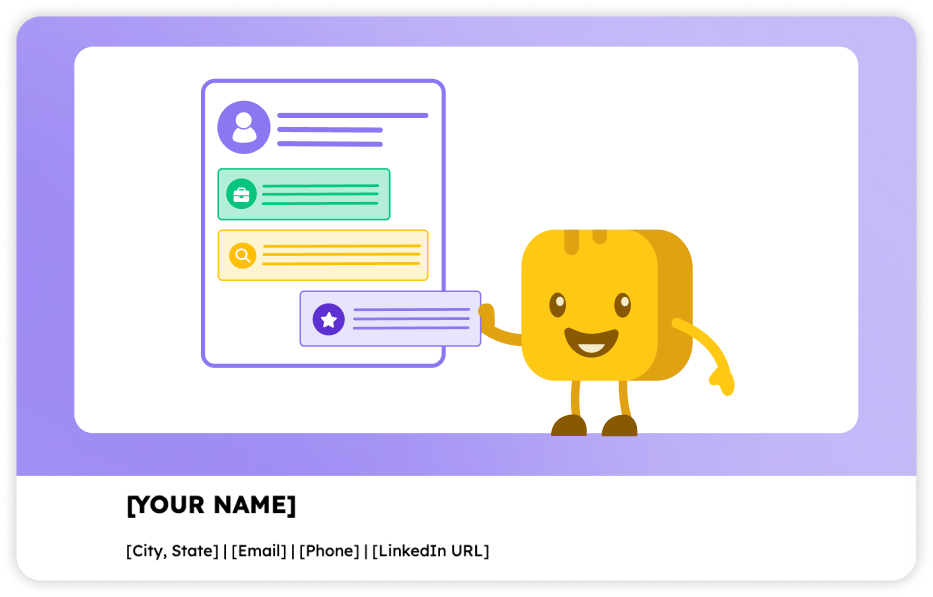
Download your free nonprofit resume template
Skip the blank page with our free nonprofit resume template. It includes every section covered in this guide, with prompts you can tailor to your own skills and experience.
It’s available as a Google Doc and can be easily exported to Word, Pages, or PDF.
Nonprofit resume example: Development associate
How does the template work in reality? Here’s an example of a nonprofit resume for a changemaker looking for a new role as a development associate:
Jordan M.
Chicago, IL | [Email address] | [Phone number]
Professional summary
Nonprofit management graduate with 200 hours of volunteer experience in supporting underrepresented communities in the arts in Chicago. Skilled in donor stewardship, events management, storytelling, public relations, and email marketing. Track record of turning attention into dollars, including leading the email and digital campaign for Chicago Arts Venue’s annual fundraiser, which brought in $25K in donations. Ready to contribute to event organization and donor relations at a mission-driven arts nonprofit.
💡 Why this works: The summary leads with a specific dollar amount ($25K) tied to a named organization, not a generic mission statement. Hiring managers scan for proof, not adjectives. Copy the pattern: [role] + [quantified accomplishment] + [named org or issue area].
Skills
- Development and fundraising: donor cultivation, stewardship, donor segmentation, major gifts, CRM management
- Programs: community outreach, stakeholder engagement, volunteer management, data collection & analysis
- Operations: event health & safety compliance, vendor management
- Communications: donor communications, storytelling, email marketing, social media strategy, content strategy, newsletter writing, website management
Experience
Intern at Arts for Chicago | Chicago, IL | Jan 2026–May 2026
- Sent personalized thank-you notes to gala attendees, which led to 10 new major gift donations.
- Transitioned the email newsletter from one tool to another, leading to a 40% increase in engagement and saving $4.5K every year.
- Introduced a new AI fundraising tool to the organization, improving efficiency by 20%.
💡 Why this works: Action verb (transitioned) + what you did (migrated the organization’s email newsletter) + two quantified outcomes (40% engagement increase + $4.5K annual savings). Two numbers in one bullet: engagement and cost savings. That is the formula. Never end a bullet without a number.
Volunteer & community experience
Volunteer Fundraising Assistant at Chicago Arts Venue | Chicago, IL | June 2024–Jan 2026
- Designed and managed the email and digital marketing campaign for an annual event, leading to $25K in donations.
- Improved engagement on social media channels from 10% to 45%.
- Supported the development of a donor engagement strategy, leading to a 30% increase in donor retention.
💡 Why this works: The Chicago Arts Venue volunteer bullets are formatted identically to the paid Arts for Chicago bullets. Quantify volunteer experience exactly like paid work. Hiring managers should not be able to tell the difference.
Education & certifications
BA in Nonprofit Management from North Park University
Put your best resume forward
Writing a standout nonprofit resume isn’t about cramming in more experience—it’s about presenting the right experience in the right way. Focus on measurable impact, tailor your resume to every role, and show hiring managers that you understand both the organization’s mission and the work it takes to advance it. Pair your resume with a thoughtful nonprofit cover letter, and you’ll have an application that stands out for all the right reasons.
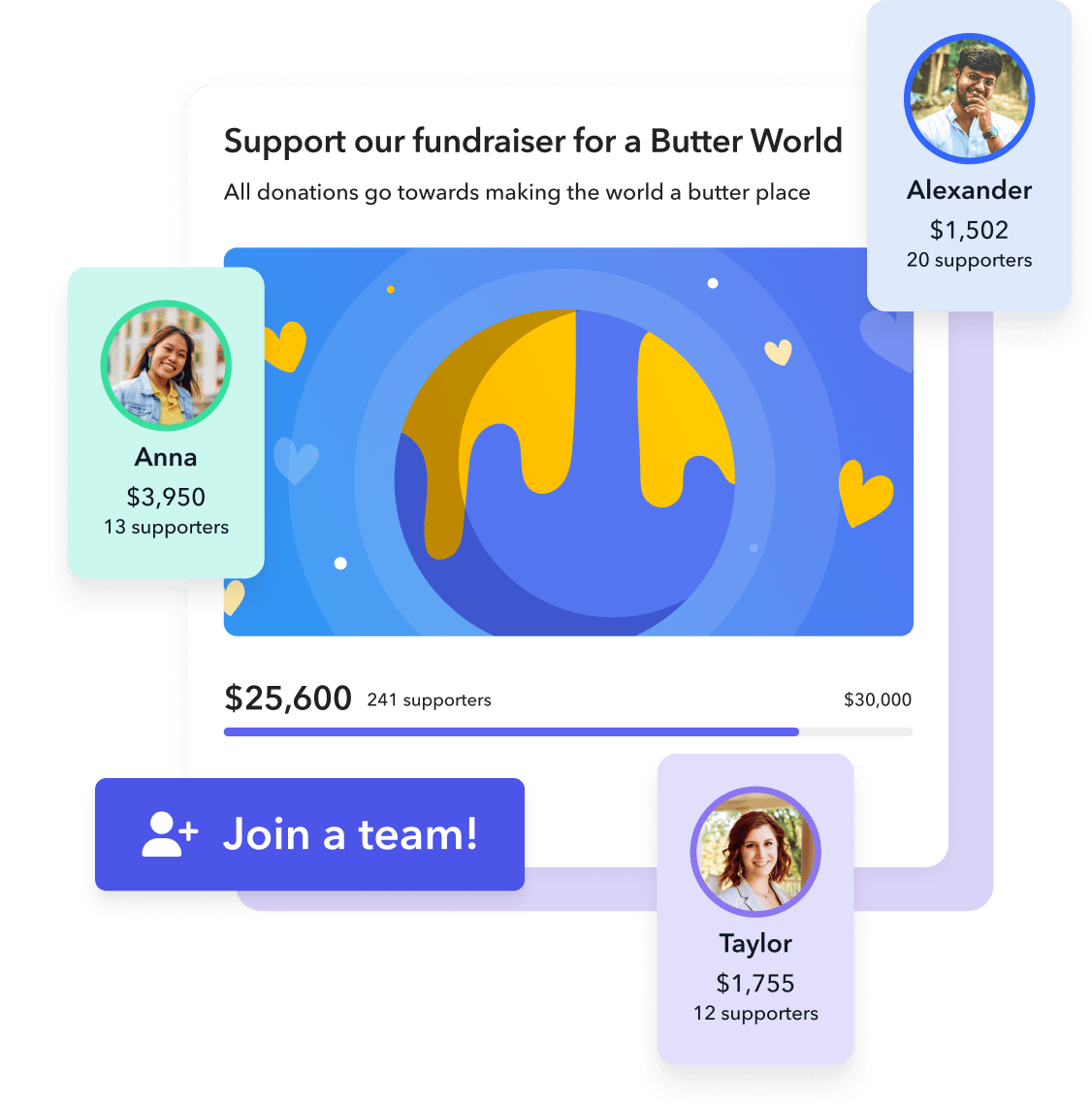
Once you’ve landed the role, Givebutter can help you keep making that impact. Our free, all-in-one fundraising platform gives nonprofit teams everything they need to raise more, engage supporters, and manage donor relationships in one place.
All your new org's fundraising tools in one place
Sign up for Givebutter for free, and when you’re ready, share it with your new team.
Nonprofit resume FAQs
How is a nonprofit resume different from a corporate resume?
Nonprofit resumes are similar to corporate ones, but they stand out in three significant ways: they include mission-alignment signals, volunteer and community work carries more weight, and there’s a focus on programmatic language rather than corporate jargon.
How do I write a nonprofit resume?
Start with a professional summary that highlights your experience, mission alignment, and measurable impact. List skills in an ATS-friendly way, and include relevant volunteer work and certifications.
What skills should be on a nonprofit resume?
Nonprofit hiring managers are generally looking for skills like fundraising experience, program management, donor communications, storytelling, CRM management, donor cultivation, grant writing, stakeholder engagement, and volunteer management, but the specific skills depend on the role you’re applying for.
Can I put volunteer work on my resume?
Yes, volunteer work deserves to be included on your nonprofit resume. Quantify the impact you made in the same way that you would with paid work experience. For example, you helped raise $5K in a community fundraiser, or you managed a team of 12 volunteers.
How long should a nonprofit resume be?
It depends on where you’re at in your career. Entry-level and recent grads should generally stick to one page. Mid-career and senior professionals can use two pages if their experience warrants it.
Nonprofit hiring managers are clear: a longer resume is not a problem as long as it focuses on quantified achievements and avoids padding. A third page is rarely warranted unless you have publications or academic appointments to include.
What format works best for ATS?
An ATS-friendly nonprofit resume has clean, standard sections, with no text in images, headers, or footers. PDFs are usually the best choice, but refer to any guidance from the organization regarding their preferred format.
How do I write a resume with no nonprofit experience?
Lead with your volunteer work, and include facts and figures that demonstrate meaningful impact. List transferable skills like communication, marketing, and experience with design or CRM software, and use the summary section to explain how you’re aligned with the organization’s mission and vision.
Share this article









.svg)
.svg)