.svg)
.svg)
.svg)
.svg)
.svg)
.svg)
.svg)
.svg)
.svg)


.svg)
.svg)
.svg)
.svg)
.svg)
.svg)
.svg)
.svg)

.svg)
.svg)
.svg)

.svg)

.svg)
.svg)
.svg)
.svg)
.svg)


.svg)
.svg)
.svg)
.svg)
.svg)
.svg)
.svg)




.svg)



%20(1).png)

Fundraising takes more than a great mission. It takes research, outreach, proposals, follow-ups, event logistics, and a whole lot of time spent on tasks that are important but incredibly time-consuming.
AI tools can take a good portion of that off your plate. They can speed up grant research, draft donor emails, generate fundraising forecasts, and help you build campaigns quickly without starting from scratch.
That said, donors and funders care about how their data is handled, and the tools you bring into your workflow should have clear data practices and strong privacy standards. This guide covers the best AI tools for fundraising, along with practical tips for using each one safely and securely.
Key takeaways
→ AI can save your team significant time by handling repetitive tasks like donor research, email drafting, and reporting.
→ AI delivers better results when paired with clean data, connected systems, and consistent human oversight.
→ Start small, set clear internal guidelines, and expand your use of AI only after you understand what works for your team.
→ Because donors and foundations have mixed feelings about AI, transparency and responsible data practices are essential to maintaining trust.
→ You don't need a large budget to explore AI, because free or low-cost tools like Double the Donation or FreeWill make it easy to test what works for your team.
→ AI becomes far more powerful when your CRM, fundraising, and donor communications live in one unified platform (or connect with each other) instead of in disconnected tools.
How we chose the best AI fundraising tools available
To put this list together, we looked at the real work that nonprofits do every day and the responsibility that comes with using AI in mission-driven spaces.
We ensured that each tool:
✅ Solves a real nonprofit task. Every tool on this list is designed to handle tasks that nonprofits do, including donor management, donor research, grant writing, social media management, stewardship, forecasting, donation optimization, and reporting.
✅ Supports ethical and responsible use. We prioritized tools that allow human oversight, are transparent about how data is handled, and don't encourage risky donor data uploads.
✅ Is accessible and affordable. Many of these platforms offer free plans or entry-level pricing so small nonprofit teams can get started without a major upfront investment. We also considered ease of use and chose tools that your team can navigate confidently without extensive training or technical support.
✅ Fits into real workflows. The tools in this list can integrate with major CRMs, other fundraising tools, email platforms, or reporting systems. AI works best when it plugs into your existing tech stack.
✅ Delivers measurable value. We looked for tools that produce results you can actually see, whether that's higher conversion rates, stronger donor retention, faster grant submissions, or hours saved each week.
In short, we focused on tools that help you raise more while protecting the trust your community places in you.

6 best AI fundraising tools for nonprofits
AI for fundraising: 6 tools your nonprofit should try
1. DonorSearch: Best for identifying high-capacity donors
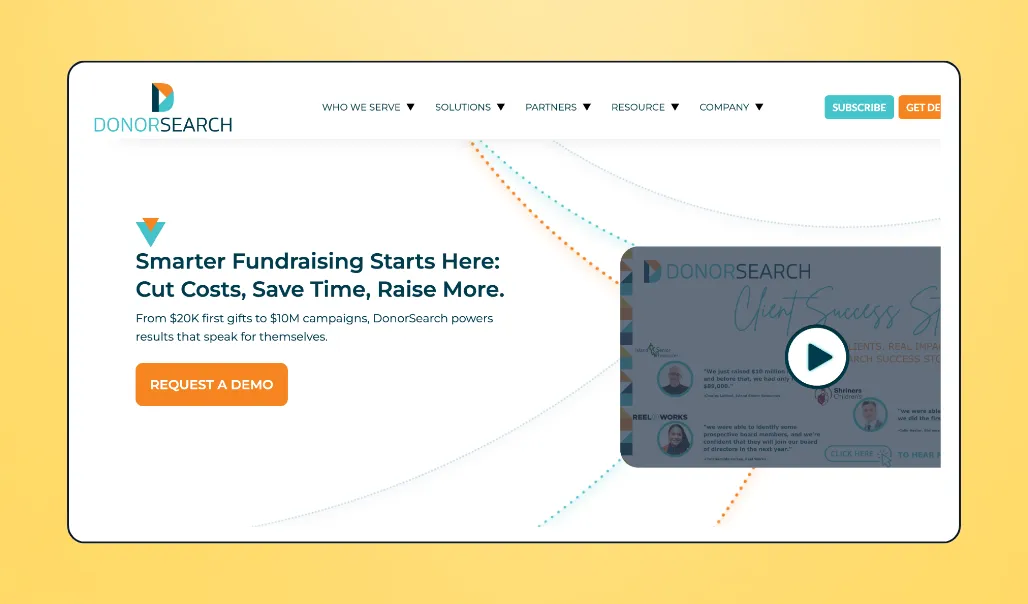
DonorSearch helps you identify donors who have the capacity and likelihood to give. It combines wealth screening with philanthropic data so you can see past giving, affiliations, and other indicators in one place.
For nonprofits, this can save hours of manual research. You can screen your database, segment high potential donors, and build more focused outreach strategies.
💡 Pro tip: Givebutter integrates with DonorSearch, so you can connect prospect research directly to your donor records and fundraising activity. This means your team can move from insight to action without switching between tools.
💰 Price
DonorSearch's pricing is not publicly available.
🌍 Our tip for safe and secure use
Only upload donor data you have permission to use, and limit access within your team to those who actually need it. Review how data is stored and shared, and make sure your team follows clear internal guidelines when handling sensitive information.
💬 What users like about DonorSearch
Users say DonorSearch stands out for how much data it pulls into one place and how quickly it turns research into something usable. Reviewers highlight its flexibility—you can run quick searches on individual prospects or upload spreadsheets for bulk screening—and note that it saves significant staff time while still being easy to learn and use. Source
2. Instrumentl: Best for finding and tracking grants
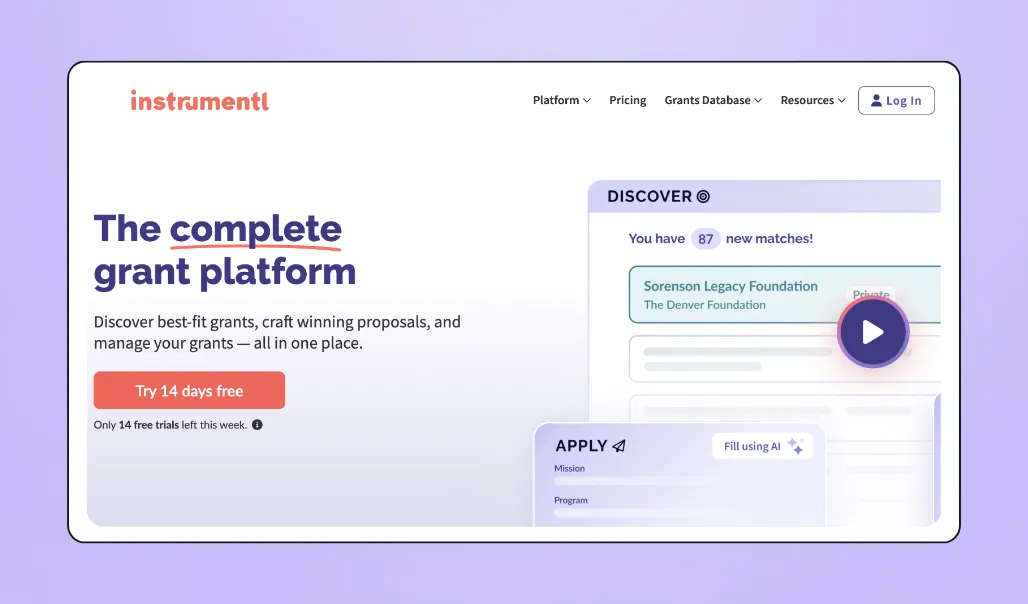
Instrumentl helps you discover grant opportunities and manage the entire grant process in one place. Instead of jumping between websites, spreadsheets, and calendar reminders, you can search for grants that match your mission, track deadlines, and organize application materials inside a single dashboard.
You can also set up saved searches based on your cause area and location, track which grants you've applied for, and monitor reporting requirements after you win funding. That reduces last-minute scrambling and helps you build a more consistent grant pipeline over time.
💰 Price
Instrumentl offers a 14-day free trial. Paid plans start at $299/month, billed annually.
🌍 Our tip for safe and secure use
Grant applications often contain sensitive organizational data, including financials, program details, and leadership information. Make sure any platform you use to draft or store proposals has role-based access controls so only authorized team members can view or edit application materials.
💬 What users like about Instrumentl
Grant professionals say Instrumentl takes the friction out of prospecting. They appreciate that Instrumentl's search results only surface active opportunities and can be sorted by deadline and other filters.
Reviewers also praise the built-in grants calendar, noting that it lets them organize prospects and share updates with clients without having to build a separate document from scratch. Source
3. GoodUnited: Best for social media donor engagement
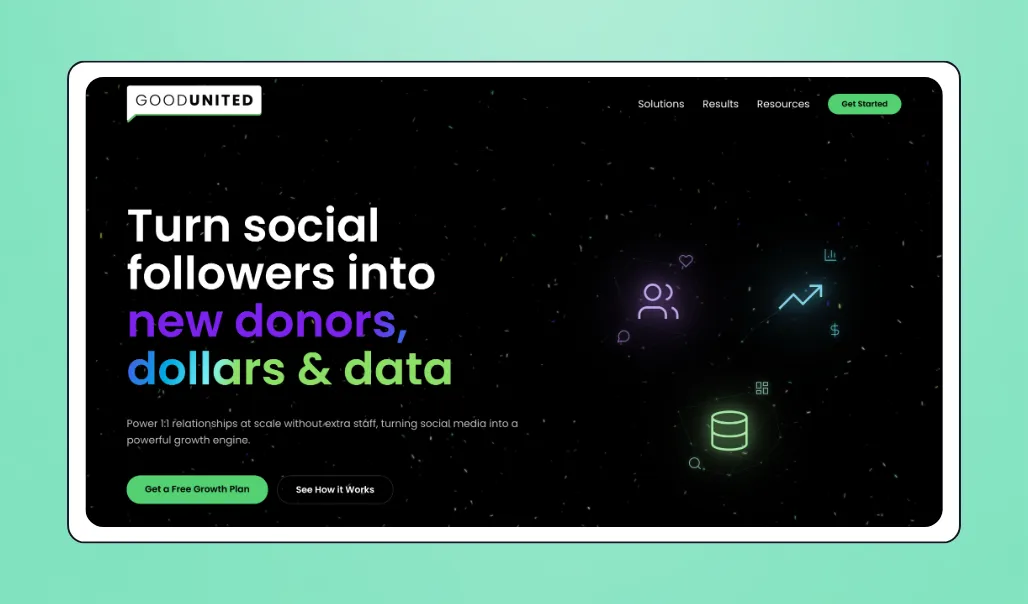
GoodUnited helps you turn social media conversations into fundraising opportunities. It connects to platforms like Facebook and Instagram so you can identify people who are interested in your mission, respond to comments, and send direct messages. Over time, that can lead to donations, event registrations, or peer-to-peer fundraisers.
💰 Price
GoodUnited's pricing is not publicly available.
🌍 Our tip for safe and secure use
Social media integrations can create unexpected data flows between platforms. Before connecting GoodUnited to your Facebook or Instagram accounts, review what permissions it requests and what data it stores. Limit access to your social accounts to authorized staff only, and revoke credentials for anyone who leaves your team.
💬 What users like about GoodUnited
Reviewers say they love how GoodUnited meets supporters where they already are. They describe it as a natural fit for social fundraising, praising the ability to have meaningful, conversational interactions with donors without pulling them out of the platforms they use every day. Source
4. FreeWill for Nonprofits: Best for legacy giving and grant support
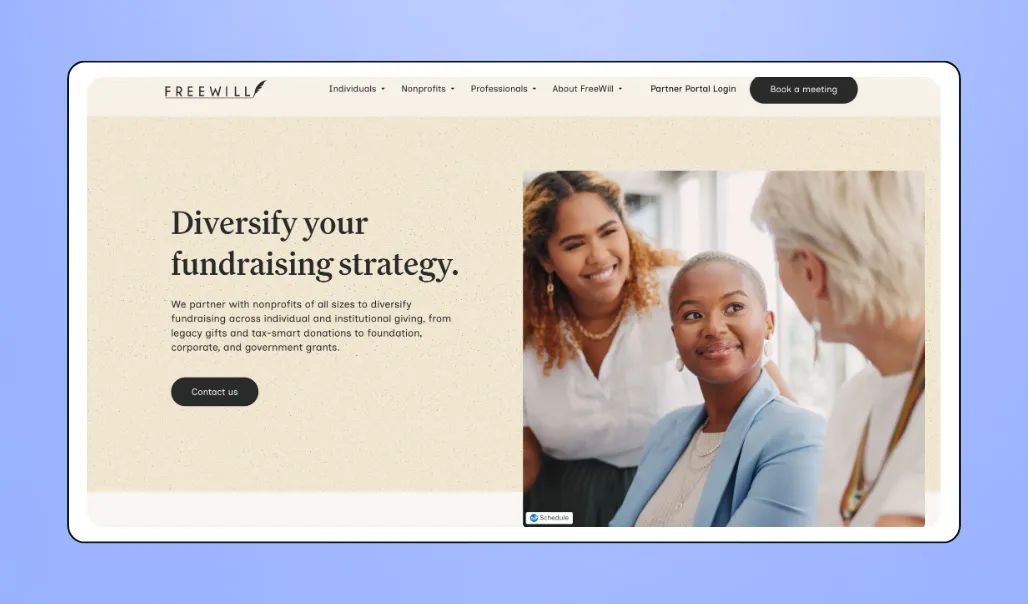
FreeWill helps nonprofits grow planned giving programs by making estate planning simple and accessible for donors. Through the platform, supporters can create a legally valid will for free and choose to include your organization as a beneficiary.
Beyond legacy gifts, FreeWill also offers Grant Assistant, which uses AI to help you draft high-quality grant proposals faster, and Willy, a free AI content companion that can generate fundraising emails, thank you notes, direct mail copy, social posts, and even press releases—so you're not starting from a blank page every time.
💰 Price
FreeWill's pricing is not publicly available.
🌍 Our tip for safe and secure use
Planned giving involves some of your donors' most personal information. So confirm that FreeWill's data-handling practices meet your organization's privacy standards, and ensure donors understand how their estate-planning information is stored and protected. And before feeding any legacy gift details into AI tools for donor outreach, review your data use agreement first.
💬 What users like about FreeWill
FreeWill users say the platform makes legacy gift management a lot simpler. Donor submission details are clearly organized and easy to pull up, and the AI companion William makes donor outreach and marketing materials faster to produce. They also say the Learning Hub is a great resource for teams looking to strengthen their planned giving program. Source
5. Double the Donation: Best for maximizing matching gifts
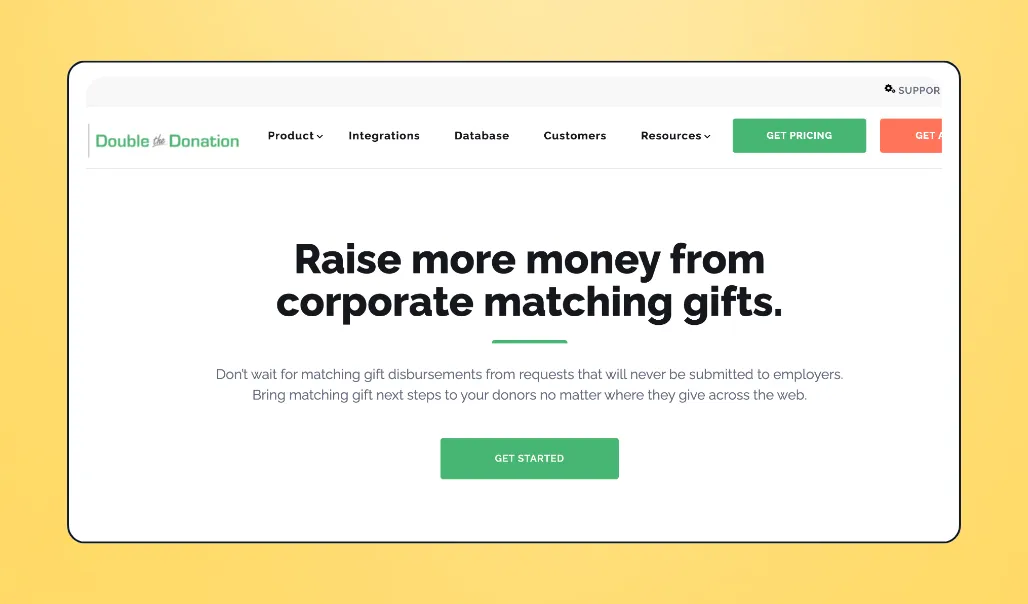
Double the Donation helps you increase revenue from corporate matching gift programs. Many donors work for companies that will match their charitable contributions, but most never submit the paperwork. This tool uses AI to identify eligible donors and guide them through the match process.
You can embed a search tool on your donation page so supporters can check their employer's matching policy in just a few seconds. The platform also sends follow-up reminders and tracks match status, reducing the manual work your team would otherwise handle through spreadsheets and email.
💰 Price
Double the Donation allows nonprofits reporting under $250K in Contributions on their most recent Form 990 to sign up for free and pay based on usage. Paid tiers start at $999/year.
🌍 Our tip for safe and secure use
When embedding matching gift tools on your donation page, verify that the integration doesn't introduce third-party tracking scripts that could compromise donor privacy. Review Double the Donation's data-sharing practices to confirm that donor-employer information is used solely for matching purposes and isn't shared with any other parties.
💬 What users like about Double the Donation
Reviewers say Double the Donation gives them a clear, detailed view of their matching gift pipeline. They get visibility into how requests are submitted, whether through email or directly on the donation form, and say the engagement metrics, like email open rates and cadence tracking, make it easier to evaluate performance and fine-tune outreach without a lot of manual digging. Source
6. ThankView by EverTrue: Best for personalized video stewardship
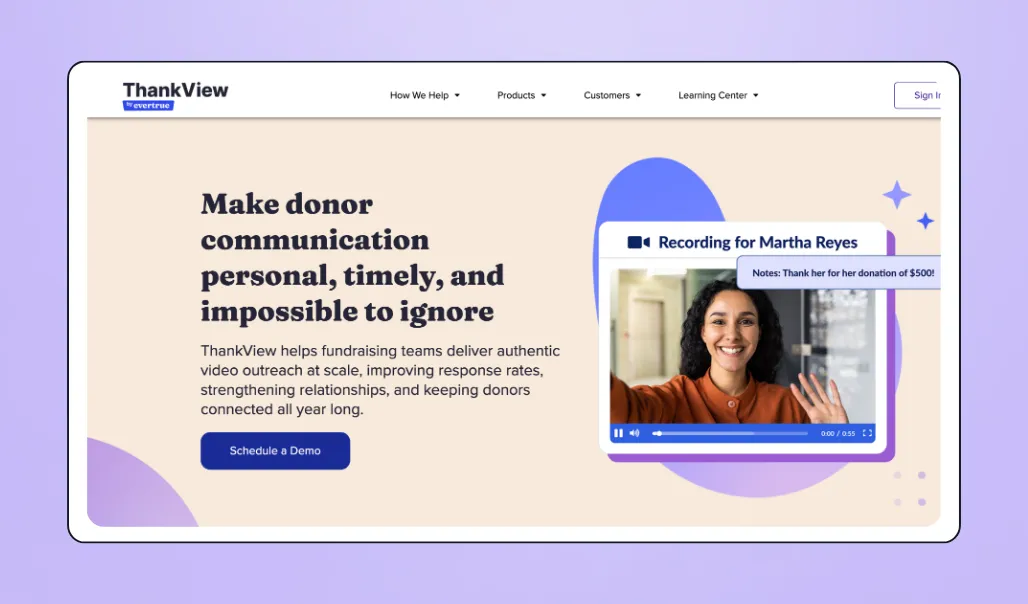
Instead of relying solely on email or printed letters, ThankView lets you record short thank-you videos and share them via text or email. This creates a more human follow-up experience as you can thank first-time donors, recognize recurring givers, celebrate volunteers after an event, or update major donors with a quick message from your executive director.
ThankView's AI message drafting tool also helps you write the accompanying text for each video send, so you're not starting from scratch every time you hit record. The platform tracks views and engagement, too, so you can see who watched and follow up accordingly.
💰 Price
ThankView's pricing is not publicly available.
🌍 Our tip for safe and secure use
Video stewardship tools often store donor contact information and engagement data on external servers. Before uploading your donor list, review ThankView's data retention and deletion policies, and confirm that video views and engagement metrics are kept within your team and not shared with or sold to third parties.
💬 What users like about ThankView
Ease of use is the throughline in ThankView reviews. Users say the platform walks you through exactly what to do and when, making it approachable even for less tech-savvy team members. Source
How to choose your go-to AI fundraising tool
There are six tools on this list, but you don't need all of them. You only need the ones that address your biggest gaps (and a system that keeps everything connected).
Start by identifying where your fundraising operation needs the most support right now. Are you struggling to find the right donors? Losing steam on grant applications? Not following up with supporters as consistently as you'd like? Your answer points you to the right place to start.
From there, layer intentionally based on your priorities:
- If you're building a major gifts pipeline, DonorSearch helps you prioritize high-capacity donors.
- If grants drive your revenue, Instrumentl and FreeWill's Grant Assistant support research and proposal writing.
- If your audience lives on social media, GoodUnited helps you turn comments and DMs into conversations and donations.
- If planned giving is part of your strategy, FreeWill for Nonprofits makes it easier to present legacy gift options to donors.
- If you want to unlock corporate matching gifts from supporters who've already donated, Double the Donation takes care of that.
- If you want to strengthen stewardship, ThankView by EverTrue helps you send personalized videos to donors at scale.
The key is to avoid stacking tools that solve the same problem. A lean tech stack is easier to manage, easier to train your team on, and far more effective than a collection of overlapping tools.
How Givebutter ties your AI fundraising stack together
AI fundraising tools generate a lot of useful output, but that output needs somewhere to live to be truly valuable.
Givebutter provides just the place. It's a free fundraising platform that keeps your donor CRM, donation forms, fundraising pages, event management, and email marketing in one place, so the insights and content your AI tools produce have somewhere to go immediately.
For example, you could:
- Run a wealth screening in DonorSearch, then pull those insights directly into Givebutter's CRM to segment high-capacity donors and build a targeted outreach campaign.
- Use Givebutter's native Double the Donation integration to identify donors with employer matching programs and encourage them to submit a match request.
- Trigger a personalized video via Givebutter's native integration with ThankView, so every new donor receives a warm, timely thank-you without any manual input.
For tools without a native integration, Givebutter connects with Zapier so you can plug in whatever else your team needs.
For teams that want extra functionality, Givebutter Plus provides workflow automation and task management so you can build automated workflows and manage multiple projects as you scale.
Ready to see how it all fits together? Sign up for Givebutter for free today.

Explore Givebutter Plus
FAQs about AI fundraising tools
Is it safe to use AI tools with donor data?
AI can be safe if you use it carefully. Be cautious about uploading sensitive donor details into AI tools, and review each platform's privacy and security policies before using it. Limit what data you share, anonymize information when possible, and create internal guidelines for how your team uses AI. Protecting donor trust should always guide your decisions.
Will donors lose trust if they find out we use AI?
It depends on your donor base. Some donors are comfortable with AI, while others have valid concerns about data privacy and automation. Knowing which camp your supporters fall into should shape how you use these tools and what your AI policy covers.
Either way, transparency helps. Being clear about how you protect donor data, what you use AI for, and that your team reviews everything before it goes out goes a long way in maintaining trust.
What fundraising tasks should we automate first?
Start with repetitive, low-risk tasks like thank-you emails, event reminders, social media drafts, reporting summaries, or matching gift follow-ups. These areas often take hours each week, but don't require complex nuance.
Over time, you can expand AI and automation to support major donor conversations, but have a team member review personalization and messaging before anything goes out.
Do small nonprofits really need AI fundraising tools?
AI isn't only for large organizations. For small teams juggling multiple roles, tools that draft emails, forecast revenue, or automate workflows can save hours each week and help prevent burnout. The key is choosing tools that solve your biggest bottlenecks and make operations smoother.
How do we build an AI fundraising tech stack without overcomplicating things?
Pick 1–2 tools that address your most pressing gaps and build from there. For example, start with Instrumentl if grants are your priority, or DonorSearch if you want better donor prospecting.
Then use a donor CRM, like Givebutter, as your central hub so donor data, campaign activity, and follow-ups all live in one place rather than scattered across platforms. Review your stack regularly, remove overlapping tools, and resist adding tools just because they look useful.
Share this article






.svg)
.svg)