.svg)
.svg)
.svg)
.svg)
.svg)
.svg)
.svg)
.svg)
.svg)


.svg)
.svg)
.svg)
.svg)
.svg)
.svg)
.svg)
.svg)

.svg)
.svg)
.svg)

.svg)

.svg)
.svg)
.svg)
.svg)
.svg)


.svg)
.svg)
.svg)
.svg)
.svg)
.svg)
.svg)




.svg)



%20(1).png)

When considering a new restaurant, one of the first things you do is look at the reviews online.
Signing up for software like Bloomerang is an even bigger commitment than a one-off dinner. So, it only makes sense you do your due diligence here, too.
The problem is, reviews are time-consuming to wade through, and a five-star rave rarely tells the same story as the two-star complaint beneath it.
This article gives you a more comprehensive picture of Bloomerang's strengths and pain points than any single Bloomerang review could. We looked for common themes among users and have broken down who Bloomerang serves best so that you don’t have to.
What is Bloomerang?
Bloomerang is a nonprofit CRM and fundraising platform designed to help nonprofits retain their existing donors. The platform combines donor management, online giving, reporting, and communication tools into a single system, so teams can track every interaction a supporter has with their organization.
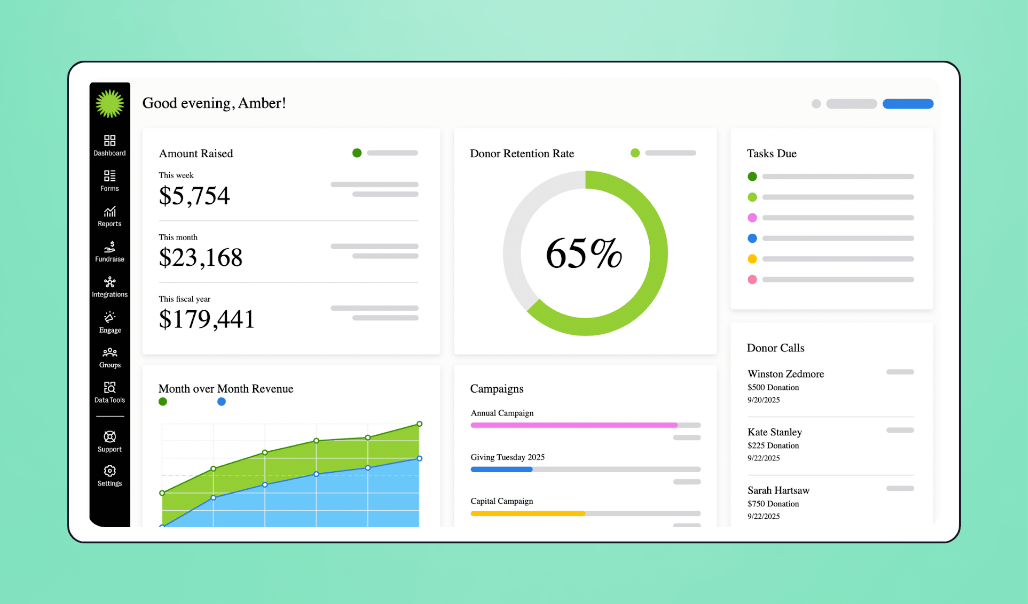
For its first 8+ years, Bloomerang grew organically, sticking close to its clean-sheet CRM designed to improve donor retention. However, after receiving strategic investments from firms like JMI Equity and Warburg Pincus, the company shifted to a “growth-through-acquisition” expansion strategy to compete with all-in-one fundraising platforms.
In 2021, Bloomerang acquired Kindful, adding online fundraising and data integration capabilities. Two years later, it acquired InitLive and rebranded it as Bloomerang Volunteer, bringing volunteer management into the platform.
Then in 2024, Bloomerang acquired Qgiv, adding auctions, peer-to-peer giving, and text-to-give to the mix.

While these features have different origins, Bloomerang has been rebranding and integrating them into a unified giving platform to ensure a consistent interface and a single data source.
Today, Bloomerang markets itself to small and midsize nonprofits seeking a single system to manage donors, fundraising, and volunteers, particularly teams focused on building lasting supporter relationships.

Bloomerang pricing
Bloomerang offers three standalone products, all billed annually with unlimited users:
- Bloomerang Fundraising (starting at $40/month): Includes donation forms, event management, text fundraising, and mobile apps, with optional auctions and peer-to-peer fundraising tools. Must be bundled with Bloomerang CRM to get the full benefits.
- Bloomerang CRM (starting at $125/month): Includes donor management, predictive giving insights, marketing & engagement, reporting & analytics, and data management.
- Bloomerang Volunteer (starting at $119/month): Includes volunteer management, AI-powered scheduling, communication & messaging, screening & verification, and a mobile app for both managers and volunteers.
For nonprofits that want the whole stack, The Giving Platform bundles Bloomerang Fundraising, Bloomerang CRM, and Bloomerang Volunteer into one integrated suite (with an expert support team at your service). Pricing is custom and based on your constituent count, so you'll need to contact sales for a quote.
💡 A quick note: Bloomerang uses constituent-based pricing rather than per-user fees, so your cost scales with the size of your database, rather than the size of your team.
Bloomerang nonprofit CRM reviews: What real users say
We pulled together feedback from across G2, Capterra, and Trustpilot to see where Bloomerang consistently earns praise and where users run into friction. Three themes came up again and again.
1. On ease of use 🧭
Reviews consistently praise Bloomerang for how quickly new users can get up and running. On G2 alone, there were 31 Bloomerang reviews positively mentioning the platform’s ease of use as of April 2026.
For example, Jamiel M., a Resource Development Manager reviewing Bloomerang on G2, described onboarding and implementation as straightforward, citing the platform's intuitive organization and the QuickBooks integration as helpful for keeping records clean.
Angeleah O., an Engagement Services Manager on G2, echoed that sentiment, highlighting constituent timelines and dashboards as useful for understanding donor giving history and engagement.
That said, Angeleah also flagged a few workflow quirks she noticed in the platform:
- New donor automations don't factor in household giving history, so individual donors can be flagged as "new" even when the household has been giving for years. That means one has to manually review the donor data to catch the mismatch.
- Journey Automations rely on the "Relationship Manager" field, which requires her team to migrate data from a custom field to get assignments working properly.
- Journey Automations only work with static Groups, not dynamic ones, which makes it more difficult to manage groups that update frequently (such as recurring donors).
2. On customer support 💬
Support is where Bloomerang reviews are most split. Some users rave about it, while others find it difficult to actually reach someone from support. On the whole, G2 Bloomerang reviews as of April 2026 paint a positive picture, with 15 reviewers mentioning it.
Laura W., a Development Manager on G2, spoke highly of the implementation team during her organization's transition from Blackbaud's Raiser's Edge, mentioning the free training sessions, webinars, and robust API documentation that made integrating her school's SIS straightforward.
Anita S., an Executive Director on G2, shared a similar experience, appreciating both the AI-assisted and human admin support as well as the ongoing onboarding and learning resources.
However, via Trustpilot, Thomas, who has been using Bloomerang for three years now, reported difficulty reaching human support. He described long phone hold times, 24-hour email response windows that sometimes missed the actual question, and a preference within the support team to direct users to web-based training modules rather than live help.
He also felt the written documentation was thinner than he'd expect for a platform at this price point.
3. On fundraising features 🎯
Bloomerang's fundraising tools receive a lot of positive feedback, though a few reviewers noted gaps depending on how they use the platform.
Carol Z., a G2 reviewer, appreciated how simple it is to enter donations and build out constituent profiles, and she found the HubSpot integration useful for tracking which appeals donors had received.
Abi W., an Associate Director of Philanthropy on G2, shared that her team uses Bloomerang Fundraising (formerly Qgiv) for their annual gala, and she loves the ability to combine ticket purchases and silent auction bidding into a single branded site they can personalize year over year.
However, some reviewers noted restrictive email features and difficulty with user permissions. There were nine critical reviews on those specific features on G2 as of April 2026. Capterra also showed similar struggles amongst users.
Kaitlyn S., an Executive Director reviewing on Capterra, praised Bloomerang’s donor engagement and reporting tools for helping her team make more informed fundraising decisions. But she found the email features restrictive for segmented outreach and custom formatting, and said tracking engagement didn't go as deep as she'd hoped.
Philip P., an AVP of IT on G2, raised a different concern around user permissions. He noted that Bloomerang doesn't offer granular permissions tied to specific constituent groups or individual tools, which can be a limitation for nonprofits running multiple campaigns with different team leads.
Who is Bloomerang best for?
Based on the patterns in reviews and independent write-ups across several websites, here are the kinds of nonprofit organizations that Bloomerang is best suited for:
- Small to midsize nonprofits. Organizations that are growing their donor base and are ready to move beyond spreadsheets or legacy databases tend to benefit most. Bloomerang’s CRM stores donor information, maps every interaction and activity to the right record, and keeps things updated automatically.
- Teams without a dedicated data person. Reviewers consistently note how quickly new staff can get up to speed without technical training, which makes it a fit for lean teams where one person wears several hats.
- Organizations that prioritize donor retention over heavy customization. Bloomerang’s intuitive, donor-centric interface is built primarily to help nonprofits retain existing donors, rather than for deep configuration. If your team values simplicity over the ability to rebuild the system from scratch, this platform may be a good fit.
- Nonprofits running standard fundraising programs. Human services, faith-based, education, and community-focused nonprofits are well-represented among satisfied users. But organizations with complex advocacy programs, major-gift-heavy operations, or multi-entity structures usually need more horsepower than Bloomerang provides.
If we had to sum it up into one sentence, we would say: Bloomerang is a good fit for teams that want an intuitive, retention-focused CRM without the overhead of an enterprise system.
Considering a Bloomerang alternative?
If you're a:
- Budget-conscious nonprofit
- A nonprofit that wants a natively integrated platform rather than acquired tools rebranded under one roof
- A team looking for an all-in-one platform without stacking add-on costs, or
- An organization that wants modern fundraising tools as well as a CRM
… Givebutter is a Bloomerang alternative worth considering.
Givebutter is a free, all-in-one fundraising platform built specifically for small to midsize nonprofits that want essential fundraising tools in one place without paying for each module separately.
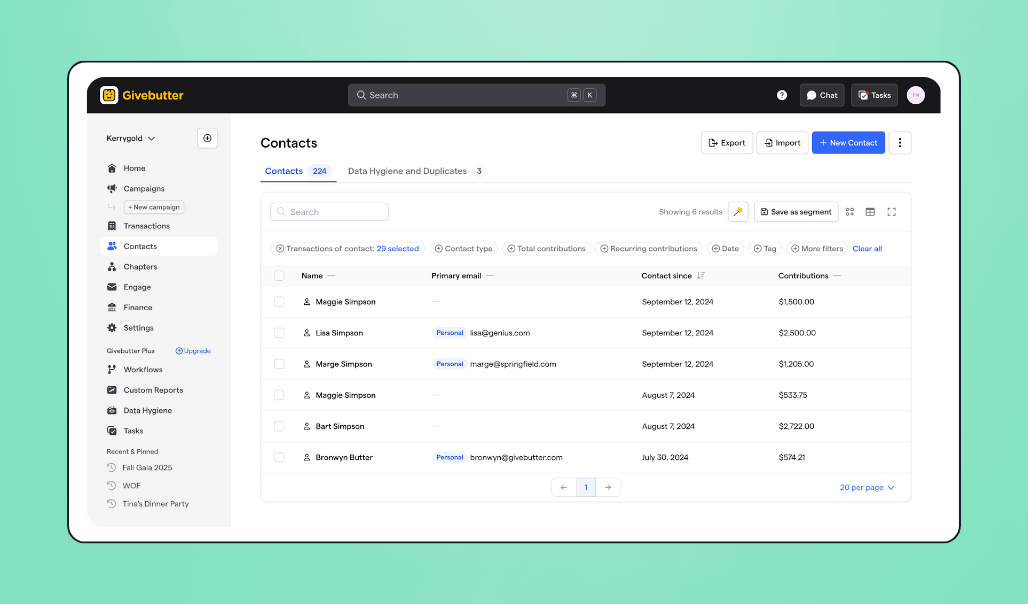
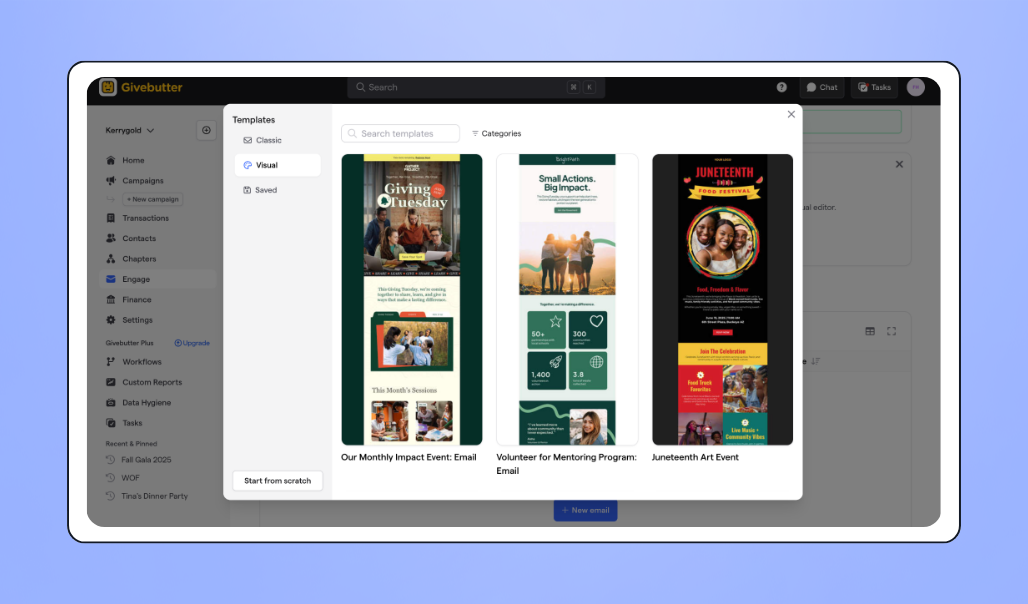
Unlike Bloomerang, which usually starts at $125+/month (since Bloomerang Fundraising has to be bundled with the CRM), Givebutter is free to use with optional donor tips enabled. That gives you access to the core suite of donation forms, fundraising pages, peer-to-peer campaigns, event and auction management tools, text-to-give, email and marketing tools, and a powerful donor CRM at no platform cost.
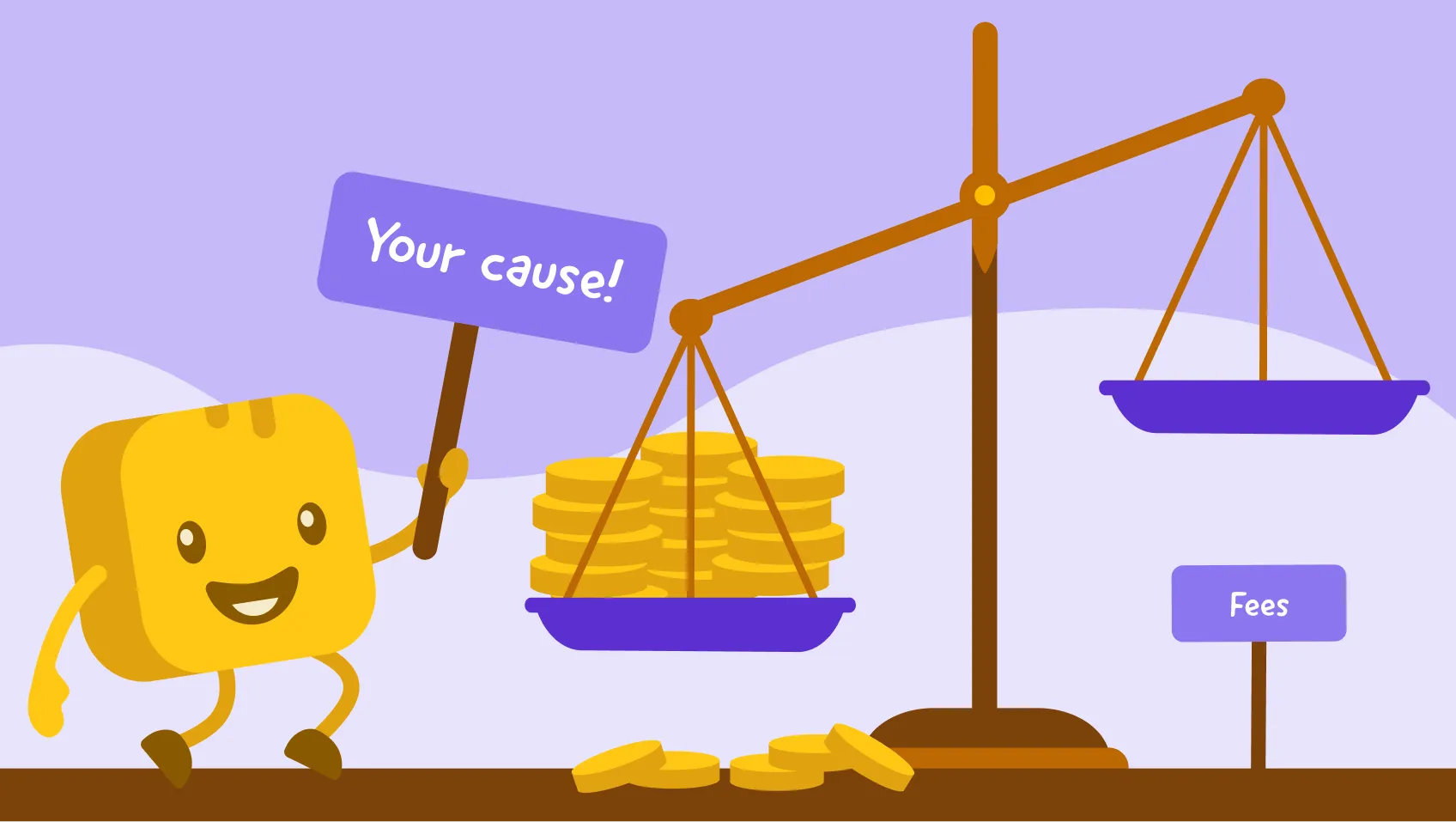
And thanks to the Givebutter Guarantee, if donors don't cover the processing fees, Givebutter will—so your nonprofit keeps every dollar raised.
If you opt to turn off tips, Givebutter charges a flat 3% platform fee on all campaigns, plus standard processing fees. You can choose whether to cover those fees yourself, pass them to donors, or make them optional.
Bloomerang’s cost, especially among smaller nonprofits, is a major reason many organizations switch. Capterra and G2 both had reviews from small nonprofits that stated price as an issue:
Kaitlyn S., the Capterra reviewer mentioned earlier, shared that the cost was too high for her organization's size, so they ultimately had to switch to a different platform.
Sara P., on G2, described Bloomerang as pricey and stated that the executive director does not like the cost, despite it having such essential functionality.
More specifically, companies like Unless U switched from Bloomerang to Givebutter. Marye Grace S., Marketing and Development Director at Unless U, explained:
"We were paying for Bloomerang, and an email tool, and we would also have to pay to outsource ticketing. We ultimately chose Givebutter over other CRMs because it could do everything all in one."
💡 Already on a different CRM or juggling a patchwork of tools?
Switching platforms doesn't have to mean losing your donor history or rebuilding your database from scratch. Givebutter offers self-service import tools alongside Magic Migration services, giving organizations flexible options for moving donor data from supported platforms like Bloomerang.
Making the right call for your nonprofit
By now, you've got a sense of where Bloomerang shines, where it may fall short, and the kinds of organizations that get the most out of it. So you don’t have to scroll through hundreds of G2 threads or piece together opinions from five different review sites. You've got the synthesized version right here.
- If you're exploring alternatives, you can see how Givebutter stacks up against Bloomerang on features, pricing, and ease of use.
- If Givebutter feels like the better fit for your team, you can sign up for a free Givebutter account today. Better fundraising awaits!
FAQs on Bloomerang Reviews
1. Is Bloomerang a CRM or a fundraising platform? 🧩
It’s both, but it started as a CRM. Bloomerang added fundraising, volunteer management, and auction management capabilities by acquiring tools such as Kindful, InitLive, and Qgiv.
However, you’ll need to bundle Bloomerang Fundraising with the CRM to get the full benefit of the platform (which invariably adds to the cost). Platforms like Givebutter combine both a donor CRM and other fundraising tools into a single system and offer it to nonprofits for free.
2. How does Bloomerang compare to DonorPerfect? 🔍
Both are nonprofit CRMs aimed at small to midsize organizations, but they emphasize different things.
Bloomerang centers on donor retention with a clean, beginner-friendly interface, while DonorPerfect leans toward deeper customization, more reporting flexibility, and broader scalability for growing or complex organizations. Their pricing structures also differ.
3. Is Bloomerang used in K-12 schools or for grant management? 📚
Bloomerang is primarily a donor management and fundraising platform, not a dedicated grants management or school administration system.
That said, K-12 schools and educational nonprofits can use it for donor tracking, alumni engagement, and giving campaigns. Bloomerang’s CRM also includes basic grant tracking for organizations managing incoming grant funding, though teams with heavy grant operations usually pair it with a specialized tool.
Share this article








.svg)
.svg)