.svg)
.svg)
.svg)
.svg)
.svg)
.svg)
.svg)
.svg)
.svg)


.svg)
.svg)
.svg)
.svg)
.svg)
.svg)
.svg)
.svg)

.svg)
.svg)
.svg)

.svg)

.svg)
.svg)
.svg)
.svg)
.svg)


.svg)
.svg)
.svg)
.svg)
.svg)
.svg)
.svg)




.svg)



%20(1).png)

Email inboxes are crowded, social feeds move quickly, and even your most loyal supporters can miss an important fundraising appeal. A phonathon gives your nonprofit a more personal way to reconnect—but a successful campaign takes more than handing volunteers a script and asking them to start dialing.
You need accurate donor information, thoughtfully targeted call lists, confident callers, and a reliable way to record every conversation and pledge. Without that preparation, even the strongest script can fall flat.
This guide walks you through how to plan and run a successful phonathon from start to finish. You’ll learn how to identify the right donors, prepare and train your callers, write a flexible script, organize calling shifts, manage pledges, and follow up after the campaign. You’ll also get free phone scripts and real campaign examples to help your team turn calls into stronger donor relationships—and more support for your mission.
Key takeaways
- Start with supporters who know you 📞 Phonathons are better suited to existing donors, alumni, members, and other warm audiences than cold prospects.
- Preparation builds caller confidence 📋 Giving history, donor notes, mission updates, and responses to common objections help callers have more natural conversations.
- Segment before you dial 📊 Organize your list by giving history and relationship to your organization so each caller can make a relevant, personalized ask.
- Record every call outcome 📝 Log pledges, unanswered calls, wrong numbers, donor preferences, and follow-up requests while the information is still fresh.
- Treat follow-up as part of the campaign 💛 Prompt thank-yous, pledge reminders, and impact updates can help turn one conversation into a stronger donor relationship.
What is a phonathon?
A phonathon is an organized fundraising campaign in which staff members or volunteers call a targeted list of supporters to request donations, secure pledges, or invite donors to give monthly.
Sometimes written as “phone-a-thon” or “phoneathon,” this fundraising format gives nonprofits an opportunity to raise money while having personal conversations with donors. Although phonathons can cost less than events or direct mail campaigns, they still require careful planning, trained callers, accurate donor data, and consistent follow-up.

Are phonathons still effective?
Yes, especially when callers contact people who already know and support your organization, such as previous donors, alumni, members, families, or faith communities. A familiar voice and personalized conversation can help your appeal stand out from the emails, letters, and social posts supporters receive.
Before organizing a phonathon, weigh what it could add to your fundraising strategy against the time and coordination it requires:
How to run a successful phonathon in 6 steps
These six steps combine practical phonathon strategies and best practices to help you organize your campaign from the initial plan to the final thank-you.
1. Set your goal & build your call list 📊
Start by deciding what you’re raising money for, whom you’ll contact, and how you’ll measure success. Set a clear fundraising goal, then identify any additional outcomes you want to track, such as pledges secured, completed conversations, updated contact information, and follow-up requests.
Next, build a clean, accurate, and targeted call list. Instead of calling every person in your database, prioritize supporters who already have a relationship with your organization:
- LYBUNTs: Donors who gave last year but haven’t yet given this year may welcome a personal reminder about the impact of their past support.
- Lapsed donors: Supporters who haven’t given in two or three years may be open to reconnecting and hearing what’s changed since their last gift.
- Alumni and long-term supporters: People with an established connection to your school, faith community, or nonprofit can be strong candidates for a phonathon.
- Recurring gift prospects: Donors who give consistently may be interested in making their support monthly or increasing their usual contribution.
Divide your list into manageable segments based on giving history, relationship, campaign participation, or other relevant details. Then, create a caller prep sheet that includes each donor’s name, contact information, previous gifts, connection to your mission, and relevant notes. Remove anyone who has opted out of phone outreach, and establish a clear process for honoring new requests.
💡 Pro tip: Givebutter’s donor segments help you identify groups such as LYBUNTs, recurring donors, and supporters who gave during a specific period. You can review their giving history or export a filtered list to prepare for your calls.
2. Write your phonathon script 📄
A strong phonathon script gives callers structure without making every conversation sound rehearsed. Include these five elements:
- Personal introduction: Use the donor’s name, introduce yourself and your organization, and reference their connection to your mission when appropriate.
- Mission update: Share one timely milestone, story, or result that shows what your organization is accomplishing.
- Specific ask: Connect a suggested donation amount to a tangible outcome. When appropriate, you can also anchor the request to the donor’s previous support: “Would you consider renewing your $50 gift this year?”
- Responses to common objections: Prepare callers for responses such as “I need to think about it,” “I can’t give right now,” or “Please send me more information.” Give them respectful ways to continue or close the conversation.
- Clear next step: Thank the donor for their time and explain what will happen next, whether that’s an emailed fundraising page, a pledge payment link, or no further contact.
💡 Phonathon caller tip: Treat the script as a conversation guide, not something callers must read word for word. Encourage them to listen, respond naturally, and never pressure someone who declines.

3. Train your callers 🎓
Even an excellent script can’t replace thoughtful preparation. Before the phonathon begins, hold a training session that covers:
- Practice conversations: Use role-playing to help callers become comfortable making the ask, answering questions, and responding to common objections.
- Mission knowledge: Give callers one or two recent stories, milestones, or examples of impact they can comfortably share in their own words.
- Donor context: Show callers how to review the prep sheet and reference donor information naturally without making the conversation feel overly scripted.
- Voicemail and rejection: Practice leaving a short voicemail, responding graciously when someone declines, and ending uncomfortable conversations respectfully.
- Call outcomes: Explain how to record pledges, unanswered calls, wrong numbers, follow-up requests, and communication preferences consistently.
Remind callers that unanswered calls and declined requests are a normal part of phone fundraising. Regular encouragement, breaks, and opportunities to ask questions can help them stay confident.
4. Organize your calling shifts 📞
Plan the length and number of shifts around your call list, campaign timeline, and available callers. Shorter, focused shifts may help callers maintain their energy and give each conversation the attention it deserves.
For every shift, prepare:
- A clear assignment: Give each caller a specific list or donor segment so contacts aren’t called twice.
- A pre-call checklist: Ask callers to open their script, donor information, call-outcome tracker, and pledge log before dialing.
- A shift lead: Assign someone to answer questions, troubleshoot problems, and check that outcomes are recorded consistently.
- Shared tracking: Establish standard outcomes such as answered, no answer, voicemail left, pledged, donated, declined, wrong number, and follow-up requested.
- A short debrief: Review pledges, unresolved questions, donor updates, and follow-up tasks at the end of each shift.
💡 Pro tip: Celebrate meaningful milestones, such as the first pledge of the shift, a renewed lapsed donor, or a valuable conversation. Success isn’t limited to the amount raised.
5. Record & manage pledges 📝
Record every pledge as soon as possible after the call, including the donor’s name, pledged amount, intended fulfillment date, and any relevant notes. A consistent process prevents commitments and important details from getting lost between shifts.
With Givebutter, an authorized team member can create and track each pledge from the dashboard, send the donor a secure payment link, and enable automatic reminders before upcoming fulfillment dates. If callers use paper logs or a separate tracker, designate one person to add those pledges to Givebutter after every shift.
6. Follow up after the phonathon 💛
A phonathon doesn’t end when callers put down their phones. Thoughtful follow-up can help you fulfill outstanding pledges, retain donors, and continue the relationships your callers started.
Tailor the next step to the outcome of each call:

3 phonathon fundraiser examples to learn from
Phonathons can take many forms, from annual school campaigns to radio fundraisers and participant-led outreach. These real-world phonathon ideas show how matching gifts, community partnerships, and personal networks can help organizations like yours reach their goals.
1. Call-A-Thon 2026: An anniversary campaign with a $45K match 📚
First Presbyterian Academy celebrated the 10th anniversary of its annual Call-A-Thon by raising money for campus projects that support student safety, academics, athletics, fine arts, and technology.
An FPA family matched the first $45K donated, helping the school raise more than $106K from 163 supporters and exceed its $100K goal.
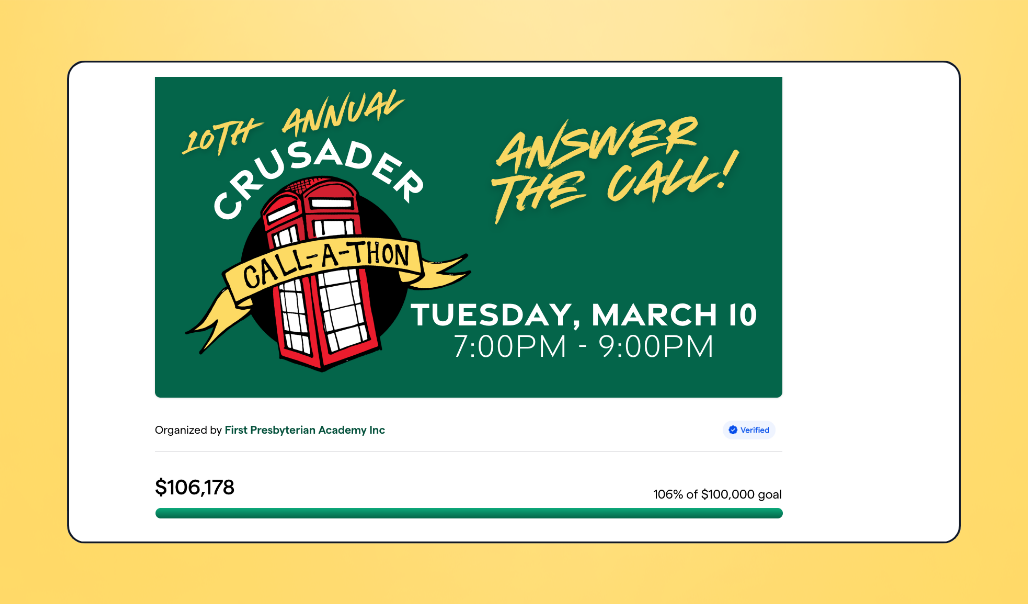
💸 Raised: $106K+
⭐ Best for: Schools with an established community of families, alumni, and supporters
💛 What nonprofits can borrow: Combine a matching gift with a milestone anniversary and clearly explain the projects each donation will support.
2. Phonathon for Hope: A 12-hour radio fundraiser 📻
His House of Hope partnered with 98Q Country for a 12-hour phonathon featuring 18 community voices, a silent auction, and updates broadcast throughout the day.
Supporters could call, message the radio station, or comment during a Facebook Live broadcast to participate. With donations matched up to $10K, the campaign raised more than $18K from 58 supporters and reached 120% of its $15K goal.
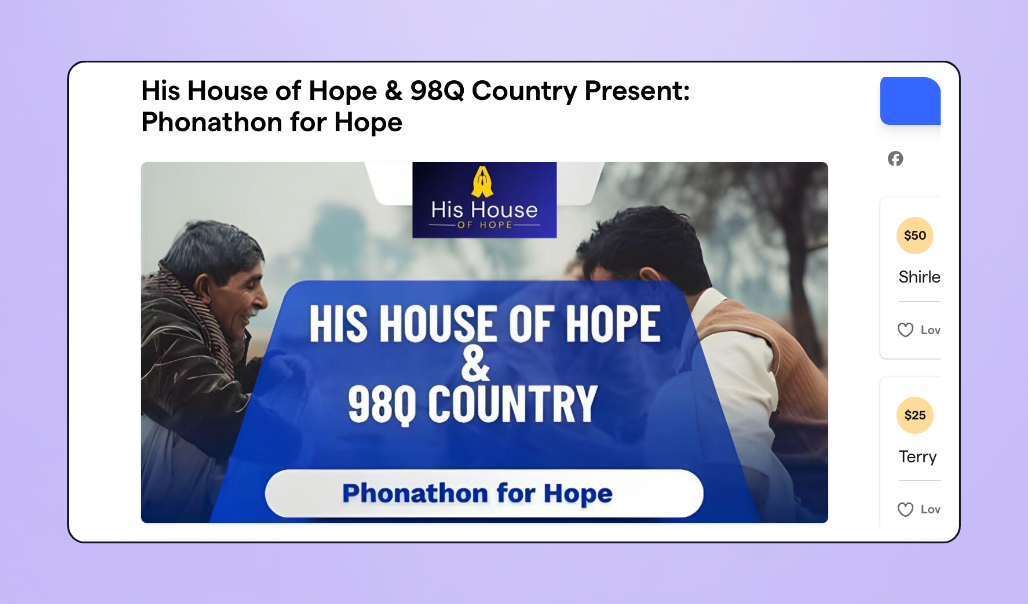
💸 Raised: $18K+
⭐ Best for: Faith-based and community nonprofits with local media or business partners
💛 What nonprofits can borrow: Create a focused campaign window, invite trusted community members to share why the mission matters, and give supporters several ways to participate.
3. 4th & Goal Fundraiser: Players reaching their personal networks 🏈
For its 4th & Goal Fundraiser, Red Land Football asked players to contact friends and family by phone and social media. The campaign raised money for seasonal expenses such as game-day meals, team events, and player gear.
By combining personal calls with social sharing, the team reached 358 supporters, raised more than $18K, and achieved 124% of its $15K goal.
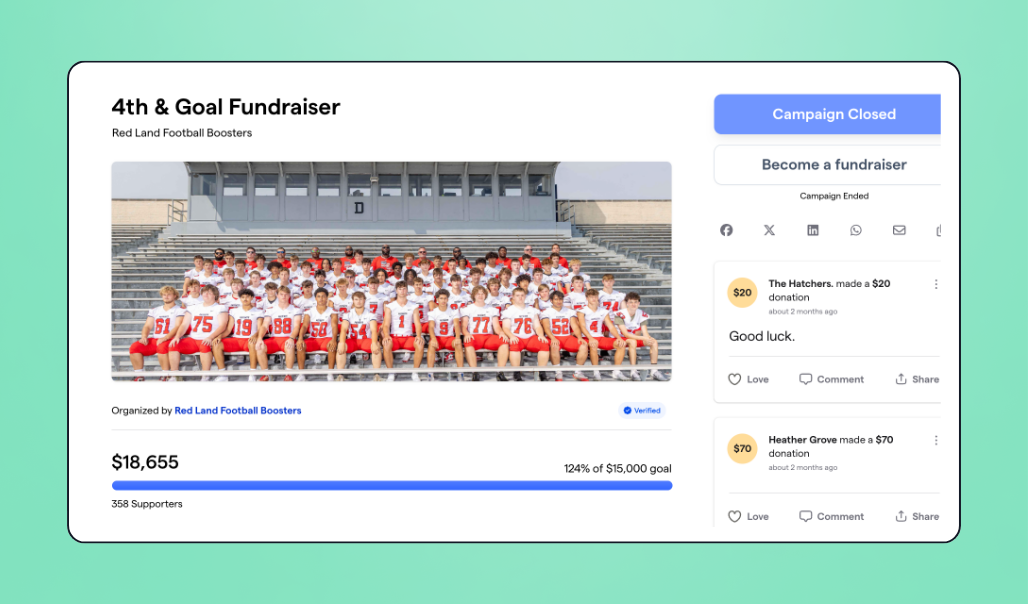
💸 Raised: $18K+
⭐ Best for: School athletic programs, booster clubs, and youth sports organizations
💛 What nonprofits can borrow: Give each participant a clear role and encourage them to pair personal phone calls with social outreach to reach more of their existing network.
Run a stronger phonathon with Givebutter
A successful phonathon doesn’t end when the final caller hangs up. Every conversation can give your organization valuable information about a donor’s interests, communication preferences, and connection to your mission. Keeping those details organized helps your team fulfill pledges, follow up thoughtfully, and make the next interaction more personal.
Givebutter brings every part of that process together. Use the CRM to create targeted call lists, review giving histories, and keep donor notes in one place. Record and track pledges, share a fundraising page where supporters can complete their gifts, and use nonprofit marketing tools to send personalized emails and letters after the campaign.
Instead of piecing together spreadsheets, call notes, pledge logs, and communication tools, your team can spend less time managing information and more time strengthening donor relationships.

Organize your phonathon with Givebutter’s nonprofit CRM
Sign up for your free Givebutter account and start building your next phonathon campaign today.
FAQs about phonathon fundraisers
How long should a phonathon last?
There’s no required length. A phonathon may take place during one focused day, over a weekend, or through several calling shifts spread across a few weeks. Choose a timeline based on the size of your call list, the number of available callers, and your fundraising goal.
What’s the difference between a phonathon and a telethon?
A phonathon centers on callers directly contacting individual supporters. A telethon is typically a live television, radio, or streaming event that encourages a broader audience to call in or donate. Some fundraisers combine elements of both, such as pairing donor calls with a live radio broadcast.
What tools do you need to run a phonathon?
At minimum, you’ll need an accurate donor list, a flexible call script, a way to record call outcomes, a system for tracking pledges, and a fundraising page where supporters can complete their gifts. A nonprofit CRM can keep those details together and make personalized follow-up easier.
How should you measure phonathon success?
Track more than the total amount raised. Useful phonathon metrics include calls completed, donors reached, donations received, pledges secured and fulfilled, updated contact details, follow-up requests, and communication preferences. Reviewing these results can help you improve future calling campaigns.
Share this article





.svg)
.svg)