.svg)
.svg)
.svg)
.svg)
.svg)
.svg)
.svg)
.svg)
.svg)


.svg)
.svg)
.svg)
.svg)
.svg)
.svg)
.svg)
.svg)

.svg)
.svg)
.svg)

.svg)

.svg)
.svg)
.svg)
.svg)
.svg)


.svg)
.svg)
.svg)
.svg)
.svg)
.svg)
.svg)






.svg)



%20(1).png)

⚖️ Disclaimer: This article is for informational purposes only and does not constitute legal or tax advice. Nonprofits and donors should consult a qualified professional about their specific situation.
Donor-advised funds have become a go-to way for many donors to give back. However, for nonprofits, they can feel like a bit of a mystery. While there are often donations set aside with the best of intentions, it's not always clear when (or how) those dollars will actually start flowing as grants.
The good news is that DAFs don't have to be a complete mystery. Where they've historically been harder to manage and slower to turn into grants, new tools and best practices are making it easier than ever for nonprofits to connect with DAF donors and stay on their radar when grant time rolls around.
In this guide, we'll break down how donor-advised funds really work, the rules and tax benefits that donors care about, and some practical ways nonprofits can turn DAF interest into reliable, on-time support.
Key takeaways
- Donor-advised funds (DAFs) are on the rise 📈 DAFs are a fundraising vehicle increasing in popularity with donors, especially for large or legacy gifts.
- DAFs offer tax benefits for donors 💰 Donors can access tax advantages by giving through a donor-advised fund rather than a traditional one-time donation.
- Nonprofits have valid concerns about DAFs 💭 Some organizations worry about a lack of immediate funds while they wait for future DAF donations to materialize.
- Donor stewardship is essential 💚 Assigning soft credit to individuals helps nonprofits track DAF donors and continue stewardship.
- Encourage more DAF giving with Givebutter 🧈 Simplify the donor data and stewardship side while offering donors an easier way to give through DAFs.
What is a donor-advised fund?
A donor-advised fund (DAF) is a charitable giving account owned and operated by a tax-exempt sponsoring organization. Donors contribute assets to the fund, receive an immediate tax deduction, and then advise the sponsor on how those funds should be invested and distributed to nonprofits over time.
While donors play an important advisory role, the sponsoring organization is the legal owner of the assets and has final authority over all grants and investments.
In practice, several parties may be involved in a DAF arrangement:
- The sponsoring organization 🏦 A 501(c)(3) public charity that owns, manages, and controls the fund
- The donor (or donor-advisor) 💰 The individual or family who contributes assets and recommends grants
- Related persons or advisors 📋 In some cases, family members or investment advisors who may have advisory privileges and are treated as “disqualified persons” under IRS rules (a technical tax term that limits personal benefit)
⭐ Good to know: Donors can recommend grants, but they cannot legally direct or obligate the fund. Final control always rests with the sponsoring organization.
How do donor-advised funds work?
Donor-advised funds are rising in popularity, but they’re still widely misunderstood. Here’s how DAFs work in three straightforward steps.
Step 1: Donors contribute assets 💰
Donors decide what to give to their DAF. This can include cash, stocks, real estate, or cryptocurrency. Some sponsors set minimum contribution requirements, but many can be opened with relatively small amounts, especially workplace giving DAFs.
Donors receive an immediate tax deduction when they contribute to the DAF, not when funds are later granted to a nonprofit.
Step 2: Funds are invested inside the donor-advised fund 🏦
When it comes to investing, DAFs allow donors to choose the level of volatility they’re comfortable with and the type of portfolio they prefer (such as stocks or bonds) over time.
It’s important to note that all DAF contributions are irrevocable, meaning donors can’t reclaim the funds.
Step 3: Donors recommend grants to nonprofits 🎉
Either immediately or in the future, donors can recommend grants to a nonprofit recipient. Some sponsoring organizations encourage giving to affiliated causes (such as a university or community foundation), while others offer donors more flexibility.
Because sponsor policies vary, it’s important to let supporters know that your organization accepts DAF donations and how they can contribute.
Types of DAF sponsors
Most donor-advised funds fall into three broad categories of sponsors. The differences matter for nonprofits because they can affect grant timing, flexibility, and donor behavior.
- National commercial DAF sponsors 🏦The charitable arms of large financial institutions (such as Fidelity Charitable, Schwab Charitable, and Vanguard Charitable). These sponsors typically offer broad flexibility in where donors can give and often process grants quickly.
- Community foundations 🏘 Place-based public charities that manage donor-advised funds alongside other philanthropic programs. While community foundation DAFs still grant significant funds each year, the pace and priorities of grantmaking can vary based on local focus, donor intent, and investment approach.
- Independent or mission-aligned DAF sponsors 🔦 National public charities that sponsor DAFs outside of a single geographic area and may emphasize specific philanthropic values or approaches (for example, donor education, impact, or access). These sponsors are not necessarily limited to one issue area.
⭐ Good to know: Research shows that payout rates vary by sponsor type and methodology. Community foundation DAFs tend to have lower average payout rates compared to national commercial sponsors, but still distribute significantly more annually than private foundations.
Some newer or donation-processor-style sponsors show especially high payout rates. Differences depend on how payout is measured (median vs. aggregate) and the sponsor’s structure. In short: where a donor holds their DAF can influence how quickly funds reach nonprofits.
Donor-advised fund rules & restrictions nonprofits should know
Because of their tax advantages, DAF grants are subject to specific restrictions. In general, donor-advised funds cannot be used to:
- Provide personal benefits to donors or related individuals (such as event tickets, memberships, auction items, or raffle entries)
- Support political campaigns or lobbying organizations
- Fund individuals directly (including personal crowdfunding campaigns or scholarships earmarked for specific people)
- Make grants to non-charitable or non-qualified recipients without proper sponsor oversight
- Receive Qualified Charitable Distributions (QCDs) from IRAs—QCDs must be made directly from the IRA to an eligible public charity, not to a DAF sponsor
⭐ Good to know: Sponsors may allow grants to certain non-U.S. or fiscally sponsored entities, but only when charitable use can be verified, and compliance requirements are met.
Donor-advised fund tax benefits & deduction limits
DAFs are popular in part because they allow donors to separate the tax moment from the grantmaking moment, but deduction rules still depend on asset type and context.
- Cash contributions: Donors may generally deduct cash gifts to DAF sponsors (which are public charities) up to a percentage of their adjusted gross income (AGI), subject to annual IRS limits and other charitable contributions made that year.
- Appreciated assets: Donations of assets like stocks or cryptocurrency are often deducted at fair market value and are typically subject to lower AGI percentage limits than cash, but may avoid capital gains tax.
- Bunching strategy: Many donors use DAFs to “bunch” multiple years of giving into a single high-income year for tax purposes, then recommend grants to nonprofits over time.
⭐ Good to know: Deduction limits vary based on asset type, recipient classification, and the donor’s broader tax situation. Donors should consult a qualified tax advisor when making large or complex gifts.
Donor-advised funds vs. foundations
DAFs and private foundations are both engines for philanthropic giving, but there are several key differences:
- Speed of grant-giving ⏱️ It’s typically faster to establish a DAF than a charitable foundation, making DAFs the preferred option for immediate or urgent giving.
- Flexibility ⚖️ Foundations often center on a core mission, which can limit flexibility when making grants to nonprofits outside that scope.
- Control 🔑 Donors can advise where DAF contributions are granted, but foundations generally offer donors a greater level of control.
- Reporting 📄 Foundations are separate legal entities and come with more extensive regulatory and reporting requirements. With DAFs, the sponsor handles all administrative responsibilities, not the donor.
- Payout expectations 📋 Private foundations are bound by a mandatory 5% minimum annual payout rule, which doesn’t apply to DAFs.
- Ease of giving 💚 Donors can typically make grants more easily through a DAF, whereas foundations may require letters of inquiry or formal grant applications.
For donors seeking a fast, straightforward way to support nonprofits, a donor-advised fund is often the most appealing option. Donors focused on legacy or multi-generational philanthropy commonly choose private foundations, where speed and simplicity are less critical.

Why are DAFs important for nonprofits?
Donor-advised funds can be an effective way for individuals to manage their charitable giving and make sizable donations to causes they care about, which is why they’re gaining popularity among donors. But what are the benefits for nonprofits?
- Increased funding driven by DAF growth 📈 Grantmaking through DAFs has risen significantly in recent years, totaling $64.89B in 2024, up from $54.77B in 2023.
- Simpler philanthropy 🧲 Individuals who may not have previously considered philanthropy can establish a DAF more easily than a foundation, opening the door to new funding sources for nonprofits.
- More diverse asset types 🎁 Through DAFs, nonprofits can receive more than just cash or checks, including stocks and cryptocurrency.
- Sustainable, predictable funding 💸 Some DAF donors provide nonprofits with reliable, long-term support through planned giving.
Donor-advised funds are a nonprofit funding source that organizations can no longer afford to overlook. At the same time, grants don’t always come through immediately, so nonprofits may wait years for relationship-building to pay off.
Who are DAF donors?
Through a donor-advised fund, individuals can access tax benefits while taking more time to decide where their charitable dollars should go. DAFs are especially popular with donors who want to:
- Receive immediate donor-advised fund tax deductions
- Grow nonprofit contributions through investment
- Facilitate planned giving now and into the future
- Avoid the cost and administrative burden of starting a private foundation
- Give anonymously
⭐ Good to know: DAF donors have historically skewed older, with the average donor age around 62, but that number continues to trend downward each year. Today, DAFs appeal to a broader audience interested in using both cash and non-cash assets for planned giving now and legacy giving later.
Donor-advised funds pros & cons
As with any charitable giving vehicle, DAFs come with both positives and negatives, including ease of use and public perception. Here’s what nonprofits should understand before promoting DAFs as a giving option.
Benefits of donor-advised funds
- Fee-free for grant recipients: Nonprofits typically do not pay donor-advised fund account or investment fees themselves.
- Growth potential: DAF assets can appreciate over time, enabling donors to give more.
- Tax advantages: Donor-advised fund tax benefits rank among the most compelling incentives to contribute, especially for high-dollar donors.
- Higher payout rates: DAF grant payout rates are three to six times higher than those of private foundations, making them attractive to donors who want to put their funds to good use.
- Administrative support: Sponsoring organizations manage investing and grant processing, which simplifies planned and legacy giving for donors.
Donor-advised fund disadvantages
- Less transparency: DAFs often limit nonprofits’ access to individual donor information, making donor stewardship more challenging than with direct giving.
- No payout requirements: The IRS doesn’t require DAFs to make any annual donations, compared to the minimum annual giving mandated for foundations.
- Longer donation process: There’s less friction in the giving process now, but DAFs previously earned a reputation for slow, complicated processes.
- Lack of donor awareness: Many donors still aren’t aware that giving through a DAF is an option, creating a need for education and awareness-raising.
- Potential impact on regular giving: Some nonprofit professionals fear that donors who give through DAFs may be less inclined to continue making direct donations.
How to get started with DAF fundraising
With more donors considering DAFs than ever before, it’s time for nonprofits to take a more proactive approach. Here’s how to build a DAF strategy that raises awareness, promotes giving, and prioritizes stewardship.
1. Promote DAF fundraising as an option for donors
Many donors don’t understand how donor-advised funds work, or whether your organization accepts DAF donations. It’s crucial to promote DAFs as a viable way to give.
- Make it easy to find 👀 Include a DAF donation option on your fundraising forms, donation pages, and website widgets.
- Inform your team 👋 Educate staff on what DAFs are and when they’re appropriate so they can confidently explain the benefits to donors.
- Promote through multiple channels 📣 Use direct mail, social media, email, text messaging, and in-person events to show supporters how to give through a DAF.
Once your audience understands that donor-advised funds are an option and how they work, they’ll be more likely to consider them for future contributions.
2. Explain the different ways donors can use their DAFs
Beyond promoting DAFs as a giving option, nonprofits should clearly communicate how and when donors can use them most effectively.
- Encourage gifts of complex assets 💸 Explain that donors can use DAFs to give cryptocurrency, stocks, and other non-cash assets.
- Promote recurring donations 📆 Let donors know they can use a DAF to fund recurring gifts.
- Highlight urgent appeals ⚡ Prompt donors to use their DAF when urgent needs arise, so idle funds can be put to good use immediately.
- Emphasize year-end giving 💰 Many donors are eager to maximize tax benefits, so position DAFs as a strong option in your year-end giving campaigns.
Nonprofit pros have told us that donors often aren’t thinking about DAFs until you mention them. Continue raising awareness through relevant appeals throughout the year, but especially at year-end.

3. Connect with sponsoring organizations
Building relationships with potential sponsors can help put your organization on their radar, so you’re top of mind when grantmaking decisions happen.
- Make local connections 🤝 Meet with local community foundation representatives and sponsoring organizations so they’re familiar with your mission and work.
- Build relationships over time 💚 Intentionally cultivate genuine, long-term relationships with sponsors rather than reaching out only when funding is needed.
- Establish credibility 💪 Keep your nonprofit’s information updated on websites that DAF providers use to verify eligibility, like GuideStar and Charity Navigator.
Although donors can make grant recommendations, it’s sponsors that have the final say, so raising your awareness with them should be a priority.
4. Make it easy for donors to give
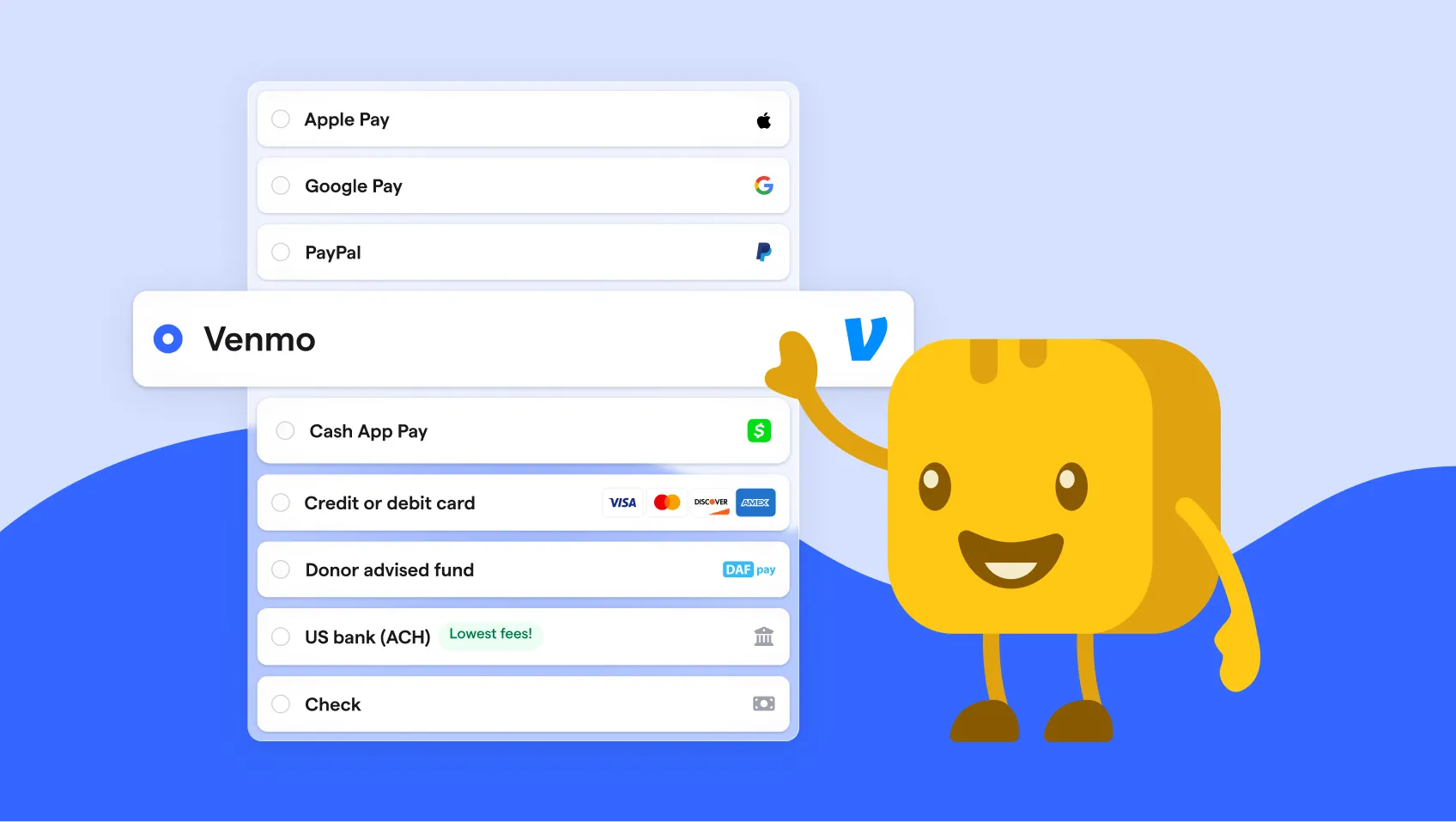
Donors are used to giving quickly and easily with credit cards, Apple Pay, and Google Pay. They’re looking for a similarly simple experience when giving through a DAF.
- Include DAF giving as an option wherever you can 💲 Promote DAFs on donation forms and fundraising pages, rather than burying them elsewhere on your website.
- Provide essential information ✔️ Donors will need details like your Federal Employer Identification Number (EIN) and legal name, so make this information clearly visible on your website.
- Use software that simplifies DAF giving 🧰 Choose a fundraising platform like Givebutter that allows you to accept DAF donations with minimal friction.
Raising awareness is only half the battle. A smooth, straightforward DAF giving experience is far more likely to win over potential donors.

Start accepting DAF donations with Givebutter
5. Prioritize donor stewardship
Like any donation method, you should express gratitude for every charitable contribution made through a donor-advised fund.
- Thank donors for their grants 💛 Go beyond an automated acknowledgement and send a personalized thank-you message to the individual donor when possible.
- Attribute soft credit 📋 Assign the hard credit to the sponsoring organization, but don’t forget to give soft credit to individual donors. For example, the grant is recorded under Fidelity Charitable for reporting, but the donor who recommended it receives soft credit in your CRM.
- Continue to build relationships with donors 🎉 Share thoughtful, relevant messages that keep DAF donors engaged and invested in your mission between grants.
Strong relationships with sponsor organizations matter, but fostering loyalty and connection with donors is what ultimately leads to sustained support.
Make DAF giving easy with Givebutter
Donor-advised funds continue to grow in popularity, offering donors a flexible way to provide recurring or legacy funds. With a strong strategy, proper knowledge, and the right tools, nonprofits can make the most of DAF giving.
You can customize every Givebutter fundraising page, donation form, campaign, and widget to accept DAF donations in just a few steps. Donors enjoy a seamless giving experience, while nonprofits gain access to donor tracking, messaging, and stewardship tools, all in one place.
⭐️ Sign up for Givebutter today to make DAF giving easier than ever before.
FAQs about donor-advised funds for nonprofits
Can donor-advised funds be used to fulfill pledges or event commitments?
Yes, in most cases. A donor-advised fund can be used to fulfill a pledge or event commitment as long as the pledge is made by the individual, not the DAF. The donor can’t receive any personal benefits in return, like event tickets or meals. Because rules vary by DAF sponsor, it’s best to confirm before accepting the grant.
Why do some donor-advised fund grants arrive without donor information?
Some donors choose to give through their DAF anonymously. When that happens, donor details may not populate in your donor management software. In other cases, missing information may result from a technical error on the sponsor’s end or because the sponsor doesn’t share donor details by default.
How do nonprofits acknowledge & receive donor-advised fund gifts correctly?
Receipt the sponsoring organization as the legal donor, and thank the individual donor when you have their info. This confirms receipt and gives you a chance to build a relationship with them.
Givebutter simplifies this step with built-in donor engagement and marketing tools, including the ability to send personalized thank-you messages.
Can donor-advised funds make recurring or multi-year grants?
Yes, donors can use DAFs to make recurring or multi-year grants. Some individuals choose to contribute a larger amount to their fund in one year, then recommend grants over time to fund nonprofit organizations.
Can a donor use a donor-advised fund to support a new or related nonprofit?
Yes, donors can use a DAF to support a new or related nonprofit, as long as the receiving organization qualifies as a 501(c)(3) nonprofit or public charity.
Share this article








.svg)
.svg)