.svg)
.svg)
.svg)
.svg)
.svg)
.svg)
.svg)
.svg)
.svg)


.svg)
.svg)
.svg)
.svg)
.svg)
.svg)
.svg)
.svg)

.svg)
.svg)
.svg)

.svg)

.svg)
.svg)
.svg)
.svg)
.svg)


.svg)
.svg)
.svg)
.svg)
.svg)
.svg)
.svg)





.svg)



%20(1).png)

Workplace giving is supposed to feel good, but sometimes it just feels awkward.
Employees want to support causes they care about without pressure, guilt, or complicated systems. Employers want to get involved but aren’t always sure which programs are effective or how to implement them responsibly. At the same time, nonprofits know there’s real potential in workplace giving, even if tapping into it can feel daunting.
The good news? Workplace giving doesn’t have to be clunky, coercive, or limited to an annual campaign. With the right program model and tools, it can be a flexible, meaningful way for employees to give back while helping organizations build sustainable, long-term support.
In this guide, we break down how workplace giving really works, the most common program types to know, and real examples you can learn from to help you build something people genuinely want to participate in.
Key takeaways
- Design giving programs around values 🌳 The strongest workplace giving programs align with company values and community impact, not participation quotas.
- Think beyond matching gifts 🌐 Payroll giving, volunteer grants, stipends, and time-bound campaigns all play a role in modern workplace giving.
- Make it easy with the right tools 🧰 Simple, flexible platforms reduce friction for employees, employers, and nonprofits alike.
- Employee choice drives participation 💛 Optional, transparent, choice-driven programs build trust and support long-term engagement.
- Learn from what’s already working 💭 Leading companies show that workplace giving can scale without pressure or complexity.
- Centralize giving with Givebutter 🧈 Run matching gifts, campaigns, and donation flows in one place, without expensive or rigid CSR software.
What is workplace giving?
Workplace giving occurs when employees support nonprofits through programs connected to their employer, such as donation matching, payroll giving, volunteer grants, or paid time off to volunteer.
In most cases, employees choose how to participate, while employers help facilitate or amplify that impact. Some companies also contribute directly by matching donations, funding volunteer hours, or offering charitable stipends.
When done well, workplace giving creates a simple, shared system that enables employees and employers to support causes aligned with their values.
How does workplace giving work?
Workplace giving channels support (either monetary or in-kind) from businesses to nonprofits, with employees initiating or directing those contributions.
- For employers 🏢 Offer and manage workplace giving programs, process requests, and follow through on donations, matches, or volunteer support.
- For employees 🙋♀️ Choose whether to participate, select from employer-sponsored programs (such as matching gifts or payroll giving), and support nonprofits they care about.
- For nonprofits 💛 Participate in workplace giving platforms or partner directly with companies, receive donations or in-kind support, and share opportunities for employee involvement.
When each group plays its part, workplace giving becomes straightforward and impactful for everyone involved.
The benefits of workplace giving
Workplace giving is an effective way for companies to give back to their community. Not only that, but it offers meaningful benefits for employers, employees, and nonprofits alike.
Benefits for employers 🏢
Employee giving campaigns help strengthen company culture and position the organization as a desirable place to work. Running workplace giving programs can:
- Attract top talent
- Increase employee engagement
- Boost employee retention
🧠 Did you know? The strongest programs are transparent and voluntary, designed to invite participation rather than pressure it. That trust is what turns workplace giving into a long-term culture benefit instead of a checkbox initiative.
Corporate social responsibility (CSR) initiatives are one of the most effective ways for businesses to demonstrate that caring about the world around them is integral to their company culture and values. Employers can then add workplace giving programs alongside other forms of support, such as volunteer opportunities, corporate donations, and pro bono work.
Benefits for employees 💼
Workplace giving campaigns also offer meaningful benefits for employees. Taking part in employer-led charitable giving can:
- Reduce taxable income (as long as contributions go to a registered 501(c)(3) nonprofit
- Support recurring giving with minimal ongoing effort
- Help individuals align their charitable values with their work
🧠 Did you know? When workplace giving is optional and flexible, it can actually reduce friction around charitable giving rather than adding to it. For individuals who want to give, participating through their workplace can make donating easier and more impactful, especially if their employer offers donation matching.
Benefits for nonprofits 💛
Workplace giving programs can offer substantial benefits for charitable organizations. In fact, nonprofits raise around $5B annually through workplace giving. Beyond direct financial or in-kind support, additional benefits include:
- More consistent and reliable revenue streams
- Stronger, long-term partnerships with local businesses and larger corporations
- Improved ability to forecast incoming funds and confidently plan future programs
Because many workplace giving programs use automatic payroll deductions, nonprofits can receive consistent, year-round support instead of relying on one-time fundraising campaigns or annual events.
🧠 Did you know? A significant portion of workplace giving funds go unclaimed each year simply because donors aren’t aware that their employer offers matching gifts or volunteer grants. By proactively highlighting workplace giving options, nonprofits can unlock funding that’s already available to them.
6 effective workplace giving programs to try
Workplace giving campaigns are a win-win for everyone involved. So why aren’t they more widely utilized? The answer may lie in the fact that these programs rely heavily on promotion and understanding.
If you’re seeking proven ways to encourage employee giving to local companies or potential partners, consider the following methods.
1. Payroll giving 🚗
One of the most efficient workplace giving models is automatic payroll deductions, where employees opt in to have a fixed amount of every paycheck donated to their chosen charity.
To make this program successful, employers need to clearly communicate that this option is available and make enrollment simple. If a company doesn’t directly support payroll deductions, employees can use a fundraising platform like Givebutter to set up recurring donations.
💡 Pro tip: Payroll giving works best when participation is voluntary and flexible. Make it easy for employees to start, pause, or change their contributions at any time.
2. Matching gifts 🎁
Just as employers match employee contributions to 401(k) plans, many also match charitable donations. But despite their potential, matching gift programs are frequently underused simply because employees don’t realize they’re available.
Many employers also aren’t aware of how easy it is to offer matching gifts. Givebutter's built-in matching donation software enables organizations to surface match opportunities, highlight match sponsors, and track matched contributions directly on their campaign pages.
💡 Pro tip: Make matching gifts easily visible to donors. Givebutter’s native Double the Donation integration lets individuals quickly check matching gift eligibility and submit match requests right in the donation flow.

3. Employee-choice giving programs 🎯
Employees are more likely to engage when they have a say in the charitable giving choices their company makes. Giving programs that empower individual input consistently see higher participation and less pushback.
One effective way to encourage employee giving at scale is through a giving hub that allows organizations to centralize multiple fundraising campaigns in one place. This public-facing website is easily accessible to employees and can include FAQs, About pages, and other resources that explain corporate giving and how to get involved.
4. Volunteer-based giving 🤝
Many companies support nonprofits by encouraging employees to volunteer their time, often through individual volunteer efforts or company-led service days.
Nonprofits can simplify the process by sharing specific volunteer opportunities and explaining how involvement fits into a company’s broader CSR initiatives. In some cases, nonprofits and their corporate partners may collaborate directly to create programs that align with the goals of both organizations.

5. Time-bound workplace giving campaigns ⏱️
Many organizations highlight their corporate philanthropy by hosting a giving week or time-bound campaign that invites employees, partners, and vendors to rally together around a good cause.
These campaigns work best when they prioritize connection. Focus on building strong relationships, spotlighting impact, and opportunities to get involved in future fundraising efforts. A clear plan helps capitalize on initial momentum and turn it into long-term support.
💡 Pro tip: Time-bound campaigns are most effective when participation is encouraged rather than monitored, and when employees can choose how or whether they get involved.
6. Charitable giving stipends & allowances 💸
Just as employers offer stipends for professional development, wellness, or meals, some companies offer employees an annual stipend for charitable donations.
Similar to other giving programs on this list, companies aren’t always aware that this option exists, so nonprofits often need to proactively request inclusion on approved charity lists and promotion as an easy way for employees to give.
🧠 Did you know? Because stipends don’t rely on payroll deductions or visible participation metrics, they’re often seen as one of the least intrusive workplace giving options.
How to set up a workplace giving program in just 5 steps
Whether you’re an employer launching a new initiative or a nonprofit looking to partner with companies, setting up workplace giving works best when it’s intentional, flexible, and employee-first.
Many nonprofits find that focusing on external workplace giving, such as corporate matches, partner payroll programs, and volunteer grants, creates more sustainable impact than asking staff to give internally.
Here’s how to launch a corporate philanthropy program.
1. Start with your goals & values 🎯
Use your mission and values to guide your approach to workplace giving.
Ask yourself:
- What causes or communities matter most to us?
- Do we want to focus on local or global issues, or both?
- How do we want employees to participate, if at all?
Clarity upfront makes it easier to design programs that feel authentic rather than performative.
2. Choose the right workplace philanthropy programs ⚖️
Not every program type fits every organization. Determine which models best support your goals, capacity, and culture.
Common options include:
- Matching gifts (e.g., dollar-for-dollar up to a set amount)
- Payroll giving with optional recurring donations
- Volunteer grants or paid volunteer time
- Time-bound giving campaigns or cause marketing efforts
- Charitable stipends or allowances
Weigh the impact, effort, and employee experience before making a commitment.
3. Invest in tools & tech that reduce friction ✅
Managing workplace giving manually can create unnecessary admin work. The right tools make it easier for employees to participate and for nonprofits to receive support.
Look for platforms that:
- Simplify donation matching and payroll giving
- Reduce paperwork and follow-ups
- Make participation optional and easy to change
Consider using a workplace giving or matching gift platform (like the options shared below) to streamline the process and unlock underused funding.

Increase your impact with a donation matching platform
4. Launch your workplace giving campaign 📣
Workplace giving shouldn’t come as a surprise. When you’re ready to launch, clearly explain:
- What programs are available
- How employees can participate
- Where to go with questions
Kick things off with an internal email or announcement that invites participation (not pressure) and makes next steps easy.
5. Promote giving sustainably over time 💛
The most successful workplace giving programs stay voluntary, transparent, and employee-led.
To keep programs healthy:
- Avoid tying giving to performance, bonuses, or reviews
- Don’t emphasize public participation metrics
- Invite feedback and adjust as needed
Use newsletters, internal communications, and occasional reminders to keep opportunities visible while letting employees choose when, how, and if they want to contribute.
4 of the best workplace giving software for nonprofits
Workplace giving often starts with employers, but nonprofits can increase participation and reduce friction by using tools that make workplace giving easier to discover, manage, and support.
Here are a few commonly used workplace giving platforms.
1. Givebutter: Best for flexible, nonprofit-first workplace giving 🧈
You want to make it as easy as possible for people to support you, and Givebutter’s all-in-one fundraising software is designed to do just that. Create a giving hub, offer streamlined donation flows, and use built-in donation matching tools to increase the impact of workplace giving.
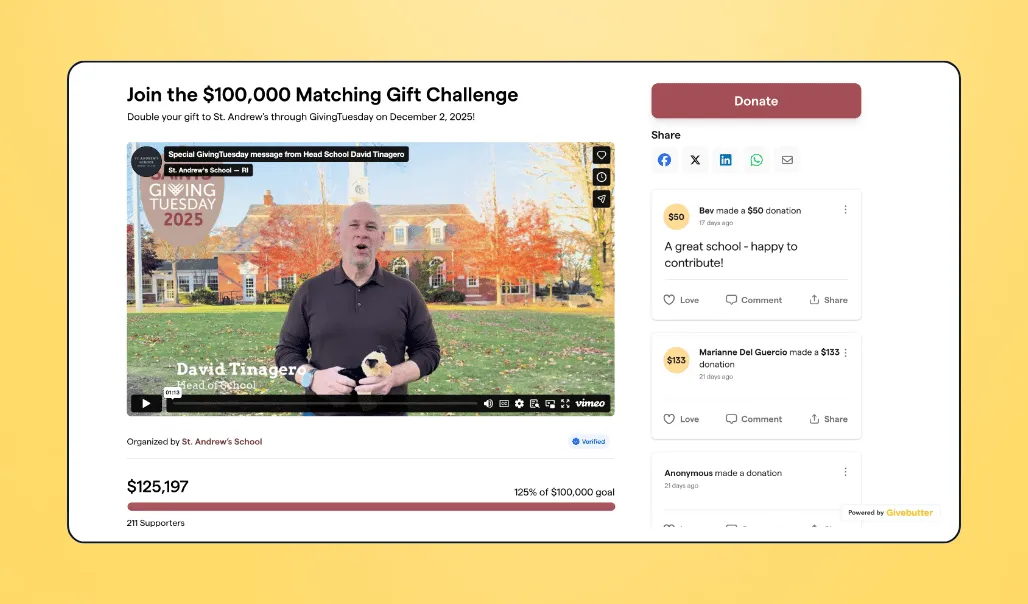
💛 How nonprofits use it: As an all-in-one fundraising, marketing, and donor engagement platform that supports matching gifts, recurring donations, and campaigns.
🎯 Best for: Nonprofits that want a flexible, easy-to-manage solution with fuss-free donation flows.
2. Benevity: Access to enterprise workplace giving programs 🏢
Benevity is an enterprise impact platform that companies use to centralize corporate philanthropy efforts. Its nonprofit portal gives organizations access to donations, volunteer grants, and workplace giving programs from hundreds of large companies.
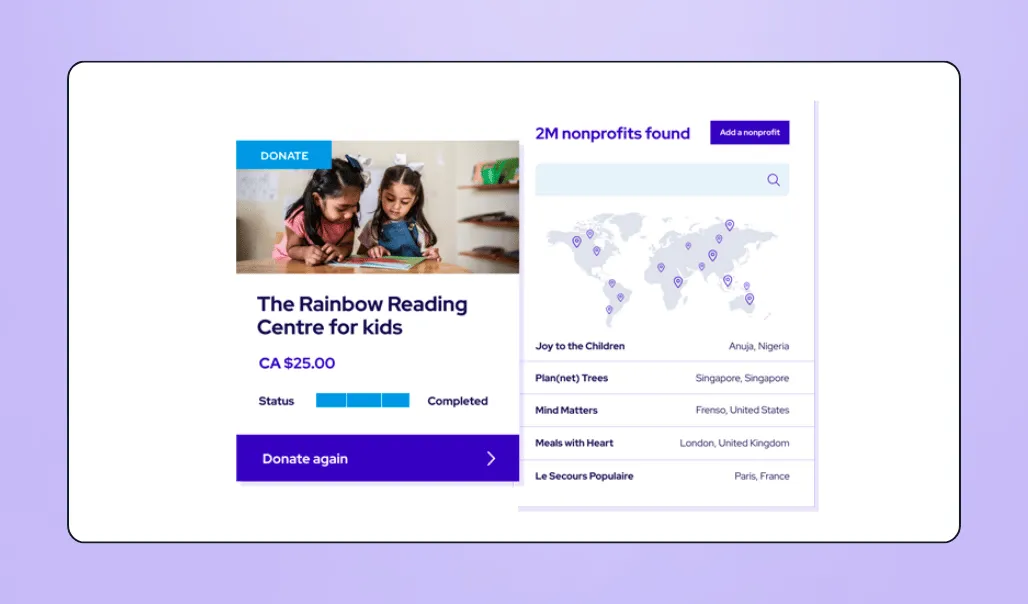
💛 How nonprofits use it: To get discovered by employees at companies that already use Benevity for workplace giving and volunteer programs.
🎯 Best for: Nonprofits seeking visibility across large, established corporate giving programs.
3. Double the Donation: Matching gifts & payroll giving 🎁
Double the Donation simplifies the donation matching process for both employers and nonprofits through auto-submission tools and a database of known workplace giving programs. Nonprofits can use the platform to notify donors of their employer’s matching or payroll giving programs and guide them through the next steps to increase impact.
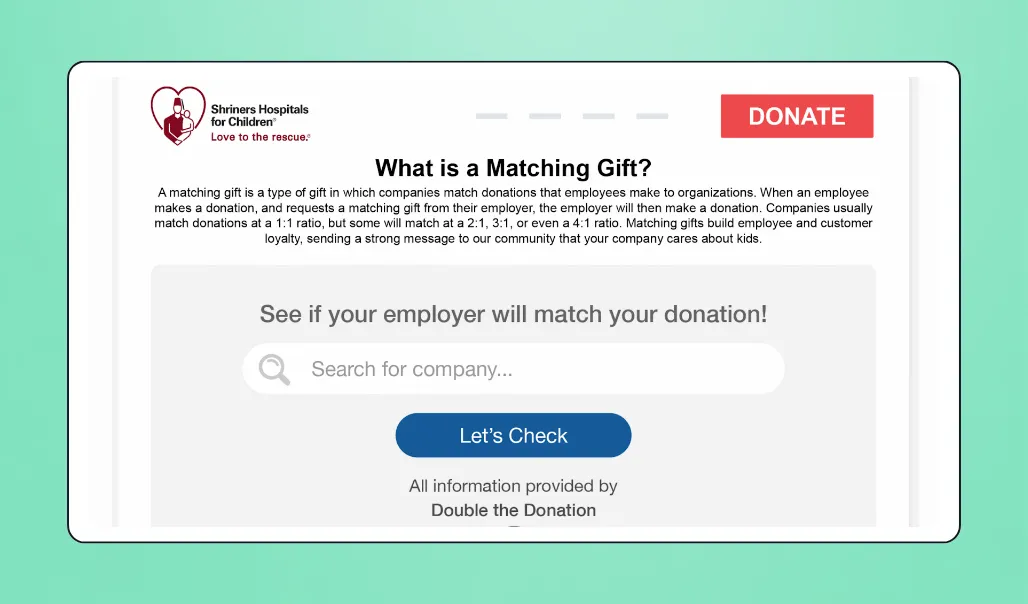
💛 How nonprofits use it: To prompt donors to check for matching gifts and complete employer requests with less friction.
🎯 Best for: Larger nonprofits that want to automate donation matching and payroll giving workflows.
4. Deed: Volunteer engagement & corporate connections 🤝
Deed is a workplace impact platform that helps nonprofits connect with businesses through volunteering, donations, and corporate grant opportunities. Nonprofits can create profiles to reach new partners and showcase opportunities that align with employee interests and company values.
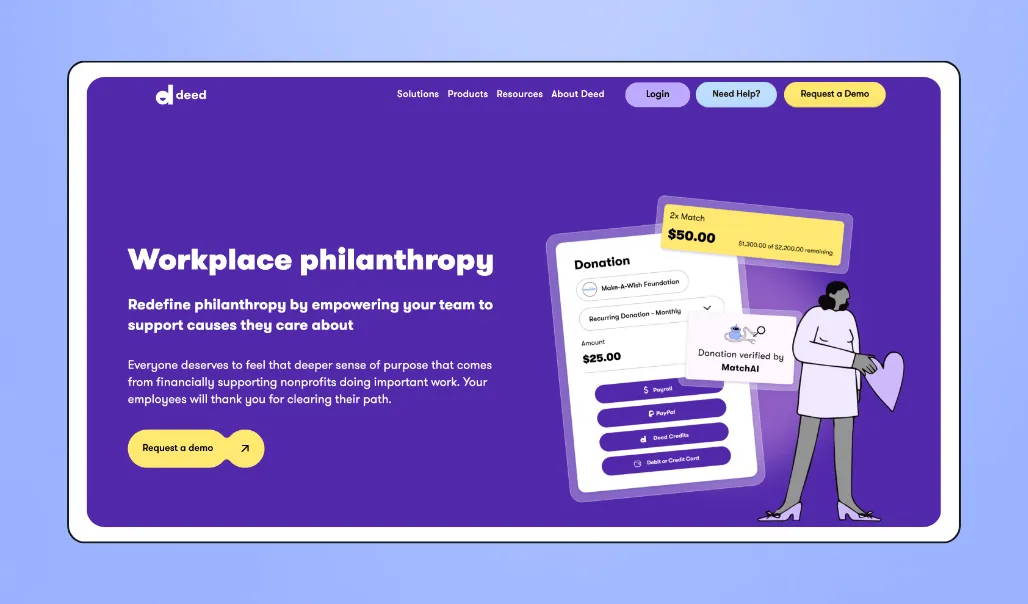
💛 How nonprofits use it: To attract volunteers and build relationships with socially minded companies.
🎯 Best for: Nonprofits focused on expanding corporate partnerships and volunteer programs.
Real-world workplace giving program examples
What does corporate philanthropy look like in practice, and what kind of results can it drive? Here are a few well-known (and lesser-known) examples of workplace giving in action:
- Costco 🛒 Costco’s workplace giving initiatives include both warehouse donations and grants, with a focus on supporting children, education, and health and human services.
- Apple 🍎 Apple’s workplace giving programs include employee volunteering and donation matching, resulting in more than $880M contributed globally to date.
- Dell 💻 Dell has contributed more than 8.7 million volunteer hours, with a 48% volunteer participation rate from team members.
- Starbucks ☕ Through The Starbucks Foundation, the company provides grants to nonprofit organizations and matches employee donations up to $1K per employee each year.
- Disney 🏰 Disney has a strong social impact focus, raising $263M in charitable giving and contributing more than 13 million employee volunteer hours to date.
- Canva 🎨 Alongside generous nonprofit discounts for its software, Canva also supports workplace giving initiatives, including a volunteer paid time off program.
Although these are large brands, workplace giving programs can be scaled for businesses of any size, with the right program type, clear promotion, and a passionate team to pull it all together.
Support workplace giving programs with Givebutter
Employees are increasingly asking their employers to support causes they care about, and companies are responding. As more businesses introduce workplace giving programs, nonprofits that are prepared, visible, and easy to support are well-positioned to benefit.
Givebutter helps nonprofits streamline admin and workflows, promote matching gift opportunities, and simplify the donation experience. So when an employee is ready to give, the process stays friction-free and buttery smooth.
Now is the perfect time to build relationships with businesses and get involved in their workplace philanthropy programs.
Sign up for a free Givebutter account today to make workplace giving easier for everyone involved.
FAQs about workplace philanthropy
What are some key workplace giving trends and statistics?
Workplace giving raises roughly $5B each year, with an estimated $2–$3B coming from matching gift programs. Many companies are increasing match ratios, expanding volunteer and “Dollars for Doers” programs, and more small-to-mid-sized businesses are now adopting workplace giving.
Which employee giving platforms do companies use for workplace donations?
Popular examples of workplace giving and CSR platforms include Benevity, Fidelity Workplace Giving, Deed, and KindLink.
Is workplace giving tax-deductible?
Yes, many workplace giving contributions are tax-deductible. Individuals can deduct charitable contributions made to qualified organizations, such as 501(c)(3) nonprofits. These deductions are typically claimed on an individual’s annual tax return, not through payroll.
Can employees choose which nonprofit they support?
In most workplace giving programs, employees can choose which nonprofit they support within program guidelines. Some employers may place restrictions, such as requiring organizations to be registered as 501(c)(3)s or limiting eligible causes to certain focuses like healthcare or education.
Is workplace giving mandatory for employees?
This question comes up frequently because some organizations have blurred that line in the past. Best practice is to keep participation optional, private, and separate from performance reviews or workplace standing. Employee giving programs should always be voluntary, and participation in them shouldn’t be linked to other areas of an employee’s performance, contract, workload, or experience.
Share this article









.svg)
.svg)