.svg)
.svg)
.svg)
.svg)
.svg)
.svg)
.svg)
.svg)
.svg)


.svg)
.svg)
.svg)
.svg)
.svg)
.svg)
.svg)
.svg)

.svg)
.svg)
.svg)

.svg)

.svg)
.svg)
.svg)
.svg)
.svg)


.svg)
.svg)
.svg)
.svg)
.svg)
.svg)
.svg)





.svg)




%20(1).png)

Pricing raffle tickets seems like it should be simple, but without a clear framework, it’s easy to second-guess yourself. Price them too low, and you leave money on the table. Price them too high, and ticket sales can stall.
That’s why many raffle organizers end up defaulting to a gut feeling or last year’s numbers. But there’s another way, and it might be less complex than you expect.
This guide breaks down a simple pricing formula, common ticket prices by raffle type, bundle pricing strategies, and real nonprofit examples so you can start pricing tickets with confidence.
Key takeaways
- Price raffle tickets strategically ⭐ Base your raffle ticket pricing on your fundraising goals, total costs, event type, and audience’s budget.
- Use a simple pricing formula 🧮 Calculate your ticket pricing using real data: (goal + total costs) ÷ expected tickets sold = minimum price per ticket.
- Match ticket prices to prize value 🎁 Higher-value prizes often support higher ticket prices and larger ticket bundles.
- Increase sales with bundled tickets 🎟️ Encourage larger purchases with bundled pricing, like 3 tickets for $5 or 10 tickets for $15.
- Keep more revenue with the right tools 💰 Free raffle and fundraising platforms like Givebutter can help you avoid unnecessary platform fees and keep more of what you raise.
How to price raffle tickets for a fundraiser
Pricing raffle tickets can feel like a guessing game, but it doesn’t have to be. Instead, use the simple formula below to price raffle tickets based on your fundraising goals, event costs, and data from your previous fundraisers.
1. Set your net revenue goal 🎯
Determine how much revenue your raffle needs to generate. This should reflect your target net profit after accounting for organizational costs. Tie your revenue goal to a specific fundraising need to keep planning focused.
🎬 See it in action: A nonprofit needs to raise $5K to launch a new program. They expect to raise $3K through gala ticket sales, so they set the remaining $2K as their raffle revenue goal.

2. Add up your raffle expenses 💰
Estimate your total raffle expenses by category. Here are some of the most common expenses for a fundraising raffle:
- Prizes 🎁 Often, your prizes are the key draw to your raffle. Make sure you have enough funds set aside to offer exciting raffle prizes, or keep costs low by reaching out to local businesses for raffle prize donations.
- Tickets 🖨️ Whether you use a raffle ticket template or pre-bought, you’ll need to budget for ticket costs.
- Platform fees 🪙 Some raffle sites charge a fee to use their platform. Reduce costs by using platforms like Givebutter that offer free raffle tools and event ticketing.
- Marketing 🎨 Include anything that helps promote your raffle, like printing, paid ads, or additional marketing staff.
- Venue 🏐 If you’re hosting an in-person raffle, you may need to set aside funds to rent a venue.
Add these expenses (along with any additional raffle costs) to calculate your total event budget.

3. Estimate how many tickets you’ll sell 🎟️
If you’ve hosted raffles before, estimate future sales on past attendance and ticket sales data. If this is your first raffle, use attendance data from similar fundraising events and factor in the resources you have available to promote your raffle.
Whatever number you land on, be conservative. If your formula is based on selling 500 tickets and you only sell 300, you’ll fall short of your goal.
4. Calculate your minimum ticket price 🧭
Now it’s time to calculate your ticket price using your fundraising goal, estimated ticket sales, and total event costs. Once you’ve finalized those numbers, use this formula:
(goal + total costs) ÷ expected tickets sold = minimum price per ticket
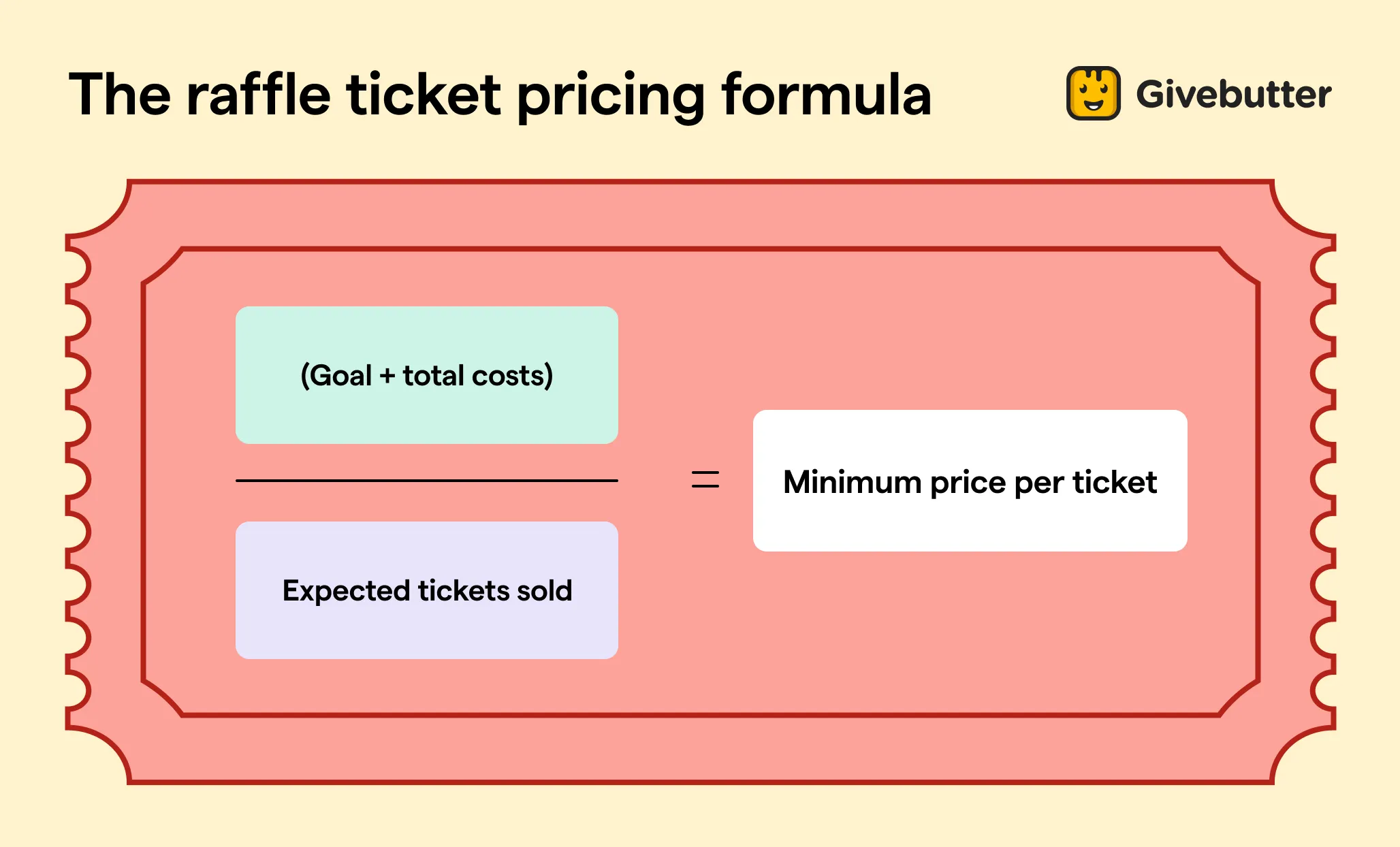
🎬 See it in action: The same nonprofit with the $2K revenue goal secures their raffle prizes from a local business, which brings their total organizing costs to $500. Based on previous years' data, they expect to sell 500 tickets at their 200-person gala.
Their formula looks like this: ($2K + $500) ÷ 500 = $5.
This means their minimum ticket price is $5. They increase it up to $6 and opt for a bundle of 2 for $10.
💡 Pro tip: If your formula gives a number that feels too high for your audience, aim to reduce your event costs rather than lower your ticket price.
Common raffle ticket prices by event type
The formula gives you a floor. These real nonprofits show you what pricing looks like in practice. Each example below ran on Givebutter and took a different approach based on its event type, prize value, and audience. Use them as a benchmark for your own pricing decisions.
School & community events 🏫
At school raffles, PTO events, church fairs, and other community gatherings, attendance is often high, and prizes may be modest (around $50–$200). The goal is to keep ticket prices accessible so everyone can participate while maximizing ticket sales.
💸 Recommended ticket pricing: Keep base entries at $1–$2 each, with bundle tiers that offer more entries per dollar as the purchase size increases, such as $5 for 6 entries or $10 for 15 entries.
🌟 See a real nonprofit example: Twin Valley Elementary Center’s PTO Auction & Raffle raised $3.5K+, meeting 123% of its goal, with a simple three-tier pricing structure that kept participation accessible for every family.
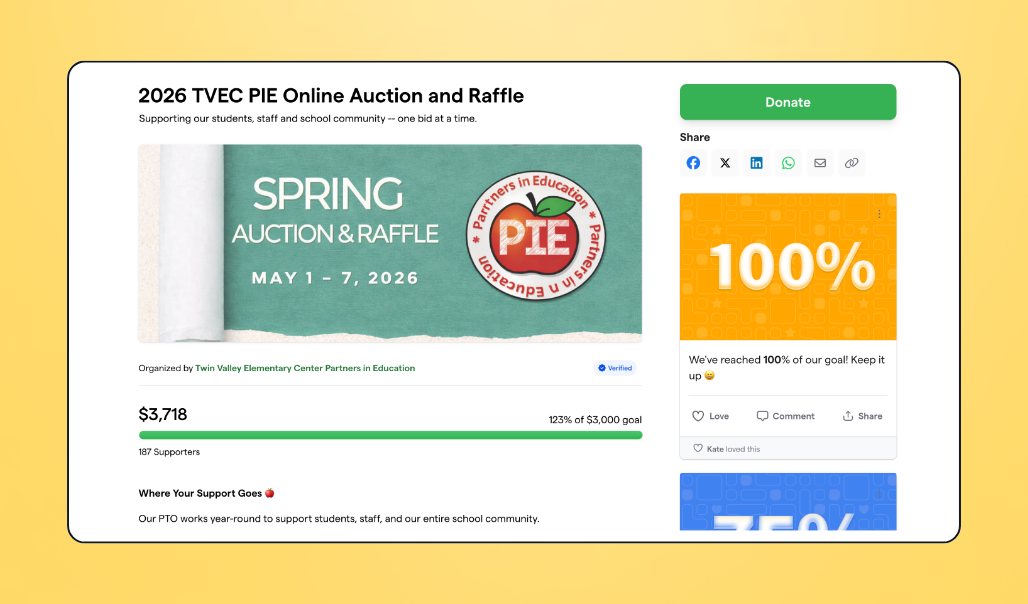
- $1 = 1 entry
- $5 = 6 entries
- $10 = 15 entries
Every ticket option for the same item was combined into a single pool, so participants could enter at any level and still compete for the same prize. The raffle ran alongside an online auction, giving supporters multiple ways to engage and contribute on a single fundraising page.
Mid-range fundraisers 🎉
For mid-size nonprofit events, such as sports fundraisers and organizational anniversary events, prizes often fall in the $1K–$2K range. A ticket value of $5 to $20, with bundling options, strikes a balance between accessibility for your guests and maximizing revenue for your nonprofit.
💸 Recommended ticket pricing: A base price of $10 per ticket works well for most mid-range events, with bundle tiers stepping up from there, such as 3 for $25, 5 for $40, and 10 for $75 for audiences with more giving capacity.
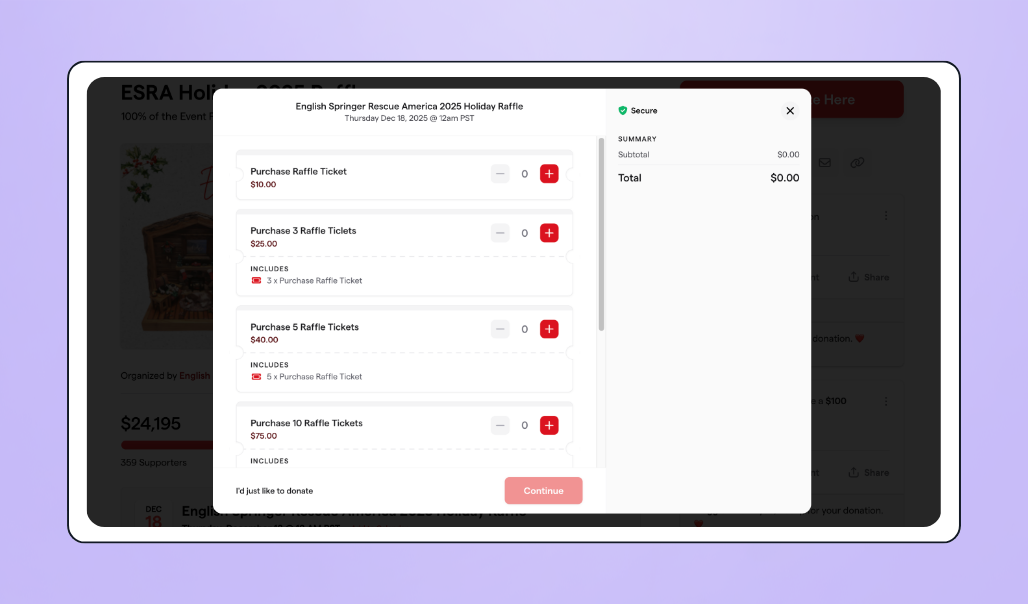
🌟 See a real nonprofit example: English Springer Rescue America’s Holiday Raffle generated $24K from 359 supporters, clearing 120% of its goal, with a thoughtfully structured bundle pricing strategy.
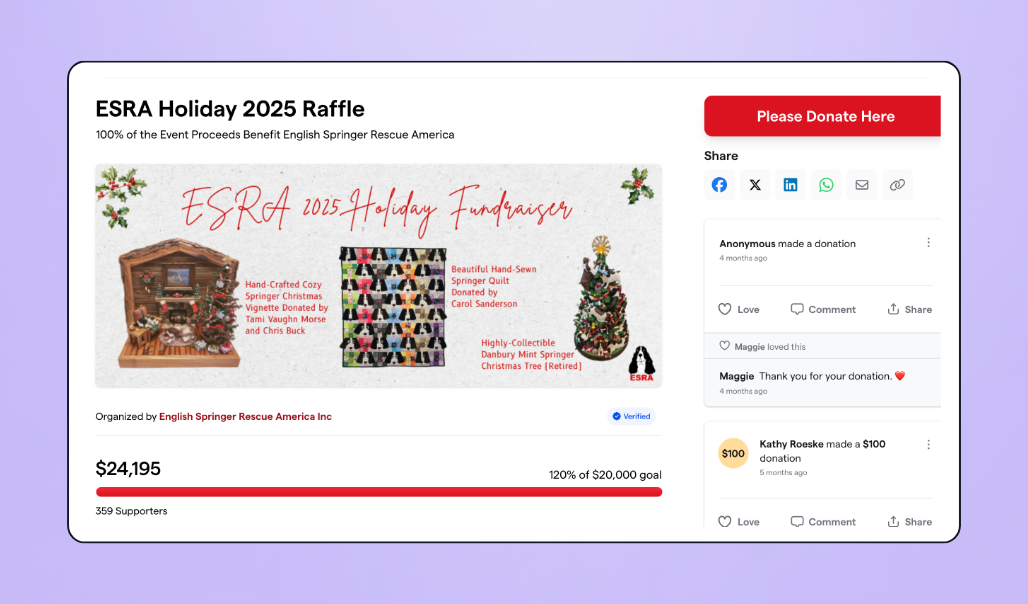
- 1 ticket for $10
- 3 tickets for $25
- 5 tickets for $40
- 10 tickets for $75
- 20 tickets for $140
- 33 tickets for $250
Every tier offered a better per-ticket value than the one before it, giving supporters a clear incentive to buy more without the discount ever feeling steep.
The prizes, three one-of-a-kind handcrafted items donated by community members, were niche by design. ESRA’s audience of passionate Springer Spaniel owners and rescue supporters had a deeply personal reason to buy in at every price point, which is a useful reminder that a prize aligned with your cause will usually outperform a generic one.
50/50 raffles 🎟️
50/50 raffles are unique because the winning amount grows with ticket sales, so pricing affects both participation and the final prize pot. Here’s the best part: the prize is built into the fundraising total, so you don’t have to account for prize costs in your ticket calculation.
💸 Recommended ticket pricing: Scale to your event size. Smaller fundraisers do well at $1–$2 per ticket with 3 for $5 bundles, mid-size events typically land at $5 per ticket with 3 for $10 bundles, and larger galas can support $10 per ticket with 3 for $20 or 6 for $30 bundles.
💡 Pro tip: Consider making your lowest bundle the entry point rather than a single ticket. It nudges every supporter toward buying multiple entries from the start without feeling like an upsell.
🌟 See a real nonprofit example: Lincoln County Public Education Foundation’s Holiday Hustle Half & Half raised $63K from 2,500 supporters, reaching 210% of its $30K goal. Their bundle-only pricing structure made every entry a multi-ticket purchase.
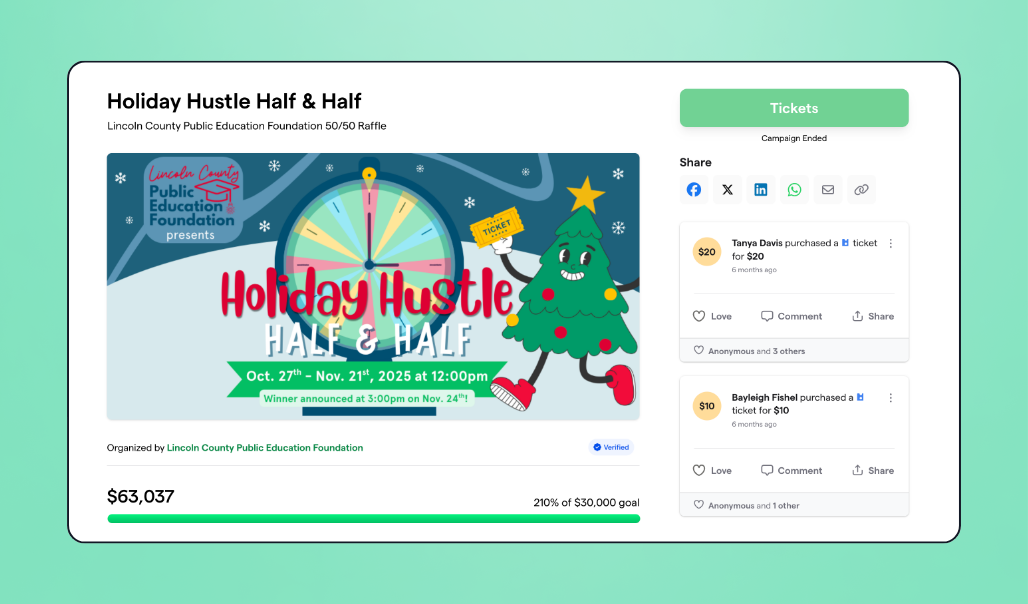
- 3 for $10
- 7 for $20
- 20 for $50
The jackpot grew with every ticket sold, giving supporters a direct stake in driving participation higher. The winner was announced via a livestreamed drawing, which kept the excitement going even for supporters who couldn’t attend in person.
Gift basket raffles 🧺
For a gift basket raffle, ticket prices should reflect the value of your baskets and what your audience is realistically willing to spend. Whether you’re running a standalone basket raffle or a tricky tray raffle where attendees distribute tickets across multiple prizes, bundle options encourage supporters to buy more entries and give them more chances to win the baskets they actually want.
💸 Recommended ticket pricing: Match your ticket price to your basket value. Baskets worth $50–$100 typically support $2–$10 per ticket, baskets in the $150–$500 range work well at $5–$20, and premium baskets over $500 can support $15–$25 per ticket.
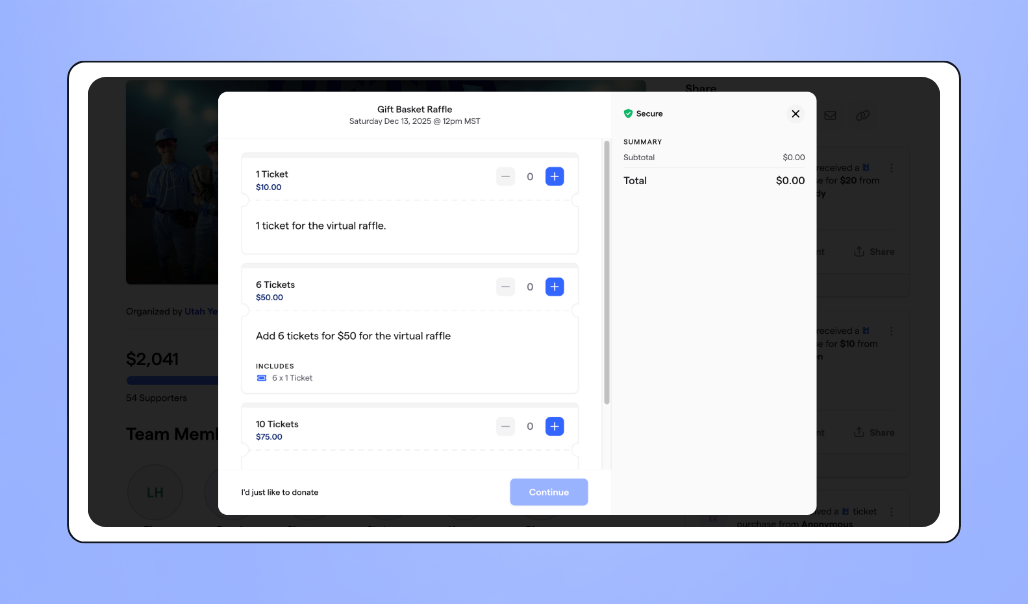
🌟 See a real nonprofit example: Utah Yetis Baseball’s Gift Basket Raffle surpassed its $2K goal with 54 supporters and five themed baskets, offering three ticket bundle options to fit every budget.

- 1 ticket for $10
- 6 tickets for $50
- 10 tickets for $75
Each basket had its own theme (Self Care, On the Go, Ultimate Kid Pack, Gentleman’s Gift Set, and Classic Cocktail), giving every supporter at least one option that felt personally relevant. The team also used Givebutter’s peer-to-peer fundraising tools, with individual players driving ticket sales through personal fundraising pages and turning the raffle into a community-wide team effort.
Grand prize raffles 🏆
Grand prizes include vacations, high-value experiences, luxury items, electronics, and even cash. Don’t flood the raffle with $1 tickets. Instead, you’ll want to price tickets to align with the value of your prize. Fewer, higher-priced tickets can improve perceived odds of winning.
💸 Recommended ticket pricing: For prizes valued at $1K–$3K, $15–$20 per ticket is a reliable starting point. For prizes worth $5K or more, $25–$30 per ticket tends to drive strong participation without pricing out your audience.
💡 Pro tip: Even for high-value prizes, overly high ticket prices can reduce participation. Unless your audience is especially affluent, keeping ticket prices below $35 often drives stronger sales.
🌟 See a real nonprofit example: Giving Voice Foundation’s Buffalo Trace Antique Bourbon Raffle raised $48K, hitting 108% of its goal, with a rare bourbon collection valued at over $10K as the prize. Ticket pricing was simple and strategic.
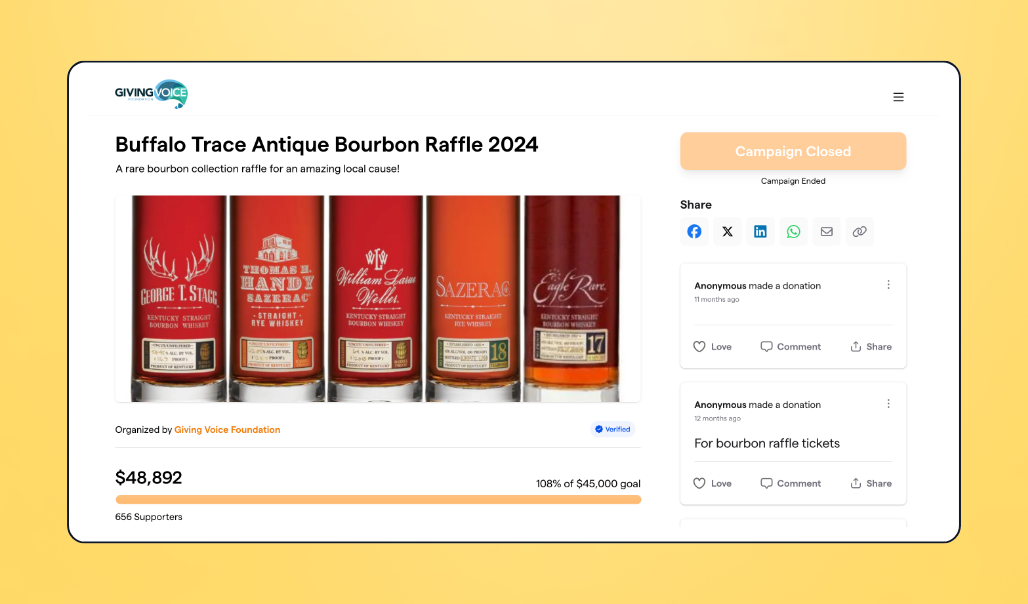
- 1 ticket for $25
- 5 tickets for $100
The niche prize did the heavy lifting. Rare bourbon collectors and supporters of the Foundation’s dementia care programming had a compelling reason to buy in at both price points. The drawing was livestreamed on National Bourbon Day, giving remote supporters a reason to tune in and keeping the excitement going well beyond the event itself.
Raffle ticket bundle pricing strategies that boost sales
Every example in the section above uses some form of bundle pricing, and for good reason. Bundles give supporters a clear incentive to spend more by offering better value at higher tiers, which increases your average transaction size without requiring you to lower your base ticket price.
The key is keeping the math obvious. A bundle that offers a meaningful but not excessive discount at each step up tends to outperform both flat pricing and steeply discounted bundles. Here are some starting structures by event type:
- Budget-friendly raffles: 1 for $2, 3 for $5
- Mid-range fundraisers: 1 for $10, 3 for $20
- High-end events: 1 for $25, 3 for $60
Keep your bundle tiers consistent with your base price. If your single ticket is $10, a bundle like 3 for $20 rewards the buyer without cutting into your margin too deeply. A 5 for $12 bundle might move more tickets, but could leave your fundraising goal out of reach.
🌟 See a real nonprofit example: Gallery5’s One Big Beautiful Raffle surpassed its $80K fundraising goal with a simple, transparent bundle structure that rewarded supporters for giving more.
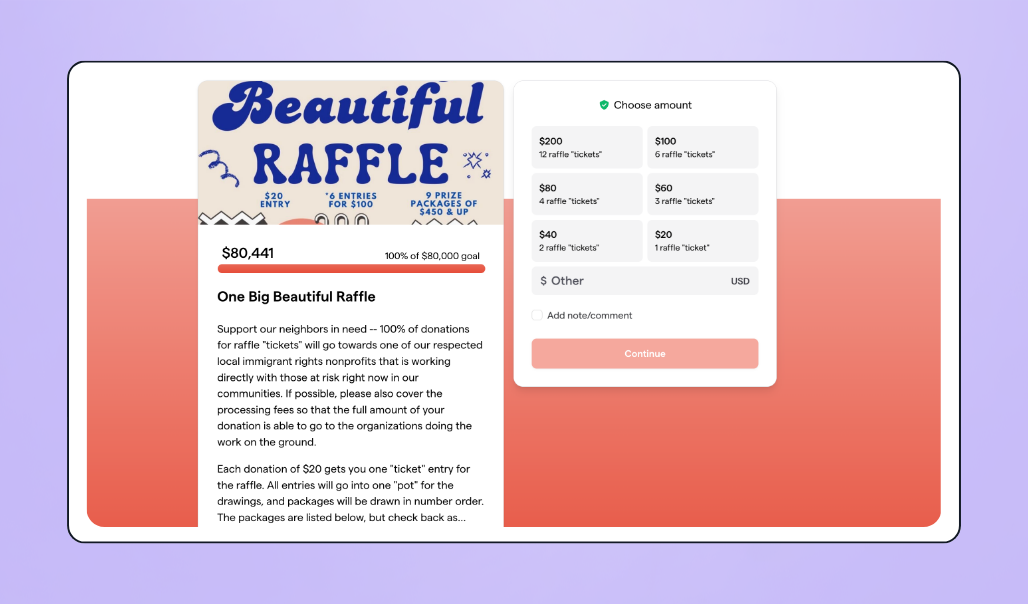
- 1 ticket for $20
- 2 tickets for $40
- 3 tickets for $60
- 4 tickets for $80
- 6 tickets for $100
- 12 tickets for $200
Bigger bundles mean a better per-ticket value, giving supporters a natural nudge to go all in. Nine locally sourced gift card packages sealed the deal, giving people a compelling reason to buy in at every level.
Simplify raffle ticket sales with Givebutter
The right ticket price balances your fundraising goal, your prize value, and what your crowd is realistically willing to spend. Use the formula and benchmarks in this guide as your starting point, then adjust based on what you know about your audience.
Givebutter handles the fundraising side of your raffle so you can focus on everything else. Sell tickets online, set up bundle pricing, and track every transaction in one place, all for free. No platform or processing fees means more of every dollar raised stays with your cause. And once the last ticket is drawn, Givebutter's CRM and marketing software help you follow up with attendees and turn one-time supporters into recurring donors.

Launch your raffle for free with Givebutter
Sign up for Givebutter today and keep 100% of what you raise.
FAQs about raffle ticket pricing
Can you sell raffle tickets 3 for $5?
Yes, you can absolutely sell raffle tickets 3 for $5. Ticket bundling helps drive higher raffle participation and generate greater fundraising. If you’re offering higher value raffle prizes, try 3 for $10 or 3 for $20 instead.
How much to charge for raffle tickets?
Use this simple formula to calculate your ideal raffle ticket price:
(goal + total costs) ÷ expected tickets sold = minimum price per ticket
If you’re still not sure, price your raffle tickets based on your event. School and community fundraisers should keep tickets under $5, while larger fundraisers may charge $10-$30 per ticket.
How to price 50/50 raffle tickets?
Since the prize is built into the fundraising total, you don’t need to factor in prize costs when setting your 50/50 raffle ticket prices. Let your event type guide your pricing instead.
- School and community raffles: $1–$2 per ticket, with 3 for $5 bundles
- Mid-range fundraisers: $5 per ticket, with 3 for $10 bundles
- Large fundraising galas: $10 per ticket, with 3 for $20 or 6 for $30 bundles
How much are raffle tickets usually?
Raffle ticket prices typically range from $1 to $35 per ticket, depending on your event type, prize value, and audience.
School and community raffles tend to stay in the $1 to $5 range to keep participation accessible, while mid-range fundraisers typically land between $5 and $20, and high-end galas with luxury prizes can go up to $25 to $35. Most nonprofits pair single-ticket pricing with bundle options to encourage larger purchases, such as 3 for $5 at community events or 3 for $60 at higher-end events.
Share this article









.svg)
.svg)