.svg)
.svg)
.svg)
.svg)
.svg)
.svg)
.svg)
.svg)
.svg)


.svg)
.svg)
.svg)
.svg)
.svg)
.svg)
.svg)
.svg)

.svg)
.svg)
.svg)

.svg)

.svg)
.svg)
.svg)
.svg)
.svg)


.svg)
.svg)
.svg)
.svg)
.svg)
.svg)
.svg)





.svg)




%20(1).png)

⚖️ Disclaimer: Raffle laws vary by state. Some prohibit online raffles entirely, while others require permits or licenses. This guide is for informational purposes only and is not legal advice. Always confirm your state's requirements before planning your raffle, and consult a licensed attorney if you have questions.
A K–8 school in Kansas raised $40K for campus security. A dog rescue raised 120% of its goal. A community arts venue raised $80K for local immigrant rights organizations. None of them rented a venue, printed tickets, or staffed a check-in table. They all ran online raffles.
This guide walks you through exactly how to run an online raffle in 11 steps, from checking your state's raffle laws to stewarding participants into long-term supporters, plus real campaign examples showing what success looks like.
Key takeaways
- Check your state's laws ⚖️ Some states prohibit online raffles, while others require permits or licenses. Confirm before you start.
- Set your fundraising goals 🎯 Set your fundraising target and use it to guide pricing, inform prize selection, and generate support.
- Secure prize donations 🎁 Keep overhead low by requesting prize donations from corporate sponsors, board members, or local businesses.
- Price tickets strategically 🎟️ Bundle deals like "3 for $25 or 10 for $50" consistently outperform single-ticket pricing.
- Use an all-in-one platform 💻 Tools like Givebutter help you create a raffle page, simplify ticketing and payments, run a fair drawing, and centralize your event data with your CRM.
How to run a raffle fundraiser in 11 steps
Whether this is your first raffle or your tenth, these eleven steps will walk you through everything you need to run a successful online raffle, from the legal basics to stewarding donors long after the drawing ends.
Step 1: Check your state's raffle laws ⚖️
Before anything else, spend 10 minutes researching your state's raffle rules. Laws vary more than you might expect. Some states require permits or licenses, while others have specific rules around online ticket sales.
A quick check now saves a headache later. If you have any questions, a conversation with a legal professional can give you peace of mind before you get started.
💡 Pro tip: Many states ask nonprofits to report raffle income after the campaign wraps. A quick check with your CPA can help you stay on top of any reporting requirements.
Step 2: Set your fundraising goal 🎯
As with any fundraising event, you should start by setting your fundraising goal. Align it with a real nonprofit need to keep your target realistic and compelling. Once you've set your goal, you can determine the value of prizes you'll need to secure.
🎬 See it in action: Your fundraising goal for your online raffle might be to raise $5K to help your nonprofit launch a new animal rescue program.
🤔 Did you know? Online raffles offer a major advantage over events that require a venue, catering, or extra staff: a higher ROI. Plus, free event management tools like Givebutter can help you keep expenses even lower.
Step 3: Select your prizes 🎁
Choose raffle prizes that grab your supporters' attention and encourage participation. Base them on your supporters' interests and demographics, and don't be afraid to get creative with mission-tied prizes, like custom artwork or handcrafted items.
Just remember, in an online raffle, winners won't be there to claim their prize, so you'll need to choose items that can be easily shipped, or coordinate with sponsors to deliver prizes directly.
💡 Pro tip: Combine one high-value prize with a few mid-range items to boost perceived value and increase ticket sales.
Step 4: Source prize donations for free 🤝
Keep overhead costs low by reaching out to local businesses, sponsors, or board members for raffle prize donations. Craft a compelling, one-page appeal that explains your mission, fundraising goal, and what donors will receive in return (like social media shoutouts or event recognition).
Reaching out to corporate donors can feel intimidating, but partnerships like these are valuable for businesses, too. In fact, sponsorships account for an average of 12% of a company's marketing budget.
💡 Pro tip: Don't rely on one ask. Reach out to multiple potential donors for each prize to increase your chances of securing donations.

Step 5: Choose an online raffle platform 💻
Choosing the right online raffle platform is key to running a smooth online raffle for your nonprofit. Look for a platform with event ticketing features, multiple payment processing methods, and a nonprofit CRM, so your raffle data flows directly into your donor records, all in one place.
Built specifically for nonprofits, Givebutter combines event ticketing, payment processing, and donor management in one platform. Set up your raffle page in minutes, sell tickets, track participants, and manage communications without juggling multiple tools. And because Givebutter's core features are free, more of what you raise goes directly to your mission.

Step 6: Price your tickets 🎟️
Base your ticket prices on your fundraising goal and the value of your prizes. A good rule of thumb: if your highest-value prize is $50, pricing tickets closer to $5 than $30 keeps participation accessible and drives more entries.
💡 Pro tip: Offer bundled pricing (like 10 tickets for $50) to increase revenue without adding extra prizes or marketing resources.
Step 7: Build your raffle page 🖥️
With your prices set, it's time to set up your online raffle page. Be sure to include your campaign name, accurate prize descriptions, and photos, since your supporters won't be able to see your prizes in person. Keep your mission front and center to inspire raffle participation.
Include essential details such as when ticket sales will end, the date and time of the prize draw, and how winners will be chosen. Many states require this information, so including it upfront keeps you compliant and builds trust with participants.
Step 8: Set your timeline ⏰
You'll want to strike a balance between building excitement and giving enough time to promote your raffle. A good rule of thumb is to base your timeline on the value of your prize. Bigger giveaways can last 2–4 weeks, while lower-value raffles can last about 1 week.
When possible, give your raffle some breathing room by steering clear of busy holiday weekends or dates that compete with other major community events.
Step 9: Promote your raffle 📣
Build a clear marketing strategy to promote your raffle across multiple channels. Plan your content in advance, so your campaign runs smoothly.
Your marketing strategy might include:
- Email campaign 📧 Map out an email marketing campaign with 3 to 4 emails, including a preview email, raffle launch, a mid-raffle reminder, and a final push to sign up.
- Social media posts 💻 Make your presence known on social media during the lead-up and while tickets are on sale. Post two to three times per week, highlighting what your fundraising will help achieve with eye-catching statistics and beneficiary testimonials.
- Word of mouth 📣 Ask board members, corporate partners, and your most committed supporters to spread the word on your raffle.
💡 Pro tip: Just because your raffle is online doesn't mean all your promotion has to be. Try setting up a booth at a local community event to sell tickets, create flyers to leave with local businesses, or spread the word in your neighborhood.
Step 10: Run a fair, transparent drawing 🎰
Host a live raffle draw to help generate excitement and to promote transparency. Start by clearly explaining your raffle rules and how you'll select the winner.
Givebutter's random number generator makes it easy to run a fair drawing. Once the winning numbers have been selected, you can share the ticket numbers on your livestream, but don't announce your winner's name until you've first contacted them privately. You'll also want to take a screenshot of the winning number for your records.
Step 11: Announce winners & steward your donors 💛
Your raffle may be over, but the relationship with your supporters is just getting started. Reach out to all participants to thank them for their generosity and share your fundraising total, highlighting how their support is making a difference.
Thank your prize donors publicly too. A shoutout on social media, your website, or your newsletter goes a long way toward building lasting partnerships.
From there, add your supporters to your CRM so you can stay in touch.
💡 Pro tip: A few weeks after your raffle wraps, share a brief impact update showing what the funds helped achieve. Then, invite supporters to stay involved through volunteering, recurring giving, or your newsletter.
3 online raffle examples that exceeded their goals
The best way to run a successful online raffle is to learn from nonprofits who've already done it. These three campaigns ran on Givebutter, hit or exceeded their goals, and each used a different tactic you can apply to your own fundraiser.
1. A Winter's Night Gala ❄️
The Winter's Night Gala jackpot raffle, organized by Prince of Peace Catholic School in Olathe, Kansas, opened participation to anyone, not just to gala attendees.
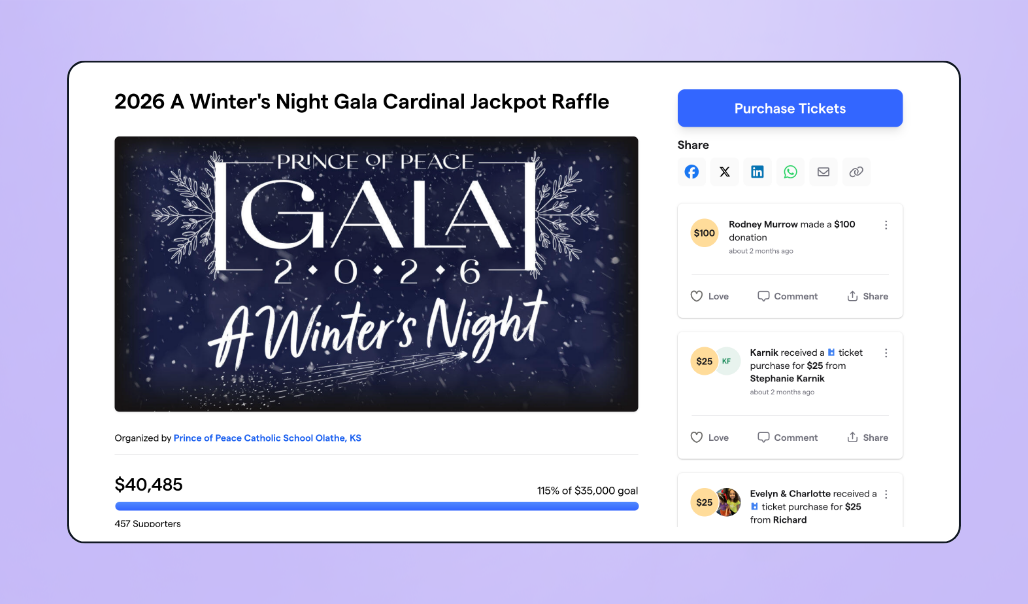
💡 What worked: Simple, high-contrast pricing ($25 ticket, $5K prize) made the value obvious. A $30K matching gift challenge from a family donor added urgency, and 12+ competing peer-to-peer teams helped push the campaign to $40K+, which was 115% of its $35K goal.
🧈 Steal this idea: Add peer-to-peer team fundraising to your raffle. Friendly competition between teams drives personal outreach that's hard to replicate with a single campaign page.
2. One Big Beautiful Raffle 😍
The One Big Beautiful Raffle, organized by Gallery5 in Richmond, VA, used a donation-based entry model, with every $20 donation earning one raffle entry. All nine prize packages were sourced entirely from local businesses, and 100% of proceeds went to local immigrant rights organizations.
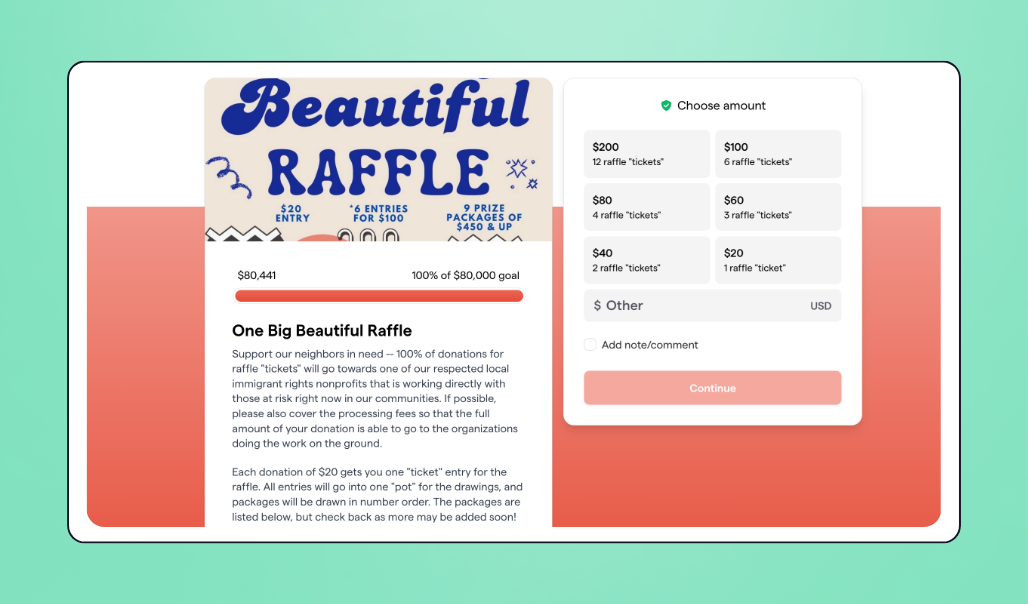
💡 What worked: Listing every prize bundle directly on the campaign page gave supporters a reason to keep reading. Local prizes made the raffle feel like a community celebration, and the mission-driven framing drove $80K in donations, 100% of its goal.
🧈 Steal this idea: Source prizes from local businesses. It keeps costs low and turns your raffle into something supporters feel personally connected to.
3. ESRA Holiday Raffle 🎄
The English Springer Spaniel Rescue holiday raffle offered three one-of-a-kind, mission-related prizes, with the winner selection details and shipping logistics clearly spelled out on the event page.
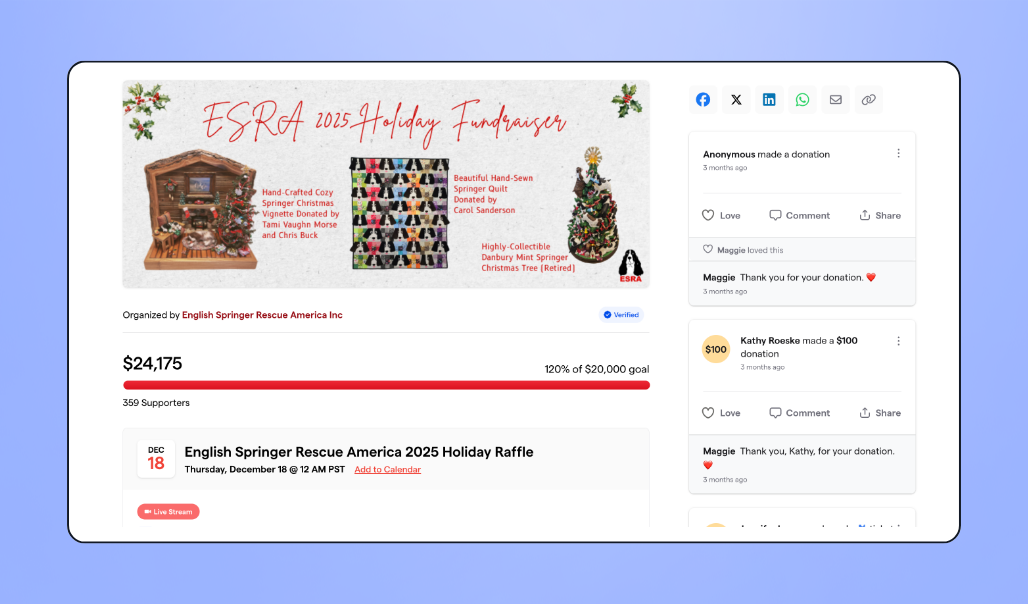
💡 What worked: Unique, handcrafted prizes created genuine excitement. They were truly one of a kind, meaning once the raffle ended, they were gone forever. Transparent rules and logistics built trust with first-time participants. Result: $24K+ raised, 120% of its $20K goal.
🧈 Steal this idea: Commission one-of-a-kind prizes from artists or makers in your supporter community. Unique items drive urgency that gift cards simply can't.
Host a seamless online raffle with Givebutter
You've got the roadmap. Now it's time to put it into action.
Start by confirming your state's raffle requirements, then set up your raffle page on Givebutter. Customize your tickets, set bundle pricing, and share your page via a unique URL or QR code. Supporters can even sell tickets on your behalf through built-in peer-to-peer fundraising tools, expanding your reach without extra work on your end.
When it's time to draw, filter your ticket data by type, quantity, or donor name, export a clean list, and select your winner with confidence. Every ticket sale and donor record syncs automatically to your CRM, so your next outreach is ready to go before the confetti settles.

Raise more with Givebutter's online raffle platform
Sign up for Givebutter today and host a seamless online raffle that raises more.
FAQs about how to organize a raffle
How to do a raffle with tickets?
For an online raffle with tickets, assign each participant a unique ticket number when they purchase. Most tickets include your organization's name, raffle date, ticket price, and prize descriptions, though required information varies by state, so check your local rules before finalizing your design.
A raffle ticket template can help you get started quickly. Collect contact information from each participant for the drawing. Platforms like Givebutter handle ticket numbering and participant tracking automatically so you don't have to manage it manually.
How to do a raffle without tickets?
A ticket-free raffle replaces physical or digital tickets with donation-based entries. Instead of purchasing a numbered ticket, supporters donate a set amount, and the platform automatically assigns them a raffle entry. The more they donate, the more entries they receive. Platforms like Givebutter automatically track all entries, making it easy to follow up with donors.
How to do a raffle draw online?
First, confirm that online raffles are legal in your state. Then secure raffle prize donations and create your raffle page using an all-in-one fundraising platform like Givebutter.
When it's time to draw, host a livestream, explain your raffle rules, and use Givebutter's random number generator to select your winners.
Can I run a raffle on Facebook?
Yes, but there are a few important rules to follow. Facebook's Pages, Groups, and Events policy requires that any raffle or promotion includes official rules, eligibility requirements, and a disclaimer stating that the promotion is not sponsored, endorsed, or administered by Meta.
Participants must also release Meta from any liability. Facebook prohibits incentivizing participants to share, repost, or tag others to enter. For a simpler experience, run your raffle on Givebutter and share the link on Facebook—you get all the reach without the compliance complexity.
How do I run an online raffle for charity for free?
To run an online raffle for free, use a platform like Givebutter, which offers free event ticketing and fundraising tools. Supporters can purchase tickets or make donation-based entries through your raffle page, and you can manage everything from payments to participant tracking in one place.
Share this article









.svg)
.svg)