.svg)
.svg)
.svg)
.svg)
.svg)
.svg)
.svg)
.svg)
.svg)


.svg)
.svg)
.svg)
.svg)
.svg)
.svg)
.svg)
.svg)

.svg)
.svg)
.svg)

.svg)

.svg)
.svg)
.svg)
.svg)
.svg)


.svg)
.svg)
.svg)
.svg)
.svg)
.svg)
.svg)





.svg)




%20(1).png)

⚖️ Disclaimer: Raffle laws vary by state and locality. This article is for informational purposes only and does not constitute legal advice. Before running a 50/50 raffle, check your state's permit requirements and consult a legal professional if needed.
50/50 raffles are one of the easiest and most cost-effective ways for nonprofits to raise money at events. There's no need to source major prizes or manage complicated logistics—the winner simply takes home half of the total ticket sales, while your nonprofit keeps the other half.
But while 50/50 raffles are simple to run, the best ones do more than raise money. They create energy, spark participation, and give supporters another reason to connect with your mission. In this guide, you'll learn how to plan, promote, and run a 50/50 raffle that keeps excitement high and helps maximize fundraising results.
Key takeaways
- Check legal requirements first 🧑⚖️ Raffles are illegal in some states, so confirm your raffle is legal before moving forward.
- 50/50 raffles are low-overhead ➕ Because the prize is half of your fundraising total, they don't require major upfront costs or donated prizes.
- Sell tickets before & during your event 🎫 Start selling raffle tickets at least one month before your event, and assemble a team of enthusiastic volunteers to sell tickets on event day.
- Keep supporters updated on the prize 🤩 Build excitement and encourage new raffle ticket purchases by keeping participants updated on the prize pot as your raffle grows.
- Report your income 📋 Raffle winnings aren't tax-deductible and require special IRS reporting. If in doubt, contact a tax professional.
- Use the right tools 🔨 Use a free event management and fundraising platform like Givebutter to create a customizable event ticketing page and keep donor data in one centralized CRM.
What is a 50/50 raffle?
In a 50/50 raffle, the prize is half of the total ticket revenue raised. For example, if your nonprofit sells $100 in tickets, the winner receives $50, and your organization keeps the other $50.
Because the prize pot grows as more tickets are sold, 50/50 raffles naturally build excitement and participation throughout the event. You may also hear them called "split-the-pot" or "jackpot" raffles.
How does a 50/50 raffle work?
Usually, 50/50 raffles rely on volunteers selling tickets throughout an event. Because they're such a low-lift fundraising event, they're a great add-on to other types of fundraising events, like galas or dinners.
With a 50/50 raffle, there's no need to pay for prizes or request donations ahead of time. Plus, they're easy to customize for more than one winner—simply split the pot evenly in multiple ways.
When a 50/50 raffle works best (& when it doesn't)
While 50/50 raffles are among the simplest fundraising formats, another type of raffle, such as a reverse raffle or tricky tray raffle, may be a better fit. Here's when you should (and shouldn't) opt for a 50/50 format.
When to host a 50/50 raffle 💛
- Sporting events ⚽ Sporting events drum up a large crowd, making them perfect for a 50/50 raffle.
- Galas 💃 50/50 raffles can be the perfect fundraising and entertainment add-on to your annual gala.
- Bingo nights 🖊️ Because they're easy to run and inexpensive to organize, 50/50 raffles pair naturally with bingo nights.
- School nights 🎒 Jumpstart your PTA fundraiser with a PTA raffle anyone can get involved in.
When not to host a 50/50 raffle ✋
- Illegal raffle states ❌ Illegal raffles can lead to hefty fines or even a loss of your 501(c)(3) status.
- Very small groups 🧑🤝🧑 With a small audience, it's difficult to sell enough raffle tickets to create a significant fundraising total and an exciting prize.
- Formal dinners 👨🍳 At especially formal events, selling tickets table to table can feel out of place.

How to run a 50/50 raffle supporters will love
While 50/50 raffles are simpler to organize than many other raffle games, they still require thoughtful planning to maximize participation and stay compliant.
1. Check legality & permit requirements 🧑⚖️
Before moving forward, check your state's raffle laws and regulations. In some states, fundraising raffles of any kind are strictly prohibited. Some states prohibit online ticket sales, while others require permits or have specific eligibility requirements for nonprofits.
💡 Pro tip: Consult a lawyer before hosting a fundraising raffle if you're unsure about your state's requirements.
2. Price tickets 💰
Base your 50/50 raffle ticket price on your fundraising goal and the number of tickets you expect to sell. From here, you can use this simple formula:
(expenses + fundraising goal) ÷ ticket quantity x 2 = ticket price
Because the raffle prize is half of the funds raised, you won't need to factor an additional prize total into your ticket price, but you do have to remember you'll only keep half the money raised.
🎬 See it in action: A nonprofit has a $5K fundraising goal, and their total event expense is $1K. They plan to sell 400 tickets. To split the pot evenly with the winner while still reaching their goal, they'd need to charge $30 per raffle ticket.
3. Make or buy raffle tickets 🎫
Buying or printing raffle tickets is often the main expense of a 50/50 raffle. At a minimum, create enough tickets to match your fundraising goal and ticket price, but the goal is always to sell as many tickets as possible.
Use a customizable raffle ticket template to feature your organization's logo and name. Be sure your ticket includes a tearaway stub with the buyer's contact information so you can easily notify the winner.
🤔 Did you know? Many states regulate what information must appear on raffle tickets. Make sure you check your state's regulations before buying or printing your tickets.

4. Market your raffle 📣
Use a multi-channel approach to spread the word on your 50/50 raffle and boost ticket sales.
- Email campaign & newsletter 📧 Spread the word about your raffle via emails and your newsletter.
- Social media 💻 Share info about your 50/50 raffle on your social media platforms.
- Website 🖱️ Promote your raffle on your website and create a customized event page where supporters can easily buy tickets.
- Community outreach 🗣️ Ask board members, volunteers, and supporters to share your raffle with their networks. Consider setting ticket-selling goals to help expand your reach.
5. Recruit volunteers 🤗
Recruit a team of volunteers to help sell tickets. Reach out to past volunteers early, so you have enough time to build and organize your team before your event.
Train volunteers on your 50/50 raffle rules, ticket pricing, and talking points so they can confidently explain how ticket purchases will support your cause.
6. Sell tickets 📈
Start selling your 50/50 raffle tickets about a month before your event date. Use a platform like Givebutter to create a customized event ticketing page with easy payment processing and highlight any ticket bundles or early-bird discounts you'll offer.
7. Share prize pot updates 💰
Lean into the built-in suspense and excitement that come with a growing prize pot. Update your raffle ticket event page with the total prize amount every few days leading up to the raffle to incentivize more ticket sales.
Update your guests on the prize total throughout the event, or use a live display so they can watch it grow in real time.
8. Draw & document your winner 🎤
Determine your winner by drawing from a raffle bucket or using Givebutter's random number generator. Before announcing the winner, make sure your audience is fully engaged.
Reiterate how the funds raised will support your cause, and thank event attendees for participating. Keep clear records of your fundraising total and winner payout for reporting purposes. If you use an online fundraising platform like Givebutter, winner payouts can typically be processed after funds clear.
9. Complete IRS reporting 📋
Unlike other types of fundraising, raffle winnings may be considered gambling income and aren't tax-deductible. Depending on the prize amount, nonprofits may also need to complete IRS reporting.
If the prize exceeds $600 and is more than 300x the ticket price, you'll need to issue Form W-2G to the winner. Always consult a tax professional to ensure compliance with current IRS regulations.
10. Steward donors 👐
What happens after your event is just as important as the event itself. Plan your post-event donor stewardship strategy to keep supporters engaged long after the raffle.
- Immediate thank-you 💛 Send a note of appreciation to all raffle participants within 48 hours.
- Impact reporting 📈 Within 2–3 weeks, share a detailed impact report on how raffle fundraising dollars advanced your mission.
- Opportunities for deeper involvement 🙌 Offer new ways to get involved, like signing up for your newsletter, volunteering, or joining a recurring giving program.
50/50 raffle fundraiser examples to drive participation
There are multiple ways to customize your 50/50 raffle to incorporate a little extra excitement, including livestreaming, team leaderboards, or partnering with a corporate sponsor to offer a donation match.
Here are two of our favorite nonprofit 50/50 raffle examples, with actionable insights any nonprofit can use.
1. Bingo & Bubbly 50/50 raffle 🥂
Bridging Hope tied its 50/50 raffle to Sexual Assault Awareness Month and promoted the campaign alongside its "Bingo & Bubbly" livestream event. The campaign page clearly explained how the raffle worked, highlighted the impact supporters would make, and kept participation simple with accessible $5 ticket pricing and a livestreamed winner announcement.
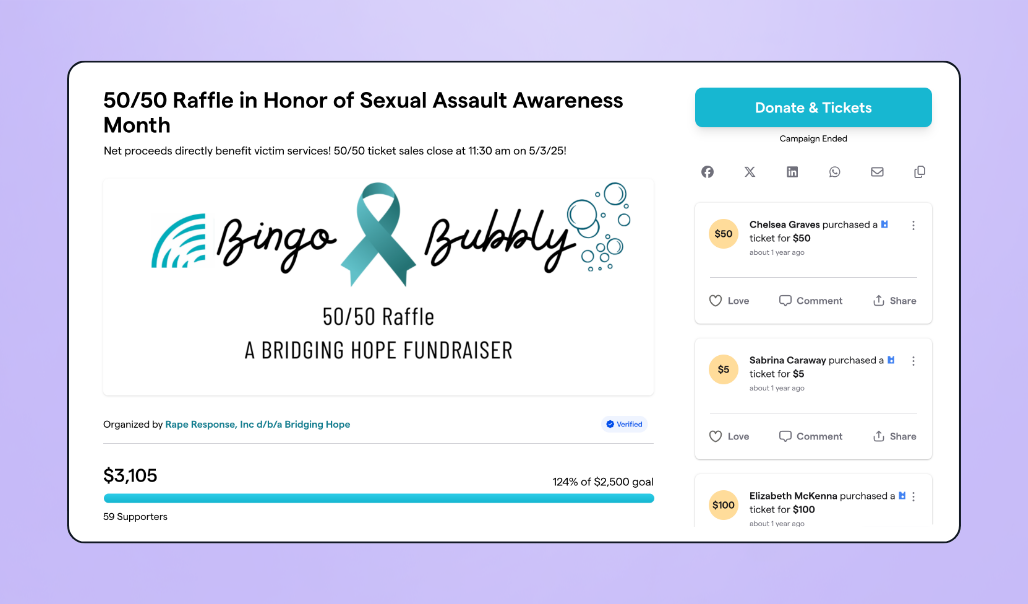
💛 Why it works: Strong mission-driven storytelling, easy-to-understand raffle rules, livestream integration, and a low barrier to entry helped supporters feel emotionally connected while encouraging participation.
💡 Make it your own: Pair your raffle with another fundraising event or livestream to build anticipation and create multiple touchpoints for supporter engagement.
2. San Diego Youth Hockey 50/50 raffle 🏒
San Diego Youth Hockey transformed its 50/50 raffle into a team-driven fundraising campaign by using leaderboards, ticket bundles, and live payout updates to spark friendly competition.
Supporters could purchase discounted ticket bundles, track the growing jackpot in real time, and rally behind individual players working toward team fundraising goals.
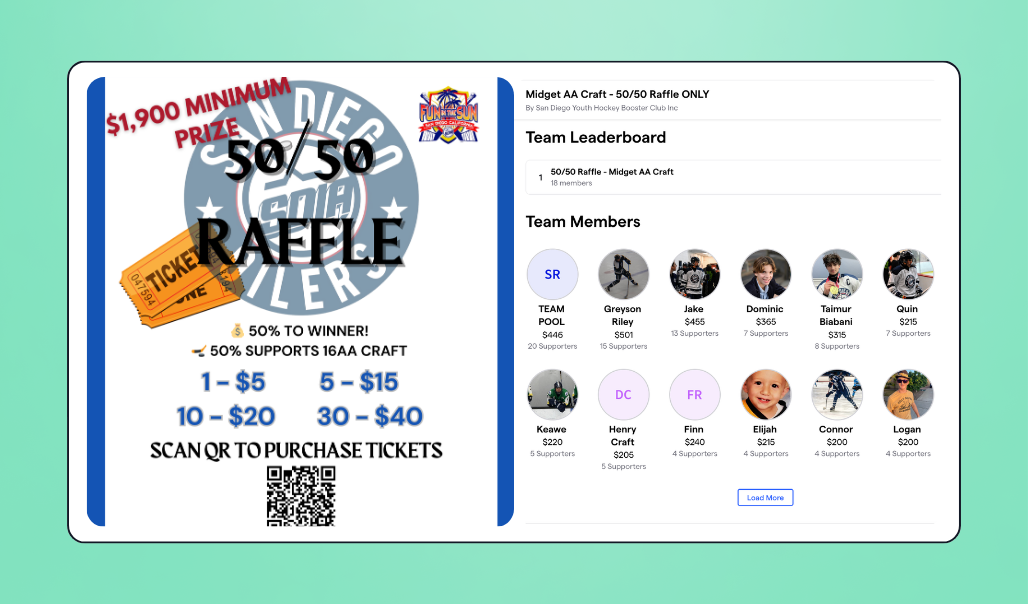
💛 Why it works: Team fundraising leaderboards, bundled ticket pricing, and frequent campaign updates created momentum while making supporters feel personally invested in the team's success.
💡 Make it your own: Use fundraising teams or ambassador leaderboards to encourage friendly competition and motivate supporters to help grow the prize pool.
Launch your next 50/50 raffle with Givebutter
A 50/50 raffle is one of the simplest, highest-margin fundraisers nonprofits can host. With the right ticket pricing, promotion strategy, and event tools, you can create an engaging experience for participants while raising meaningful funds for your organization.
The right event ticketing and fundraising platform can make all the difference in running a smooth raffle. Givebutter's all-in-one fundraising and event management solution includes free donor management tools and a centralized CRM to help you build lasting supporter relationships long after your raffle is over.

Launch a seamless raffle with Givebutter
Sign up for Givebutter and launch a seamless 50/50 raffle today.
FAQs about how to do a 50/50 raffle
How to do a 50/50 raffle online?
Use an online fundraising platform like Givebutter to sell tickets, host a live drawing, and share real-time prize updates with participants.
Before you start planning an online raffle event, review your state's rules and regulations. In some states, online raffles are strictly prohibited.
How much do you sell 50/50 raffle tickets for?
Many nonprofits charge $1–$2 per ticket, with bundle options like 3 tickets for $5 and 10 tickets for $7.
Once you choose your pricing structure, keep it consistent throughout your 50/50 event, unless you're offering early-bird or bundled discounts.
How much does a 50/50 raffle typically raise?
If you sell 400 tickets at $2 each, your nonprofit would award $400 in prize money and keep $400 for your cause. But in some cases, 50/50 raffles can raise thousands of dollars.
Can a nonprofit do a 50/50 raffle?
It depends on your state's raffle laws. Some states prohibit raffles entirely, while others require permits or restrict online ticket sales. Always review your state's requirements before hosting a raffle.
Share this article









.svg)
.svg)