.svg)
.svg)
.svg)
.svg)
.svg)
.svg)
.svg)
.svg)
.svg)


.svg)
.svg)
.svg)
.svg)
.svg)
.svg)
.svg)
.svg)

.svg)
.svg)
.svg)

.svg)

.svg)
.svg)
.svg)
.svg)
.svg)


.svg)
.svg)
.svg)
.svg)
.svg)
.svg)
.svg)





.svg)



%20(1).png)

⚖️ Disclaimer: Raffle laws vary by state and locality. This article is for informational purposes only and does not constitute legal advice. Before running a reverse raffle, check your state's permit requirements and consult a legal professional if needed.
Your nonprofit hosted a two-hour fundraising dinner, and your guests are still glued to their seats. That's the power of a reverse raffle. Unlike a standard raffle, a reverse raffle becomes part of the entertainment itself, building suspense throughout the event and increasing the per-ticket value.
In this guide, you'll learn exactly how reverse raffles work, when they make the most sense for your nonprofit, and how to plan an event that keeps supporters engaged from the first ticket draw to the final winner. We'll also walk through pricing strategies, promotion tips, legal considerations, and ways to create a high-energy experience that boosts both participation and donations.
Key takeaways
- Draw until there's one winning ticket 🎫 In a reverse raffle, the emcee draws until there's just one winning ticket left.
- Reverse raffles build suspense 🤩 Because tickets are eliminated one by one, reverse raffles create more anticipation than traditional raffles.
- Choose the right emcee 🎤 Your raffle emcee sets the tone for the event, so choose someone who can build excitement and keep your guests engaged.
- Pace your raffle drawing 🪨 Keep guests engaged with presentations, speakers, and other entertainment throughout the drawing.
- Start selling tickets early ⏰ Reverse raffles typically have higher ticket prices, so you'll want to start selling at least a month before your event.
- Keep your raffle smooth with the right tools 🧈 With Givebutter, you can create a customizable event ticketing page, centralize attendee and fundraising data in your CRM, and send out event reminders—all from one place.
What is a reverse raffle?
A reverse raffle is a fundraising event where losing tickets are drawn one by one until only the final ticket remains. The holder of the final ticket wins the grand prize.
Sometimes called "last man standing" raffles, reverse raffles unfold more slowly than standard raffles, helping build anticipation throughout the event. With the right prizes, emcee, and event format, reverse raffles can be among the most suspenseful and engaging raffle games.
How does a reverse raffle work?
Reverse raffles usually involve selling a limited number of tickets in advance, often at a higher price point than traditional raffles.
Reverse raffles can also include multiple prize winners or bonus rounds throughout the drawing process. For example, the last 10 ticket holders might get to pick from secondary prizes. Some reverse raffles include a "buy-back" option, allowing eliminated participants to buy a new ticket at a higher price to re-enter the drawing.
When a reverse raffle works best (& when it doesn't)
The key difference between a reverse raffle and a tricky tray raffle or other raffle types is the time it takes to draw a winner, and the focus on a single grand prize rather than raffle baskets or several smaller raffle prizes.
When to host a reverse raffle 👌
- Gala 💃🏼 Incorporate a reverse raffle into your gala as entertainment and an additional source of fundraising revenue.
- Dinner event 👨🍳 Build excitement during a dinner event by announcing ticket numbers between courses.
- Annual fundraiser 📅 Add an extra fundraising element to your annual fundraiser.
- High-attendee events 🎪 Create a sense of exclusivity and increase perceived prize value with limited ticket availability.
When not to host a reverse raffle ✋
- Small groups 🧑🤝🧑 Reverse raffles work best when enough tickets are sold to generate excitement and support a meaningful grand prize.
- Virtual events 🖥️ You'll need to find a way to keep participants engaged throughout your prize draw—this isn't always easy in a virtual setting.
- Fast, low-effort fundraising 🏃♀️ Reverse raffles require advance ticket sales, recruiting an emcee, and sourcing a grand prize.

How to run a reverse raffle that keeps guests engaged
Reverse raffles require more planning and resources than other types of raffles, but the payoff is a high-energy event that keeps participants engaged. From securing a grand prize to choosing the right emcee, every detail helps build anticipation and boost participation.
1. Check your state's raffle laws 🧑⚖️
Before moving forward, confirm that fundraising raffles are legal in your state and whether your nonprofit needs a permit or license to host one. Some states place specific restrictions on raffle formats and nonprofit qualifications. Spend time researching your local raffle regulations, and consult a lawyer if you have questions.
💡 Pro tip: Online raffles tend to come with stricter rules than in-person raffles. If you're planning to sell raffle tickets online or feature a virtual raffle, be sure to check your state's legal requirements.
2. Choose your venue & date 🏰
Your venue should be large enough to accommodate your expected number of participants and suitable for catering or any other entertainment you plan to include. Remember, reverse raffles take longer than other raffle types, so you'll need to pick something comfortable and accessible.
Make sure your venue is available on your chosen date and doesn't clash with any national or local holidays.
💡 Pro tip: Venue costs can take up roughly 30%–50% of your event budget, according to industry experts. Be sure to choose a space that fits both your audience size and fundraising goals.
3. Set your fundraising goal & ticket price 🎯
Reverse raffles often use higher ticket prices to support the cost of grand prizes and event expenses. To determine how to price raffle tickets, start by setting your total fundraising goal and estimated ticket quantity, then use this formula:
(total prize + expenses + fundraising goal) ÷ ticket quantity = ticket price
Determine if you'll offer early-bird pricing or special group discounts. Then, you can decide if you'll offer buy-back tickets, and how much you'll charge. Some nonprofits offer buy-back tickets for two to three times the original ticket cost.
🎬 See it in action: A nonprofit has a $5K fundraising goal. Their grand prize is $1K, and their event expenses are $2K. They aim to sell at least 400 tickets. Their ticket price is $20. ($5K + $1K + $2K) ÷ 400 = $20. They set a buy-back price of $40.
💡 Pro tip: If you're looking to host a less resource-intensive raffle, try a 50/50 raffle. The grand prize is 50% of what you fundraise for tickets, so you won't have to factor a grand prize into your event budget.
4. Promote your grand prize 🤝
Raffle prizes are the key to encouraging participation. Contact local businesses, corporate sponsors, and your board members for prize contributions. Grand prizes are typically cash, but nonprofits can also offer unique experiences, such as classes or tours, which tend to generate more excitement than physical prizes.
Create a short, compelling message that explains how raffle proceeds will support your mission, and highlight the recognition you'll offer prize donors in return, whether it's a shoutout in the event program or a social media spotlight.
Once secured, feature your grand prize on your event page, social media, and website to build anticipation.
💡 Pro tip: Reverse raffles naturally create built-in audience attention. Offer short speaking slots to corporate partners as part of your recognition package.
5. Start selling tickets 🎫
Determine your ticket sales timeline. Because reverse raffle tickets are often higher priced, it's best to start promoting your event early.
Create a ticketing strategy that includes the following elements:
- Email campaign 📧 Create an email campaign with multiple touchpoints, sharing information on your raffle.
- Board members 👨💼 Ask your board members to promote your raffle within their networks.
- Social media & newsletters 💻 Spread the word about your reverse raffle on the platforms where your supporters are most active.
- Event page 🎟️ If you’re hosting a reverse raffle as part of a wider event, be sure to advertise your raffle (and grand prize) on your ticket purchase page.
- Day-of volunteers 💛 Enlist an enthusiastic team of volunteers to sell any remaining tickets to event guests.
💡 Pro tip: Create a customizable event ticketing page with Givebutter. Supporters can easily purchase tickets, review raffle rules, and learn more about the grand prize.
6. Recruit your emcee 🎤
Emcees help maintain energy and keep the raffle running smoothly, making them one of the most essential components of the event experience. The right emcee can elevate your event, especially during longer drawings or event breaks.
First, define the emcee's responsibilities (e.g., just the raffle drawing or additional announcing expectations) and the qualities you're looking for (e.g., humor, charisma, or a more polished approach). Start by looking to your own support base and board members for confident speakers, or consider corporate or influencer partnerships. You could also opt for a professional emcee—just be sure to factor it into your event budget.
7. Host an engaging raffle 🎉
Reverse raffles work best when the drawing feels interactive and well-paced, so plan your event flow carefully in advance. Batch ticket drawings strategically to maintain momentum—whether that's drawing several tickets at a time in the early rounds or slowing down near the end.
Give your emcee breaks throughout the drawing by incorporating presentations, donor shoutouts, or entertainment. Eliminated participants can use these breaks to repurchase tickets and re-enter the drawing through a buy-back option. Just be sure to state your buy-back rules before your raffle gets started.
💡 Pro tip: Create a visual board featuring every ticket number, and place it on the drawing stage where everyone can see. As your raffle gets going, cross off each drawn ticket number, and consider bringing the final 10 up to the stage to add some extra suspense.
8. Complete required reporting 📊
Raffle events are subject to IRS reporting requirements, which vary by state. In some cases, nonprofits must withhold and report taxes on raffle income.
If your prize exceeds $600 and is more than 300x the ticket price, your nonprofit may need to issue Form W-2G to the winner. Consult a legal professional to ensure your raffle stays compliant.
9. Steward raffle participants 🫶
Post-event communication is just as important as the event itself. Make follow-up seamless by planning touchpoints with your raffle attendees prior to your event.
- Prompt thank-you & event recap 🤗 Within one to two days after your raffle, send a thank-you note to every one of your ticket buyers, congratulate the winner, and share how funds will advance your mission.
- Deeper impact reporting 📈 Within two to three weeks, send a more detailed impact report sharing how funds raised have supported your beneficiaries.
- Opportunities for deeper involvement 🤝 Offer new ways to get involved in your mission, like volunteering, recurring giving, or future events.
💡 Pro tip: Create a segment in your CRM for new raffle participants and tailor communication with mission overviews and low-level engagement opportunities, such as signing up for your newsletter.
Reverse raffle fundraiser examples to capture (& hold) attention
Successful reverse raffles balance strong promotion, clear prize details, and an engaging event experience. These nonprofit campaign examples show how reverse raffles can build excitement and drive participation—and what they can look like on Givebutter.
1. Reverse Raffle & Lucky Bingo Bash 🍀
Sawyer's Wish Foundation turned its reverse raffle into a full St. Patrick's Day-themed fundraiser, combining a $500 reverse raffle cash prize with 10 rounds of bingo and additional raffle games.
The event page clearly explained what attendees would receive with their ticket purchase, highlighted the organization's mission, and showcased fundraising progress to help build excitement before the event even began.

💛 Why it works: The themed experience, bundled entertainment, transparent ticket details, and visible fundraising goal helped create a high-energy event that supporters could easily understand and get excited about.
🎨 Make it your own: Combine your reverse raffle with bingo, trivia, or another interactive activity to keep guests engaged throughout longer drawings.
2. FHS Indoor Track Banquet Reverse Raffle 💙
The Franklin High School Indoor Track & Field Booster Club incorporated its reverse raffle directly into the team banquet, helping families understand exactly how proceeds would support athletic gear, scholarships, and championship travel.
The campaign page also clearly walked supporters through the raffle format—including the suspenseful "split the pot or keep going" finale for the last remaining finalists.
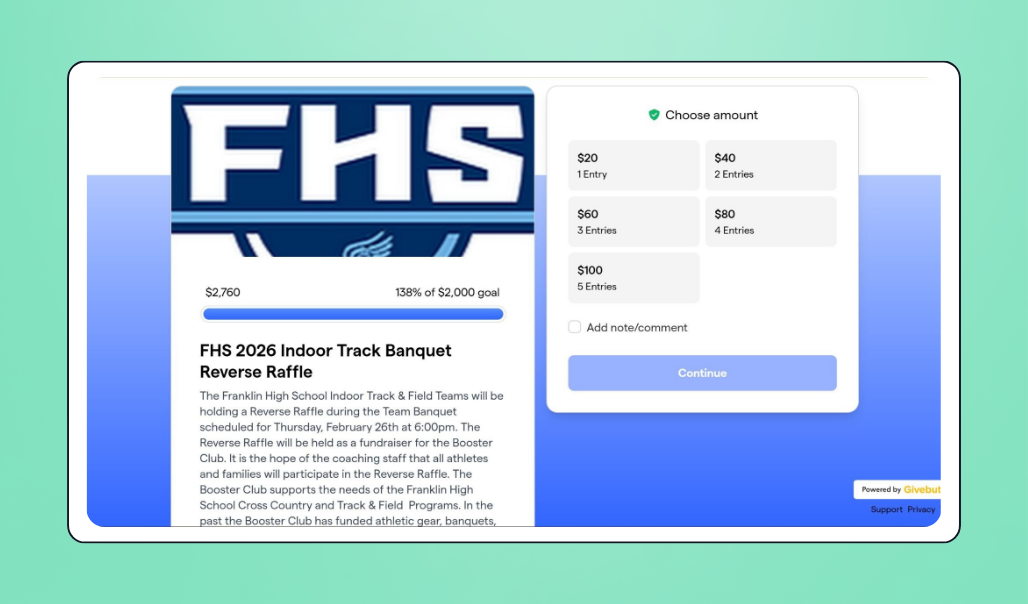
💛 Why it works: Clear rules, mission-driven fundraising, and the interactive split-the-pot ending helped build trust while keeping participants invested until the final drawing.
🎨 Make it your own: Add a finalist decision round where the remaining participants can choose to split the prize pool or continue competing for a larger grand prize.
Launch a reverse raffle with Givebutter
A successful reverse raffle combines strong planning, clear communication, and an engaging event experience that keeps supporters invested until the final ticket draw. With the right prize, pacing, and promotion strategy, reverse raffles can help nonprofits raise more while creating a memorable event that supporters genuinely enjoy participating in.
With Givebutter, nonprofits can sell tickets online, launch branded campaign pages, manage donors, and track fundraising progress all in one place. That means less time juggling tools and more time creating an engaging event experience.

Run your raffle for free on Givebutter
Sign up for Givebutter today and host a reverse raffle that supporters will remember.
FAQs about how to do a reverse raffle
How many tickets should I sell for a reverse raffle?
Nonprofits recommend selling between 100 and 300 reverse raffle tickets for a smaller event and 1,000+ for a larger one. Many nonprofits aim for odds of roughly 1 in 300.
How long does a reverse raffle drawing take?
According to nonprofits, reverse raffle drawings can take well over an hour. To maintain interest, they recommend pairing the raffle with a game, a silent auction, or dinner and drinks to pace the event and add extra excitement.
What's the best prize for a reverse raffle?
The best reverse raffle prizes are high-value cash prizes, travel packages, or gift-card bundles. Ask local businesses for gift card donations, such as private brewery tours, Broadway packages, high-end hotels, jewelry stores, and resorts.
Can I run a reverse raffle without a sit-down dinner?
Yes! You don't have to host a sit-down dinner to host a successful reverse raffle. Bear in mind that reverse raffles can take several hours, so it's usually best to include a different form of entertainment.
Try hosting a cocktail hour instead, break up your raffle with speakers, entertainment, or presentations, or incorporate a reverse raffle into a different fundraising event.
What's a buy-back rule, and should I use one?
In a reverse raffle, a buy-back rule allows eliminated participants to pay to re-enter the drawing.
Some nonprofits find this option increases both engagement and revenue, though it's important to state the rules clearly before the event begins.
Share this article









.svg)
.svg)