.svg)
.svg)
.svg)
.svg)
.svg)
.svg)
.svg)
.svg)
.svg)


.svg)
.svg)
.svg)
.svg)
.svg)
.svg)
.svg)
.svg)

.svg)
.svg)
.svg)

.svg)

.svg)
.svg)
.svg)
.svg)
.svg)


.svg)
.svg)
.svg)
.svg)
.svg)
.svg)
.svg)






.svg)



%20(1).png)

Nonprofits and charitable foundations are often used interchangeably, but they're not the same thing. Each operates under different rules, tax implications, and fundraising strategies. Understanding those distinctions is essential, whether you're starting a foundation, applying for grants, seeking foundation funding, or explaining your structure to a major donor.
In this article, we'll cover what a charitable foundation is, the main types, how foundations raise money, and real examples from foundations using Givebutter to support their missions.
Key takeaways
- Know the difference between a foundation vs. nonprofit 🤔 The legal and tax differences between the two entities are crucial to learn before you start your organization.
- Understand the five main types 💸 Private, family, corporate, community, and operating foundations all function differently.
- Think about how you want to raise money 💰 Foundations host galas, P2P fundraisers, matching challenges, and more.
- Consider private vs. public charity status 🔒 Private and public statuses have different donor deduction caps and compliance obligations.
- Know your default IRS status 📋 The IRS presumes every 501(c)(3) is a private foundation unless you can demonstrate broad public support—and you have five years to do it.
- Do it all with Givebutter 🧈 From matching gift campaigns to P2P fundraising, foundations of every type use Givebutter to run campaigns and manage donors in one place, for free.
What is a charitable foundation?
A charitable foundation is a nonprofit organization established to support charitable causes through grantmaking, direct programs, or both. They are typically funded by an individual, family, corporation, or community and organized as a 501(c)(3) entity. In fact, the IRS presumes every 501(c)(3) organization to be a private foundation unless it actively demonstrates public support.
Unlike nonprofit organizations, which raise money through a mix of funding sources, foundations typically receive funding from a primary source and then redistribute it through grants or programs. Community foundations are the exception: they pool donations from many local donors and function more like public charities.
Types of charitable foundations
Not all charitable foundations are structured the same way. The IRS classifies them as either private foundations or public charities, and that distinction affects everything from donor tax deductions to annual compliance requirements.
Here's how the main types break down.
Private foundation 🏠
Funded by a single individual, family, or corporation, a private foundation must distribute at least 5% of net investment assets annually.
Unlike other types, private foundations are subject to self-dealing rules and excise taxes, and donors can claim up to a 30% AGI deduction (vs. 60% for public charities).
💡 Did you know? The IRS presumes every 501(c)(3) is a private foundation by default. New organizations have their first five years to demonstrate broad public support before status is evaluated on a rolling basis.
Family foundation 👨👩👧
Family foundations are a subset of private foundations, controlled by family members. Often multi-generational and mission-driven by the founding family's values, they’re subject to the same IRS rules as private foundations.
Corporate foundation 🏢
A corporate foundation is the charitable arm of a for-profit company. Legally separate from the parent company, it typically manages the company's philanthropic giving and employee matching gift programs, and is subject to the same private foundation IRS rules.
Community foundation 🌎
A community foundation is funded by many donors from a specific geographic community. As public charities (not private foundations), community foundations often manage donor-advised funds and serve as local grantmaking hubs.
💡 Did you know? Community foundations have a higher AGI deduction cap for donors (60%) than private foundations.
Operating foundation ⚙️
Operating foundations run their own charitable programs rather than primarily giving grants. These foundations must spend at least 85% of investment income on their own programs, and they qualify for slightly better donor deduction caps than a standard private foundation.
How do charitable foundations make money?
Many people assume foundations only give money away, but in reality, many actively fundraise to sustain and grow their programs. From events to matching gifts, here’s how they do it.
Events & galas 🎤
Events, like annual galas or auction dinners, are effective for cultivating major donors and generating unrestricted revenue. These events don’t have to be large-scale and expensive, which is great news for small nonprofits. All you need is a compelling mission and a clear ask.
"You can strip the big fancy dinners. You can strip the big fancy decor out, but if you don't have someone comfortable asking for money, put your event plan to the side and rethink." — Samantha Swaim, Fundraising Expert
💡 Pro tip: Use text-to-donate and mobile giving to capture in-the-moment generosity at your fundraising event.
Peer-to-peer fundraising & team campaigns 🤝
From walks to giving days, peer-to-peer (P2P) fundraising and team campaigns help foundations expand their reach without significant effort. With passionate supporters who act as ambassadors, nonprofits can easily rally their communities around their missions.

Matching gift campaigns & challenge grants 💪
Foundations and DAFs often increase their impact through challenge grants and matching gifts. These campaigns create urgency to drive donations by matching contributions before a deadline.
5 real charitable foundations raising money on Givebutter
Foundations of all types use Givebutter to support their causes. Check out how these organizations are raising funds, engaging donors, and growing their impact.
1. Metro's Million Dollar Match 📚
The Louisville public library system launched the Metro’s Million Dollar Match campaign to fund more copies of high-demand titles and reduce wait times, making reading more accessible across the community.
The challenge stated that every private donation would be matched up to $1M—a strategy that helped them raise over $2M!
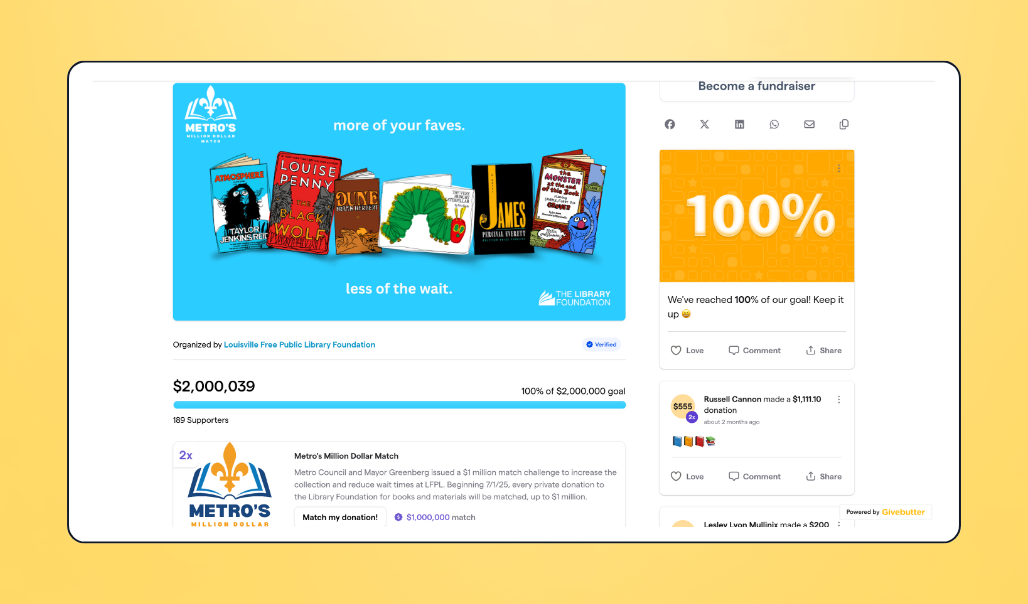
✨ What made it work: The organization’s deadline-driven matching campaign motivated supporters who might have been on the fence about giving. Plus, their frequent supporter feed updates helped sustain momentum and prevent mid-campaign lulls.
💡 What foundations can learn: Secure a matching gift of any amount and set a deadline for donors to give. Even a small match can move the needle!
2. BBF's 3rd Annual Galaween Masquerade Ball 🎭
Organized by the Better Boys Foundation, this annual masquerade ball raised funds to purchase two new passenger vans for transporting after-school program participants. In total, this event raised $207K!
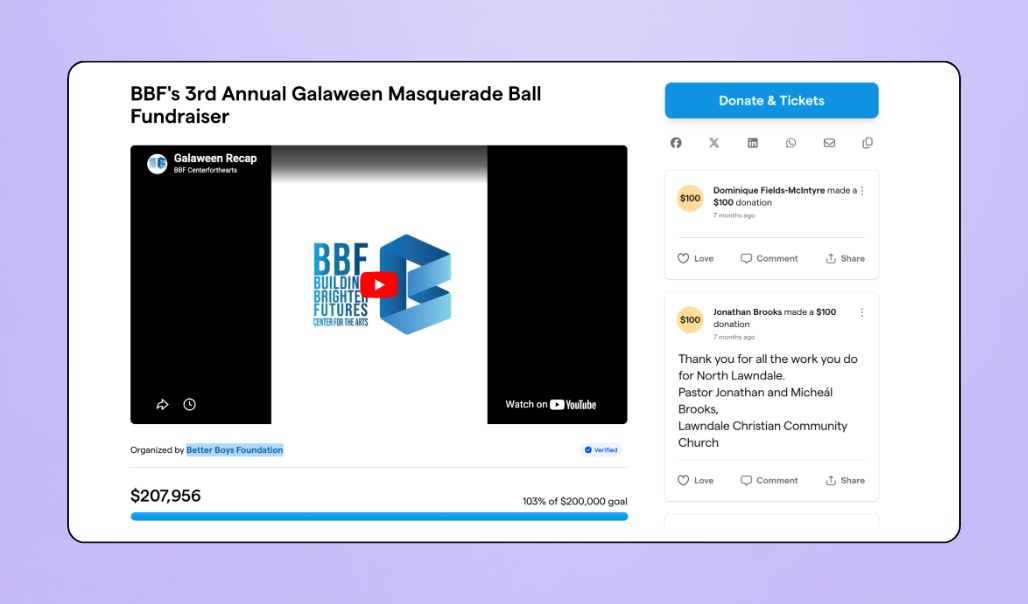
✨ What made it work: An annual themed event that invites supporters to meet, mingle, and celebrate builds community and encourages in-person giving.
💡 What foundations can learn: Host an annual gathering, big or small, and invite all your supporters. Ensure each event has its own unique theme to build anticipation year after year.
3. 2025 Love Some1 with Glut1 Campaign ❤️
The Love Some1 with Glut1 campaign doubled every dollar given up to $100K. Though their goal was to raise $150K for life-changing clinical trials for Glut1 deficiency, they were able to bring in over $220K!

✨ What made it work: This specific, time-limited campaign was the perfect motivation for donors to get involved.
💡 What foundations can learn: Use updates and campaign pages to share your impact and help donors feel confident about where their money is going.
4. Elevate Youth Voice! 🗣️
A foundation focused on empowering youth, inspiring changemakers, and energizing partnerships for impact, the Snow-Redfern Foundation ran an Elevate Your Voice general giving campaign to support its operations. In total, they raised $213K!
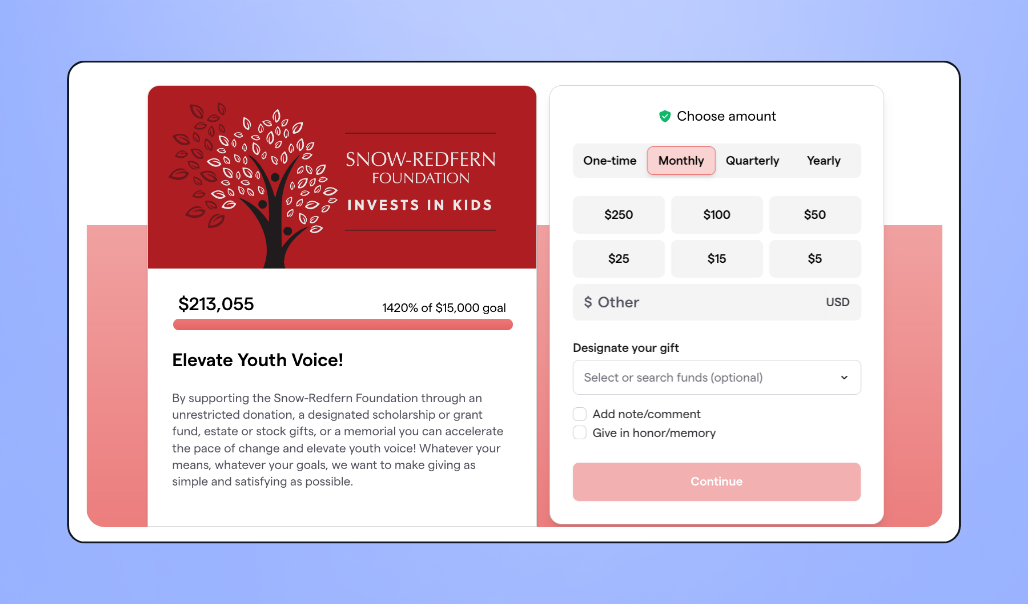
✨ What made it work: The Snow-Redfern Foundation offered supporters multiple ways to give, including unrestricted donations, designated scholarship funds, grant funds, estate gifts, and stock gifts.
💡 What foundations can learn: Partner with a giving platform like Givebutter that allows you to offer supporters multiple ways of giving, from ticket sales to DAFs.
5. Together for PURA 🏥
Together for PURA sought to raise research funds for PURA Syndrome, a rare genetic disorder that affects neurodevelopment. Through team fundraising, the campaign surpassed its goal, raising over $250K!
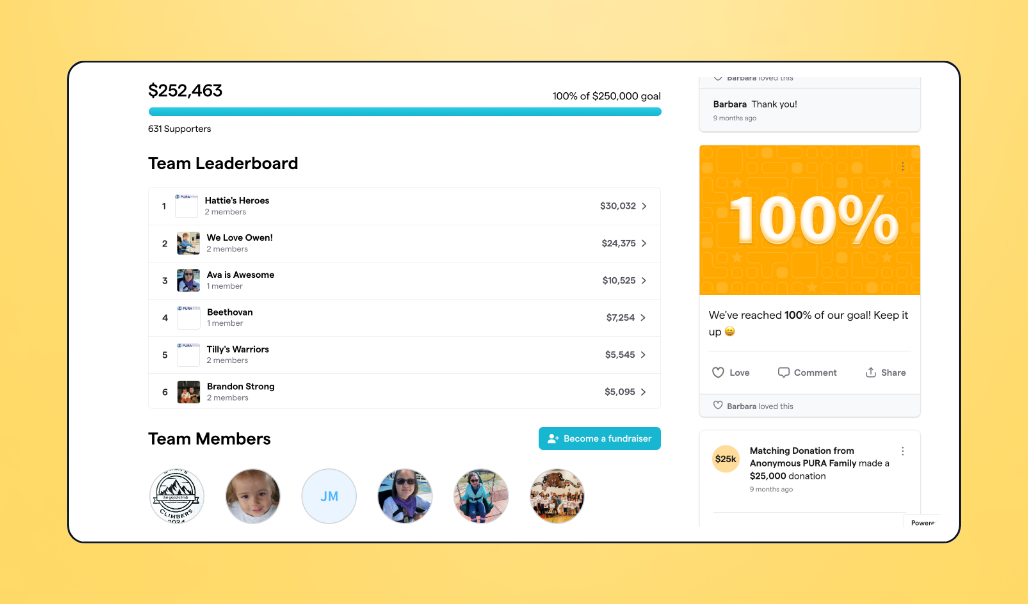
✨ What made it work: The foundation's strategic use of friendly competition was essential for raising funds. Teams eagerly competed to see who could raise the most for a good cause.
💡 What foundations can learn: Tap into your tight-knit community to support your cause using free P2P platforms like Givebutter.

Start raising more with Givebutter
There are several types of foundations, each with different rules and regulations. But what they all have in common is their commitment to making a positive impact.
Whether you’re starting a charitable foundation or already managing one, the right fundraising tools can help you grow your mission. With $0 platform fees when optional donor tips are enabled and the Givebutter Guarantee covering any gap, Givebutter brings event ticketing, donation forms, campaign pages, and donor management together in one place.
.png)
Launch your foundation's fundraising page for free
Sign up for Givebutter for free and start fundraising today.
FAQs about charitable foundations
What is the difference between a charity and a foundation?
All foundations are legally charities, but not all charities are foundations. Foundations are independent legal entities that typically focus on grantmaking and charitable programs, and must comply with specific IRS rules.
What is the difference between a charitable trust and a charitable foundation?
The primary difference between a charitable trust vs. a foundation comes down to governance. A charitable trust is governed by trust law, often irrevocable, and simpler to set up in some states.
A charitable foundation, on the other hand, is an incorporated nonprofit, governed by a board, and can be amended. While both can hold 501(c)(3) status, a trust is typically less flexible but may have lower setup costs.
What is the 5% payout rule for foundations?
Private foundations must distribute at least 5% of net investment assets annually as qualifying distributions. Grants, program expenses, and certain administrative costs can count toward this requirement, according to the IRS. Public charities are not subject to this rule.
How much money do I need to set up a charitable foundation?
There is no set amount of money required to start a charitable foundation. However, fees often range from $600–$2.5K for IRS exemption forms and state filings. Free tools like Givebutter can help you keep fundraising and donor management costs low.
Share this article



.webp)




.svg)
.svg)