.svg)
.svg)
.svg)
.svg)
.svg)
.svg)
.svg)
.svg)
.svg)


.svg)
.svg)
.svg)
.svg)
.svg)
.svg)
.svg)
.svg)

.svg)
.svg)
.svg)

.svg)

.svg)
.svg)
.svg)
.svg)
.svg)


.svg)
.svg)
.svg)
.svg)
.svg)
.svg)
.svg)





.svg)




%20(1).png)

It’s the week before your annual year-end giving campaign. You’re sitting down to write a donation letter, but you’re struggling to find the right words. Maybe your church is raising money for a new ministry, preparing for a youth mission trip, or launching a building campaign—but you want to inspire generosity without making your appeal feel transactional.
Many church leaders face the same challenge. But with the right structure and mission-led language, you can write a donation letter that feels authentic, strengthens your congregation's connection to your mission, and helps you reach your fundraising goal. In this guide, we'll walk through three simple steps to writing an effective church donation letter, plus share 5 customizable templates you can adapt for your next campaign.
Key takeaways
- Choose your letter type 💌 Match your donation letter type to your fundraising ask (we’ve included 5 customizable templates, so there’s something for every church).
- Lead with impact 🚀 Start with what your church has already achieved, and how your congregation helped make it possible.
- Make your ask specific 📣 Request a specific donation amount, and tie it back to your wider fundraising goal and mission. This is more impactful than vague or generic asks.
- Include a giving link 💸 Remove barriers to giving with a donation link, scan-to-donate QR code, and text-to-give option.
- Build a campaign page 🧑💻 Create a fundraising page for your donation letter campaign and keep it separate from your Sunday giving and tithing funds.
- Use the right tools 🔨 Use a giving platform like Givebutter that offers donation pages, multiple payment methods, QR codes, text-to-give, plus tools that help you keep more of what you raise.
Why church donation letters work 💌
Donation letters often feel more personal than social media or text-to-donate campaigns, making them a great fit for churches, where relationships and trust are foundational. A donation letter offers more space to tell your story, build an emotional connection, and create a sense of urgency.
In fact, 21% of donors prefer to receive fundraising appeals via direct mail, compared to 17% who favor social media.
How to write a church donation letter 🖋️
One of the keys to a successful church donation letter is leaning into mission-led language rather than forgettable, transactional asks.
The table below provides examples of how you can tailor your language for maximum impact.

5 types of church donation letters
Your donation letter should reflect your audience, your church, and the fundraiser you’re launching.
Not every church donation letter serves the same purpose. The 5 templates below cover the most common fundraising scenarios, so you can choose the one that best matches your campaign and congregation.
General fund appeal letter 📋
As the bread and butter of fundraising for many churches, general fund appeal letters are designed to raise money for day-to-day operational costs, such as facilities, personnel, and programming.
However, you still want to emphasize impact. Start your letter by outlining how donations keep your church running and how this benefits your community. Then share your goal, along with clear fundraising amounts tied to a real outcome.
🎯 Best used for: Annual stewardship campaigns, year-end giving appeals, and ongoing ministry expenses that support your church's day-to-day operations.
✍️ Sample general fund appeal: “Last year, with your generous support, our church was able to welcome 20 new members to our youth group, launch a new monthly community dinner, and provide food to over 30 families in need.”
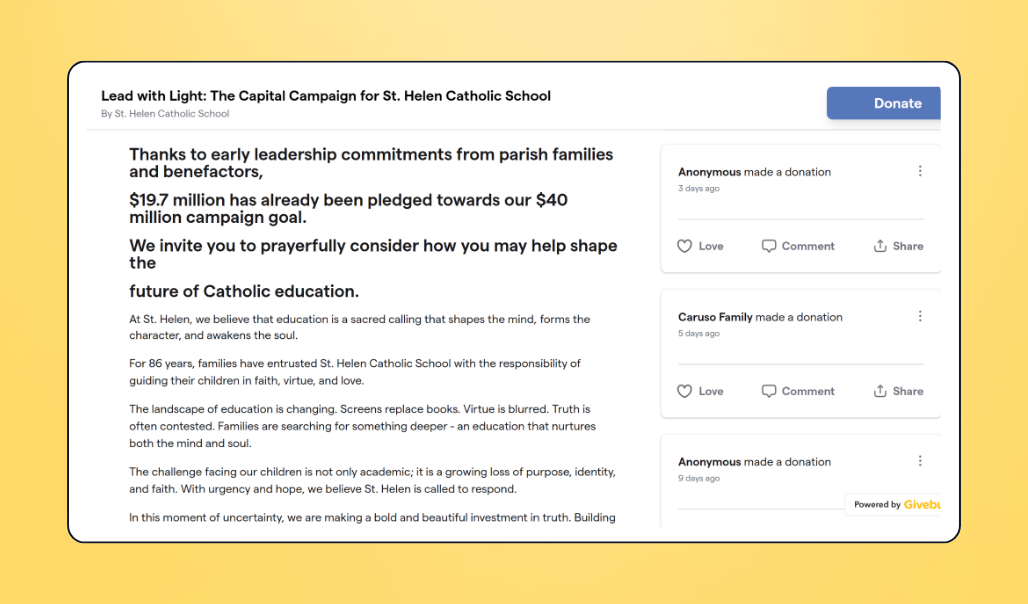
👀 What this example does well: The Lead with Light fundraising campaign for St. Helen’s Catholic school opens by highlighting the progress they’ve already made toward their goal. It goes on to share the school’s wider mission and why it matters in today’s educational landscape.
Capital campaign letter 🏗️
Capital campaigns come with larger fundraising goals and higher stakes, and your tone should reflect this increased urgency.
Explain why the project matters to your church’s mission, then clearly communicate your fundraising goal and deadline. Add your giving link, and close with a compelling vision of what reaching your campaign target will make possible.
🎯 Best used for: Building projects, major renovations, new campuses, accessibility improvements, or other one-time fundraising initiatives with a defined financial goal.
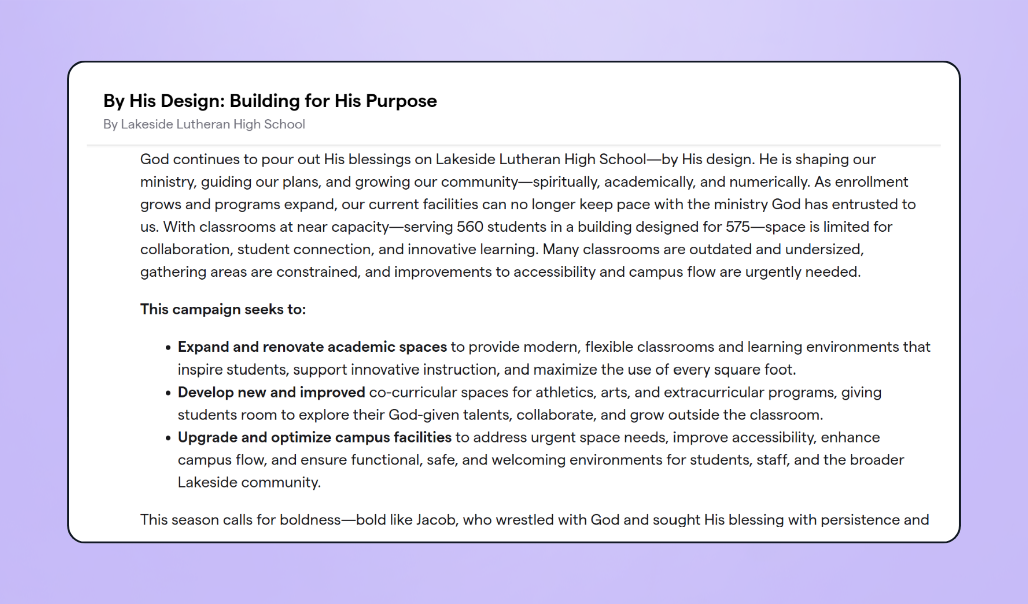
👀 What this example does well: The Lakeside Lutheran High School’s capital campaign letter clearly states three campaign goals, along with the specific, fundable reason for its campaign: keeping up with growing student enrollment. Plus, it ties the appeal back to the school’s broader mission in the final paragraph, making a direct and moving appeal to its community.
✍️ Sample opening: “We’re launching a one-year fundraising campaign to meet the needs of our growing congregation. With your help, our new building will allow us to welcome young families with a dedicated nursery space and offer a permanent home for our prayer and Bible study groups that help our church community thrive.”
Youth group or event fundraising letter 🎉
Usually, event or youth group fundraisers have lower fundraising goals than a capital campaign, so your letter can be shorter and more informal.
Grab your readers' interest with an overview of your event or program and how it will benefit attendees and your wider community. Tie specific fundraising totals to clear outcomes, like a $50 gift helps cover transportation and meals for one student attending camp, and include a campaign link.
🎯 Best used for: Youth mission trips, church camps, retreats, conferences, seasonal events, and other short-term fundraising campaigns.
💡 Pro tip: Add an event registration option directly to your giving page so you can accept donations and register attendees in one place.
✍️ Sample opening: “With your help, we’re thrilled to be offering our young parishioners a chance to return to Camp Meadow. This weekend offers our youngest members the chance to deepen their faith, build friendships, and connect with creation through habitat building, kayaking, and evenings of storytelling, Bible study, and reflection.”
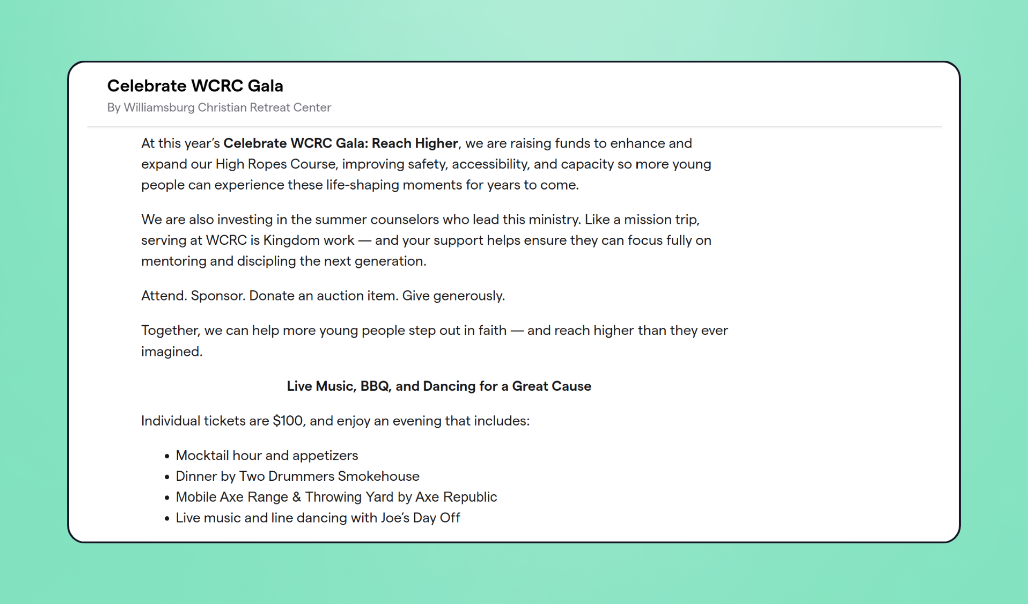
👀 What this example does well: The Williamsburg Christian Retreat Center clearly explains what its congregation can expect from its fundraising gala: live music, BBQ, and dancing for a cause. It also shares what they're raising money for, and congregation members can use the same donation button to give and purchase event tickets.

Donor thank-you letter 💌
Thank-you letters are designed to show appreciation and update your community on their impact. They should be separate from your giving appeal and shouldn’t contain another fundraising ask.
Include each donor’s name, reference their specific gift amount, and briefly describe how their gift helped advance your mission. Close with a warm, personal thank you.
🎯 Best used for: Following major gifts, year-end giving, fundraising campaigns, or any donation where you want to strengthen long-term donor relationships.
✍️ Sample opening: “We are deeply grateful for your commitment and support. Your $200 donation enabled us to launch a weekly soup kitchen, which kept members of our community fed during the cold winter months. This wouldn’t have been possible without your generosity and belief in our mission.”
Year-end tax receipt letter 📄
Any organization that accepts donations must send a year-end tax receipt letter to each donor by January 31 that includes the following information:
- The donor’s full name
- Total amount donated in that tax year
- Date of donation
- Statement that no goods or services were provided in exchange
End your letter with a brief message highlighting the impact your donors made possible. Since it’s often the last thing supporters read, take a few extra minutes to make it feel warm, sincere, and aligned with your church’s values.
🎯 Best used for: Meeting annual tax receipt requirements while reinforcing donor appreciation before the start of a new giving year.
💡 Pro tip: Givebutter automatically generates a custom tax donation receipt for every donor transaction, so you’ll have one less thing on your to-do list.
Download your free church donation letter templates
Your donation letter format should fit the type of fundraiser you’re running. That’s why we’ve included 5 different church donation letter templates, from capital campaigns to youth groups, so you can choose the one that best fits your goals.
Download a template and customize it for your congregation and fundraising campaign.

How to write a donation letter for your church ✍️
No matter your fundraising goal, writing an effective church donation letter follows the same three-step process.
Step 1: Define your ask & choose your letter type 🎯
Before you start writing, align with your team on exactly how much you need to raise and what the funds will support. This is key to crafting a compelling appeal.
Ask yourself these questions to determine which of the 5 fundraising letter types will work best for your campaign:
- Why are you raising money? 🤔 Determine the specific need behind your fundraiser and why now is the right time to ask for support.
- Who are you writing to? 👪 Consider whether you’re primarily writing to longtime members, lapsed donors, first-time visitors, event attendees, or another audience.
- What will their gift make possible? 🤩 Identify the outcome you want to highlight so you can tailor your letter to that goal.
Step 2: Write the letter using these 6 key elements 💌
While donation letters should be tailored to fit the fundraiser and audience, every successful donation letter should feature these key elements:
- Personal greeting 👋 If possible, address each recipient by name to make your appeal feel more meaningful.
- Open with impact 🙌 Don’t jump straight into your fundraising ask. Instead, share examples of previous impact and how your congregation made this possible.
- Reason for fundraising 💰 Share why you’re launching a fundraiser, framed as an exciting opportunity to expand your church's work and mission.
- Specific ask 🙋 Make your fundraising ask a specific dollar amount, and tie it back to a real fundraising outcome.
- Clear next steps 👣 Make giving easy by including a QR code, donation link, and information about recurring giving.
- Heartfelt closing 🫶 Close with genuine, personal appreciation for your church community and supporters.
💡 Pro tip: Use your P.S. line to drive home the importance of your fundraising ask and to share how signing up for recurring giving can multiply their impact.
✍️ Sample P.S. line: “P.S. Consider turning your one-time gift into a recurring gift. A $20 monthly donation will help make our annual church retreat possible.”
Step 3: Pair every letter with a Givebutter donation page 🧈
Make it easy for your congregation to act on your message by including a link or QR code to your Givebutter fundraising page in every fundraising letter. Supporters can give in seconds using ACH, credit cards, debit cards, Venmo, DAFs, and other popular payment methods.
Create a dedicated giving page for each fundraising campaign—whether you're raising money for a building fund, youth mission trip, or annual appeal—so you can keep campaign donations separate from your church's regular tithes and offerings. Customize your page with your church's branding, fundraising goal, photos, videos, and campaign updates to help supporters see the impact of every gift.
💡 Pro tip: Add a QR code to printed letters and church bulletins so members can give instantly from their phones. You can also include text-to-give details for an additional giving option.
Raise more for your church with Givebutter
Whether you're launching a capital campaign, annual appeal, youth fundraiser, or special giving initiative, Givebutter helps you turn your donation letters into lasting generosity.
With customizable fundraising pages, recurring giving, text-to-donate, QR codes, automated tax receipts, and a CRM to track every donor relationship, Givebutter gives churches everything they need to grow generosity in one place. Plus, Givebutter's core fundraising features are free with optional donor tips enabled, so your church can keep 100% of what it raises.
.png)
Launch your church fundraiser with Givebutter
Sign up for Givebutter today and create your first church fundraising campaign in minutes.
FAQs about church donation letters
When is the best time to send a church donation letter?
Often, the year-end is the best time to send a donation letter, with 30% of all charitable giving occurring in December.
If you’re launching a capital campaign, focus on your own milestones rather than specific months. For example, don’t launch your campaign until you’ve raised at least 50% of your total fundraising goal.
How is a church thank-you letter different from a solicitation letter?
Church thank-you letters express appreciation for donors, supporters, and the community, rather than asking for further donations.
A solicitation letter asks your community for support. It should share your total fundraising goal, why you’re raising money, and specific details about how each donation will help your church achieve its goals.
Should I send church donation letters by mail or email?
Both are effective channels. In fact, 48% of donors prefer email, while 21% prefer direct mail. Always include digital giving options in your mail and email communications, so it’s easy for supporters to take the next steps.
Givebutter supports both email and direct mail fundraising with donation links, QR codes, and text-to-donate tools.
Should church donation letters mention tithes?
Church donation letters can mention tithes, but they shouldn't treat them as the same thing. Tithes are an ongoing expression of faith and support for your church's regular ministry, while donation letters are typically used for special fundraising needs like capital campaigns, mission trips, community outreach, or other one-time initiatives. If your letter is tied to a specific campaign, make it clear that gifts will support that project rather than replace regular tithes and offerings.
Share this article









.svg)
.svg)